Super-Speeder Law Takes One Big Leap Forward, As Council Pushes Bill To Create The Program
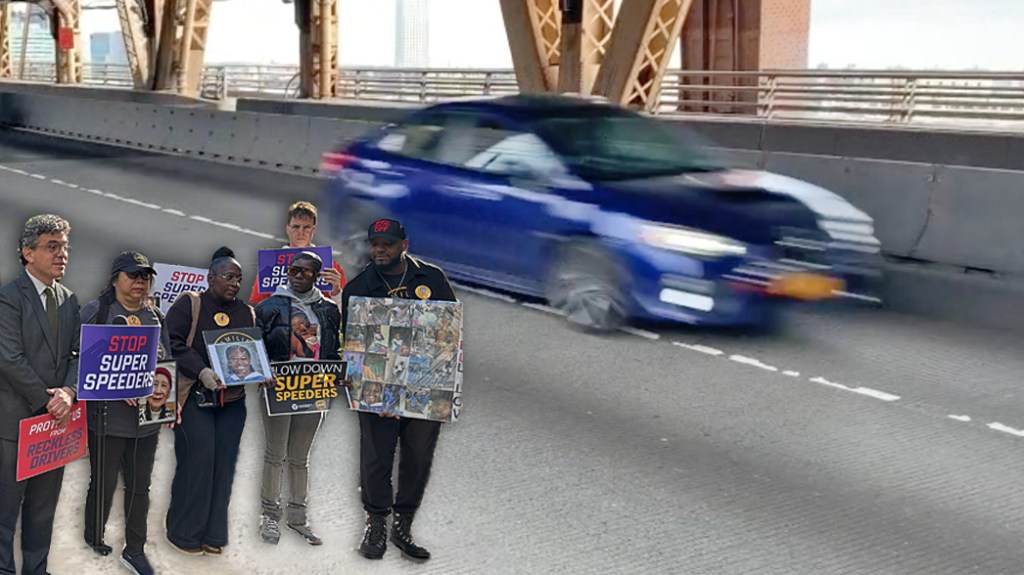
The rush is now on to slow down the fastest drivers in town.
The city’s much-anticipated program to require speed-limiting devices inside the cars of repeatedly reckless drivers would launch on May 26, 2027 under City Council legislation introduced on Thursday, a follow-up on the state’s Stop Super Speeders law that passed earlier this year.
Council Member Kayla Santosuosso (D-Bay Ridge) put forward the legislation at the Council’s regular stated meeting, where it quickly earned 15 co-sponsors. It already has the support of Mayor Mamdani and a majority of the Council.
“It’s my hope that we’ll get a quick hearing and get this passed as soon as possible,” Santosuosso said outside City Hall before the Council meeting.
The start date of the program was initially uncertain: a law passed by state lawmakers in May merely gave the city one year to set up the program. But in recent interviews, the city seemed to move the goal posts, with one city official telling a reporter from Streetsblog in September that the program was still “probably over a year away from the program getting launched” — in other words, at least four months behind schedule.
But lawmakers and activists aren’t accepting the delay.
“We want this to happen in May,” said Assembly Member Emily Gallagher (D-Greenpoint). “If we wait to implement this law, more people will die.”
The city agency that gets put in charge of the program — almost certainly the Department of Transportation — will need to work out all the many details of setting up an entirely new program from scratch. But the Council legislation does install guardrails similar to what was in the state law.
Car owners who receive 16 school-zone speed camera tickets in any 12-month period will be required to install — at their own expense — a device that prevents the car from exceeding the speed limit. And the devices will have to be installed on all cars owned by that offending driver. The owner of the vehicle will receive three letters in the mail containing instructions on how and where to obtain the required speed-limiter.
Drivers who fail to install the device face a fine of between $1,500 and $2,500 if they get another camera-issued ticket — a 30- to 50-fold increase on the normal $50 school-zone speeding fine.
The state law instructed the Department of Motor Vehicles to revoke the registration of drivers who fail to install the device — but that’s only if a driver has registered their vehicle in New York State.
But the Council bill’s sponsor and the DOT confirmed that the city program will indeed require out-of-state drivers to comply — no small issue because 32 percent of drivers with more than 16 speed-camera tickets have out-of-state plates (though the number of tickets they get in New York City in such a short amount of time suggests that they really live here and are merely committing insurance fraud).
Taxis, government vehicles and commercial vehicles shared by multiple drivers are exempt from the law.
The state law and Council bill allow for drivers “to formally contest” the order to install a speed-limiting device, but, crucially, not to dispute the underlying 16-plus speeding tickets because those would have been fully adjudicated before the driver would receive the order to install the device.
The process to contest the order to install the device is not defined in the law.
Car owners will have to foot the cost of installing the speed-limiting device and any fees associated with keeping it connected so that the car always knows what the speed limit is. Car owners whose earnings are at or below 200 percent of the federal poverty limit — $31,920 in annual earnings for a single adult and $66,000 for a family of four — are exempt from that requirement. The installation and maintenance costs for that subset of super-speeders will be paid by taxpayers.
The law and bill also require speed-limiting devices to have a button allowing for a temporary manual override of the speed restrictions “based on traffic conditions” — but it remains unclear how long the override can be used and how far over the speed limit it will allow a driver to go.
There are other unanswered questions that will need to be resolved as city officials draft the regulations:
- How long after a car gets 16 tickets will the city send the letter informing the super speeder that he must install the device?
- How long after the first letter will the city send the third and final warning?
- What will the process be for car owners to contest the installation requirement, and who are the administrative judges that will hold those hearings?
- Which speed-limiting devices will meet the city’s requirements, and how will auto shops qualify to install these devices?
- How will enforcement be conducted against the drivers with out-of-state plates, many of whom are scamming the system already and will not likely follow the super-speeder law either?
The bill to allow the creation of the program could not have come at a better time. Earlier on Thursday, Hell Gate reported that the number of drivers with 16 or more speed camera tickets in a one-year period is rising. Citing statistics compiled by Transportation Alternatives, the outlet reported that there were already more than 16,500 super-speeders by August, which exceeds by 12 percent the number for all of 2025.
The outlet also repeated the DOT’s long-quoted statistic that drivers with 16 tickets are twice as likely to be in a serious or fatal crash.
“What is happening culturally here? Why is this continuing to grow despite all that we’ve talked about and all that we know?” Gallagher told the outlet. “It just shows that talking is not enough, we really have to address this in a real way.”
The 16,500 super speeders in the Transportation Alternatives report represent a tiny fraction of all drivers, and they are sometimes found in the most unlikely of settings. Earlier this year, Streetsblog found a particular reckless one: A NYPD cop named James Giovansanti, who had accumulated more than 547 speeding and red-light tickets since 2022 on his 4,800-pound RAM 1500 truck. Staten Island residents soon reached out to Streetsblog with stories of alarming encounters with the speeding cop, and the NYPD “grounded” Giovansanti and took away his driving privileges.
But he never faced any legal repercussions because, according to city records, he paid all the tickets. If the super-speeder law had been in place years ago, he would have been forced to slow down mere weeks after buying the truck, thanks to his quick accumulation of speed-camera tickets.

Read More:
Streetsblog has migrated to a new comment system. New commenters can register directly in the comments section of any article. Returning commenters: your previous comments and display name have been preserved, but you'll need to reclaim your account by clicking "Forgot your password?" on the sign-in form, entering your email, and following the verification link to set a new password — this is required because passwords could not be carried over during the migration. For questions, contact tips@streetsblog.org.