Manhattan Community Board Asks DOT to Revise Narrow Grand Street Bike Lane
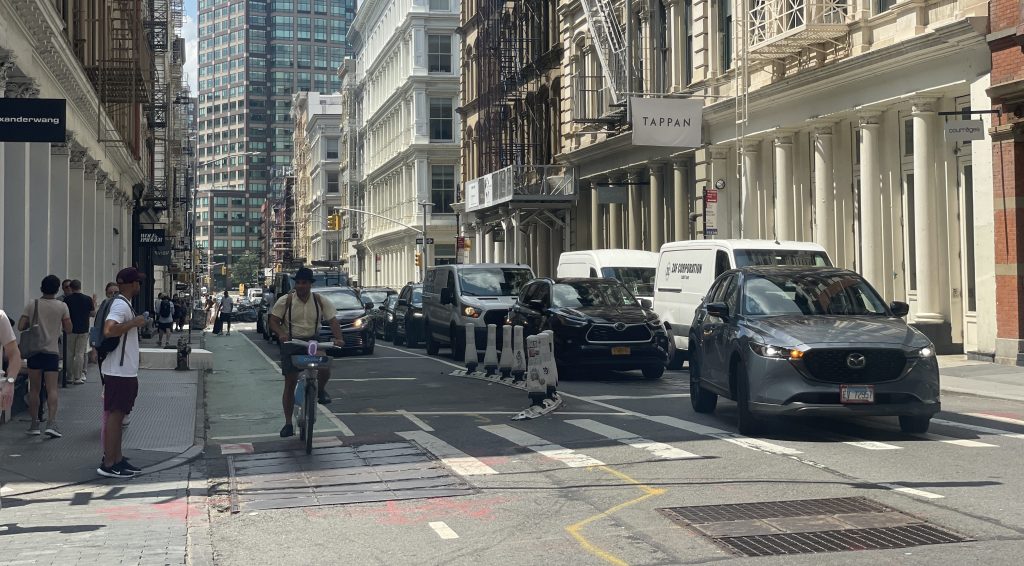
The Department of Transportation should go back to the drawing board for its narrow two-way protected bike lane on Grand Street, and consider widening the lanes or shifting them onto Canal Street instead, members of a Lower Manhattanites community board said last week.
Community Board 2 passed a non-binding resolution to oppose the plans on Thursday, in response to DOT unveiling a redesign in July that would squeeze cyclists eight-foot-wide bi-directional path on Grand Street. That’s just four feet in each direction, but officials claimed the city needed to find “balance” by preserving curbside parking spots.
“We’re trying to balance both those issues of having enough space for both the bike lane, and the moving lane, and the loading zones,” said the project’s manager, Preston Johnson, at a CB2 Traffic and Transportation Committee meeting on Wednesday. “So it’s a street with a lot of users and we’re trying to balance all of those users.”
The agency’s proposal would convert the currently east-bound protected bike lane into a two-way crosstown path, between Varick and Chrystie Streets. By year’s end, DOT plans to complete with the western section between Varick to Centre Street, and finish up the remaining six blocks to Chrystie Street next year.
The redesign belongs to DOT’s years-in-the-works redesign of Canal Street. The agency wants to add more space for pedestrians and cyclists between the Manhattan Bridge and the Holland Tunnel. For cyclists, the crosstown paths will provide a key safe route from the East River bridges to the Hudson River Greenway, the nation’s busiest bike path.
Rather than install a bike lane on Canal itself, DOT decided bike riders should take Grand Street across town for the most part, before reconnecting to Canal on the less busy western end at Varick Street and to the Manhattan Bridge via the two-way bike lane on Chrystie Street .
DOT plans to remove Grand Street’s “floating” parking lane that currently sits between the existing bike lane and moving traffic on the south side, and install the eight-foot bike lane, along with another three feet for a barrier.
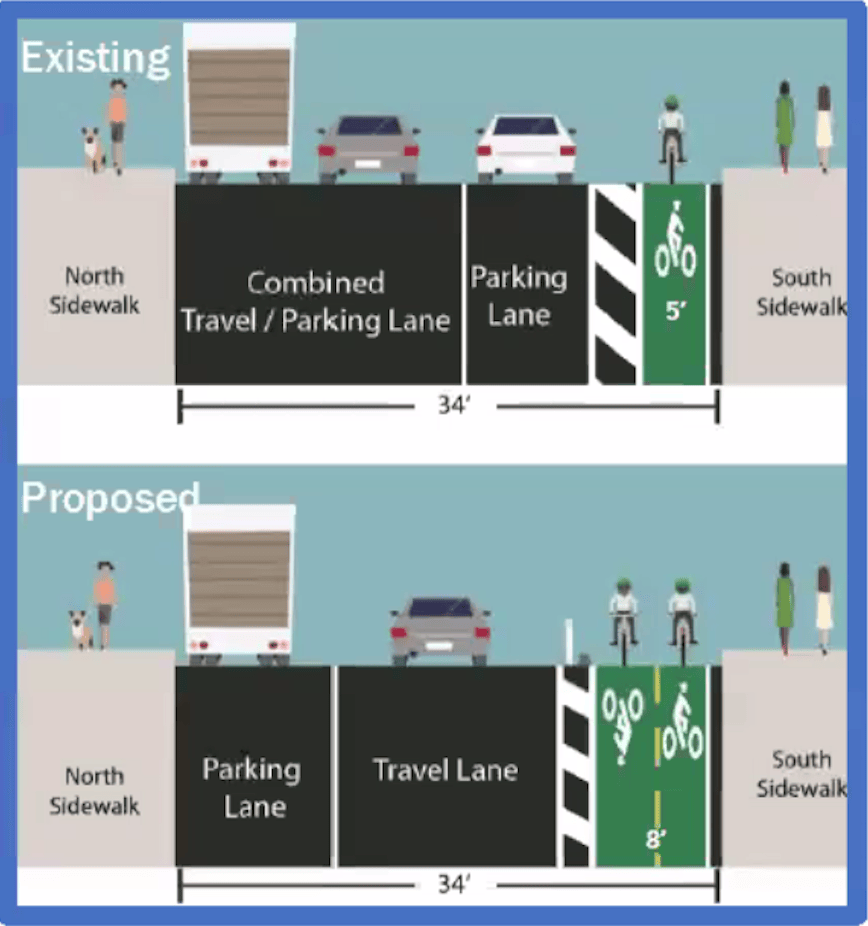
Cars still get the majority of the roadbed, which is 34 feet for most of the stretch, with a moving lane and a parking lane. The National Association of City Transportation Officials recommends against two-way bike lanes at just eight feet, saying those “should be avoided except on short street segments.” The Grand Street bike lane extends for 16 blocks.
DOT has installed far wider paths in recent years, including the 16-foot two-way bike lane on 31st Avenue in Astoria, along with the double-wide bike lanes on Second Avenue, Third Avenue, Sixth Avenue, Ninth Avenue, 10th Avenue and Queens Boulevard. Even the Bloomberg-era bike lanes on Prospect Park West are two feet wider.
Manhattanites urged DOT to shave off more space from motorists and give it over to cyclists and pedestrians. One brought up the deadly consequences of slim paths and pointed to the fatal crash in May between a cyclist and an illegal e-scooter rider on the Queensboro Bridge’s bike path. At 11 feet, that passage is actually three feet wider than the path DOT proposed for Grand Street.
“Four feet is almost dangerously narrow for two-way,” said resident Elias Schultz at a CB2 Traffic and Transportation committee meeting about Grand Street on Wednesday. “E-bikes can go quite fast, we don’t want head-on collisions like we saw on the Queensboro, so I would just wonder if you could reduce the width of that kind of extra, XL, fat moving lane by one or two feet… but not if it will delay further.”
“There are so few available safe cross-town travel options for cyclists in this part of Manhattan,” Schultz added. “Making Grand Street two way is just huge.”
Another resident, who identified herself only as Cassidy, said a tight two-way cycle path would leave everyone unhappy. “A two-way bike lane that’s too narrow is not going to please anybody, because it’s going make the bikers act crazier, they’re going to bump out onto the sidewalk, the pedestrians aren’t going to be happy, so I would love to see DOT take more space away from vehicle storage,” she said.
That dissatisfaction boiled over in a heated debate over whether DOT should even move forward with the path. “One day, you will all be elderly and frail,” said resident Irene Wu at the committee meeting. “And when you’re waiting for that emergency vehicle to get to you, minutes will feel like hours and you will hope, you will wish, to have these traffic lanes back that were taken away for these bike lanes.”
However, protected bike lanes offer unfettered access for first responders, who are otherwise obstructed whenever car traffic backs up, noted DOT’s director of the cycling and micro-mobility unit.
“Emergency vehicles are using these two-way lanes for access along these corridors,” Shawn-Paul Macias said at the meeting. “The idea is to provide options in the city, right, that’s one of the goals, get more people out of cars, hopefully freeing up the street for emergency vehicles.”
One member of the CB 2 committee still questioned the idea of diverting bikes onto Grand Street in the first place, rather than keeping them on Canal Street or another adjacent crosstown road.
“I’ve never liked the Grand Street cross [connection],” said Dan Miller. “I’ve always thought that something can be worked out either south of Canal or on Canal. So I would vote against it.”
DOT’s Manhattan borough commissioner cited vague “constraints” of space and traffic on Canal Street, as well as wanting to get the project going this year, for its reasoning behind opting for Grand Street. Canal has six lanes for the movement and storage of cars on, and congestion pricing reduced demand on the roadway by about one-fifth.
“Given some of the space and traffic constraints on Canal Street, we proposed this bike lane on Grand Street, with a connection on Canal Street,” Danielle Zuckerman told the CB 2 committee on Wednesday. “I think just given the implementation schedules and resources this year, we’re implementing a segment of Grand Street this year, as well as a segment of Canal that includes some of the pedestrian spaces and curb extensions. So we’re hoping to get both of these things in by the end of the season.”
Supporters of the project still called on DOT to move ahead with the bike lane, even if it is imperfect. “There is not room on Canal, so it is our best shot at getting a cross-town bike lane,” said CB 2 member Janet Liff. Chris Sanders, a Manhattan safe streets advocate, added: “Grand Street for the protected bike lane makes the most sense to connect the [River] path safely with the Manhattan Bridge. It’s not perfect, but I support it.”
Several members of CB2, meanwhile, argued that DOT should hold off on Grand Street until it wraps up installing new traffic signals on the two-way bike lane on Lafayette Street and Fourth Avenue.
“I think we need to get one right before we do one on an even smaller street,” said CB2’s Transportation Chair Jeannine Kiely.
The committee passed a resolution to oppose DOT’s project and demand the agency address those concerns, and that officials also study moving it to Canal Street entirely. The full board voted in favor of that resolution the following evening on Thursday.
A DOT spokesperson told Streetsblog the agency plans to forge ahead with its redesign for Grand Street, adding that officials chose the corridor after weighing “local destinations, street widths, land uses, traffic directions, the level of connectivity across Manhattan,” and proximity to Canal Street.
“We are moving forward with our current plan for the corridors because New Yorkers cannot afford yet another delay to the Canal Street redesign,” said Vin Barone in a statement. “We appreciate the feedback from the board and, after evaluating all east-west routes in the area, believe that Grand Street provides the best crosstown route for cyclists.”

Read More:
Streetsblog has migrated to a new comment system. New commenters can register directly in the comments section of any article. Returning commenters: your previous comments and display name have been preserved, but you'll need to reclaim your account by clicking "Forgot your password?" on the sign-in form, entering your email, and following the verification link to set a new password — this is required because passwords could not be carried over during the migration. For questions, contact tips@streetsblog.org.