COGE Chief: Nov. 3 Ballot Proposals Will Short-Circuit Anti-Street Safety Lawsuits
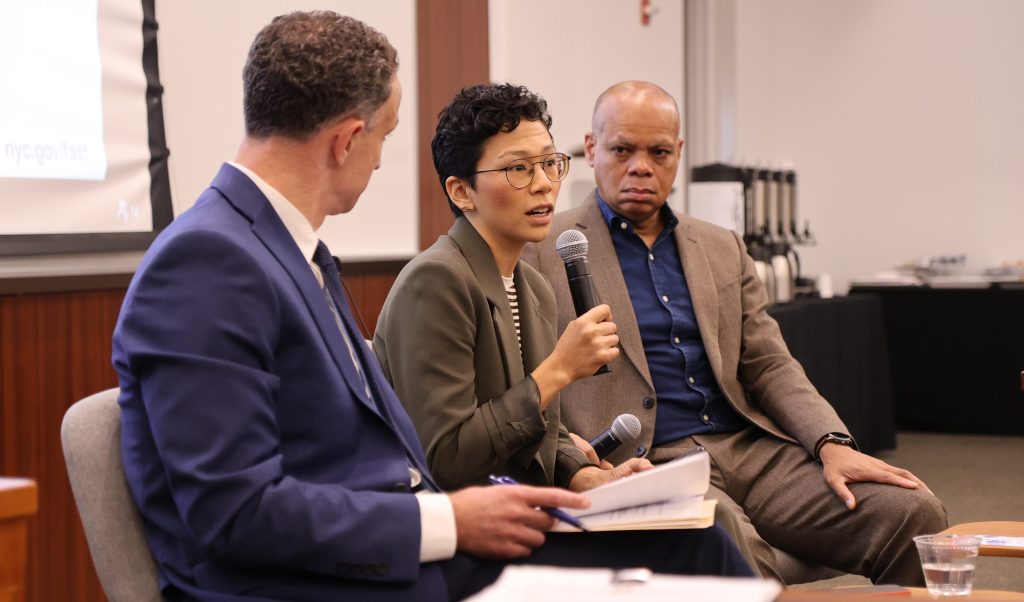
The proposals on the city’s November ballot will protect bike and bus lane projects from frivolous lawsuits by removing extensive bureaucratic requirements that opponents have exploited to impede redesigns across the city, according to the head of Mayor Mamdani’s charter revision commission.
The proposed changes, drafted by the mayoral Commission on Government Efficiency, will make it harder for street safety foes to derail Department of Transportation redesigns over minor paperwork errors within the city bureaucracy, its executive director said on Tuesday.
“We don’t think one of the remedies for a technical error in the interagency consultation process should be, rip up the bus lane and put it back how it was,” Ann Cheng told Streetsblog after a talk about the ballot proposals at the New York Law School on Tuesday.
The proposal would eliminate arduous reviews that DOT must perform with sub-units within outside agencies, and close loopholes for lawsuits if the agency misses minor paperwork.
One good government leader characterized these changes as crucial for an administration that wants to fulfill the mayor’s promise to make the city’s streets the “envy of the world” and reduce hundreds of annual traffic deaths and tens of thousands of injuries.
“It is a commonsense reform to allow the Department of Transportation to move incredibly quickly to address these concerns and make these fixes,” said Grace Rauh, the executive director of Citizens Union. “We would not ask the NYPD when they are concerned about the safety of New Yorkers to slow down their response.”
Critics of street safety improvements have repeatedly sued DOT by seizing on laws dating back to the Bloomberg-era bikelash that force the agency to consult with several other departments, and units within those departments.
For example, a 2025 suit against half-installed protected cycling paths on 31st Street in Astoria called out DOT’s apparent failure to certify consultation with local firehouses. That single detail convinced Queens Supreme Court Judge Cheree Buggs to order officials to rip up the lanes.
Rather than force disassembly of the entire project, Cheng said that judges should instead just make officials get their files in order.
“If we’re talking about an inadvertent failure to get a particular sign-off, a judge has many other available options, such as, ‘go get that sign off,’ as opposed to’ rip it all up and put it back otherwise,'” she said. “Let’s try to contain the remedies available and right-size them a bit to the size of the error.”
These lawsuits often rely on Article 78 proceedings, which cite a state law that allows New Yorkers to sue the government if the plaintiffs believe its actions are “arbitrary and capricious.”
The lawyer for local businesses suing the city on 31st Street, convicted former securities fraudster Hartley Bernstein, has turned those kinds of lawsuits into a cottage industry, filing several suits against DOT over bike lanes on Court Street in Brooklyn and on W. 72nd Street on the Upper West Side. However, none of his litigation has so far succeeded beyond delaying some DOT work.
The city’s laws expose DOT to these legal battles because the agency, for any street redesign exceeding 1,000 feet or three blocks, must consult with the Department of Small Business Services, the Mayor’s Office for People with Disabilities, the NYPD, the FDNY and local firehouses.
The latter review has slowed down life-saving projects in particular, and provided a platform for non-transportation experts within the FDNY to weaponize the deference their uniform triggers against protected bike lanes. The well-established street designs have dramatically reduce crash injuries and actually speed up first responders.
Cheng said the law should not require agency leaders to consult with local firehouses on each project. “It should be up to the heads of those agencies who they consult with within their own agency about a major transportation project,” she added.
COGE set its sight on legislation enacted by the City Council in 2009, known as the major transportation projects law, which forced DOT to do the outside agency reviews for any project exceeding three blocks or 1,000 feet.
It dates to a time of heated backlash against then-Mayor Michael Bloomberg’s roll out of bike lanes across the city. Its authors specifically designed the law to “gum up the works,” experts told Streetsblog last year.
Ballot Question 3 will let voters decide if DOT should only confer with heads of agencies and codify that lawsuits can’t stop projects just because of minor paperwork mistakes. If enacted, the commission estimates that both proposals could speed up timelines by 33 percent.
The five ballot questions also include a proposal, Question 1, to reduce required reviews for outdoor dining setups, which could speed up al-fresco dining applications by 75 percent, according to COGE.

Read More:
Streetsblog has migrated to a new comment system. New commenters can register directly in the comments section of any article. Returning commenters: your previous comments and display name have been preserved, but you'll need to reclaim your account by clicking "Forgot your password?" on the sign-in form, entering your email, and following the verification link to set a new password — this is required because passwords could not be carried over during the migration. For questions, contact tips@streetsblog.org.