‘Everyone Should Be Furious’: Lithium-Ion Battery Fires Are Up 41% As Public Fix Stalls
Fires caused by the lithium-ion batteries used in e-bikes are up 41 percent this year as the city slow-walks safe, outdoor charging and storage initiatives that have been in the works since 2023 — but there’s one bright spot: most fires now happen outside of apartments.
The rise in the raw number of fires isn’t new. In fact, the number of lithium-ion battery fires has grown every year since the Fire Department started counting them in 2020. But in the first three-quarters of 2026, the rate of increase is widening, indicating some shortcomings of the city’s many initiatives to combat battery fires.
“The New York City bureaucracy is obviously failing at its mission of preventing fires,” said Baruch Herzfeld whose company, Popwheels, offers subscription-based battery swapping to delivery workers. “Every single New York City resident should be furious.”
Lithium-ion batteries are particularly flammable. If the battery is overcharged or damaged it can easily enter into a “thermal runaway” reaction; the heat generated by the reaction causes an explosion followed by a self-sustaining fire and an expulsion of hot gases. A battery can explode when it is over-charged, damaged or hit.
E-bikes began proliferating after the state legalized them in 2020 — and an increase in battery fires soon followed. In 2023, just as many of the cheap, uncertified batteries were reaching the end of their useful life, 18 New Yorkers died in battery fires.
So far this year, five people have died in fires. That may sound like a contradiction given the increase in fires this year, but fewer deaths from more fires can be explained simply: This year, 61 percent of battery fires were determined by the FDNY to be “non-structural,” meaning they occurred outside of an apartment, business or home. By comparison, in 2023, just 33 percent of fires were ruled “non-structural.”
The greatest increase in fires this year has been in an undefined category the FDNY calls “other,” which the agency says is selected when a fire “only requires a first-alarm response” and a full investigation isn’t done. This indicates to experts that a large swath of batteries are reaching the end of their usable life and simply exploding due to age or damage.
One former official said the unspecific category was what the investigators used when a battery exploded in a garbage truck.
“There’s a huge increase in Sanitation truck fires,” said John Orlando, a retired FDNY official who supervised the Lithium-Ion Task Force from 2022 through 2024. “That’s the ‘other.’ We were tracking them back in 2023, so that incident classification ‘other’ is a sanitation truck for us.”
There have been a total of 87 lithium-ion fires in garbage trucks this year according to FDNY. Seventy six were in DSNY sanitation trucks, up from 55 in all of last year, according to the Department of Sanitation.
Early efforts by the city to curb fires focused heavily on charging safety. But it turned out that 59 percent of the lithium-ion battery fires in 2023 started when those batteries were not charging, according to the city. But given that this year, most fires occurred outside or in sanitation trucks, the biggest battle is not with charging, but with disposal.
“There’s no comprehensive plan to deal with the battery life cycles,” said Herzfeld. “There’s a fictitious belief that battery fires don’t happen unless batteries are charging. People are basing their safety guidelines on something that’s not true.”
Another expert who analyzed the recent FDNY data dump said the acceleration in fires this year can be tied to batteries dying en masse.
“From 2023 to 2024 to 2025, [the number of fires] is almost a flat line. [But] now the rate of change is increasing and batteries are reaching the end of their life,” said Adrian Kombe, whose company, Nomoto, is developing a safety device that detects warning signs of battery failure.
Orlando said despite FDNY’s best efforts to educate e-bike users, most don’t really think about the battery’s end of life. Like people, lithium-ion batteries age a tiny bit with every “cycle” of charge. If a delivery worker is recharging a battery multiple times every day, the battery will age rapidly, creating an ongoing cycle of batteries reaching the end of their life and becoming a higher risk.
“There’s a part of the consumer that thinks, ‘Oh, it’s just a battery, we throw this in the regular waste bin,’” he said. “I don’t think there’s enough information. It’s in the booklet, but who reads through the whole booklet? Or who looks at the booklet two years later if you still have it, or three years later, when the battery’s not working and you have to get rid of it?”
The fires this time
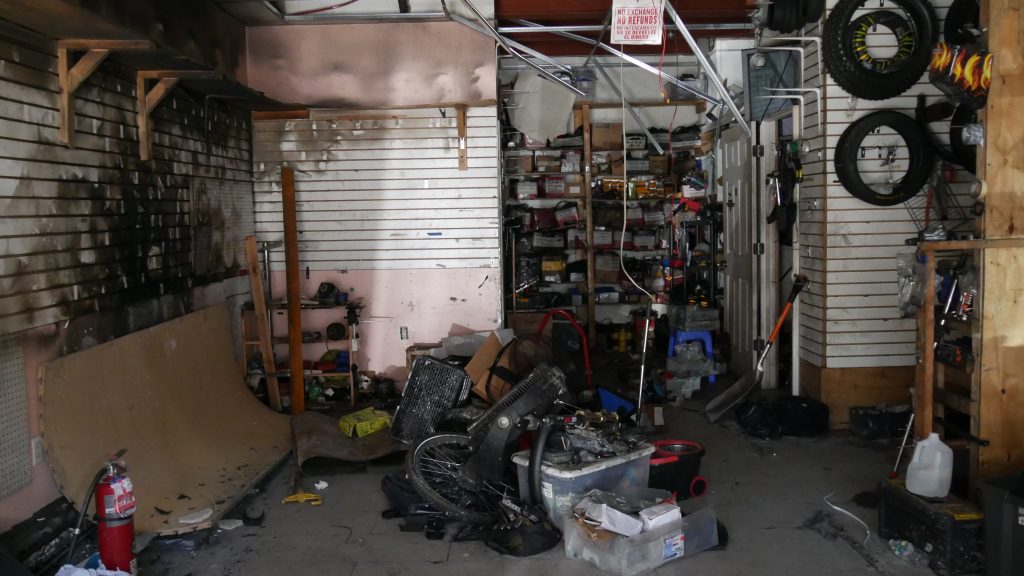
One recent fire in Corona, Queens at a Fly E-Bike shop, a company known for poor battery safety, is emblematic of the growing trend.
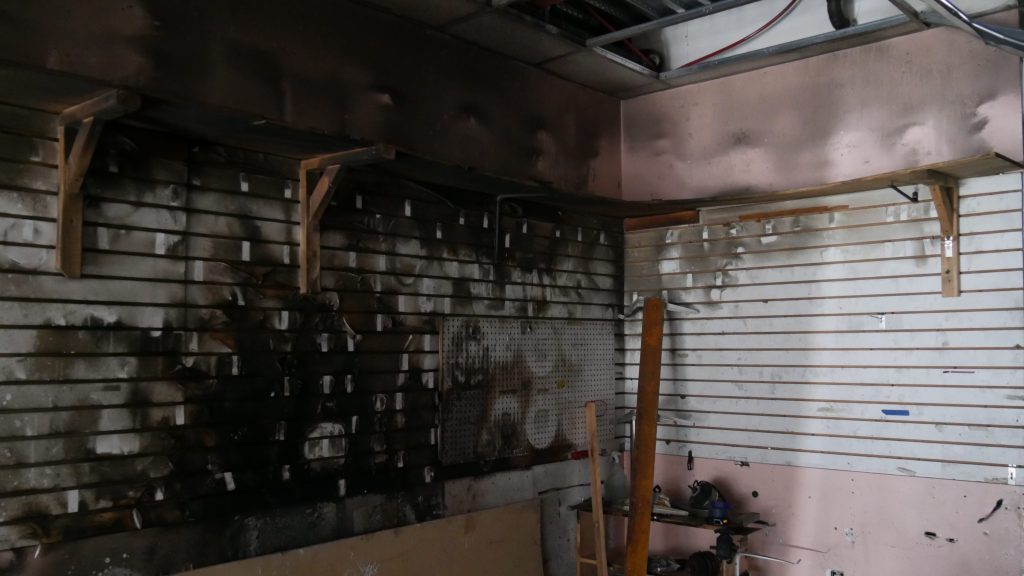
Sal Lopez, who works at the store a few days a week, said the fire started from a battery in a customer’s bike that was left at the shop, not from one that was charging. Customers often call asking if they can dispose of their old batteries at the shop, but the shop doesn’t permit it.
“They have to take it with them,” he said of customers coming in with old or damaged batteries. Most of the store’s customers are delivery workers, he added. “There should be a place to dispose of [the batteries]. Sometimes people call or ask, they want to leave it or want to find out where to throw it out.”
In this case, the sprinkler system suppressed the blaze for long enough to everyone escape safely. But witnesses expressed horror at how quickly the blaze spread.
“It was really fast,” Elias Castañeda, a mechanic at another bike shop on the street that only services traditional bikes, said in Spanish of the fire. Regular bikes cause “less problems” and have “less risks.”
The FDNY acknowledged the increase in fires, but said the increase in non-structural fires shows that a key part of the safety messaging is working.
“The FDNY has shared consistent safety messaging with the public about storing and charging these devices outside where possible. The number of ‘structural’ versus ‘non-structural’ fires leads us to believe that message is being received,” said spokesperson Clare Bourke.
But fires that spare the lives of those around them still scare residents and damage property.
On May 29, an e-bike battery sparked a blaze in a residential building in the Navy Yard section of Fort Greene, and smoke “spread throughout” the entire floor and went into “all the apartments,” said one neighbor.
“When I did look through the peep hole I couldn’t see anything — too much smoke,” said Anette Diaz. “Once the smoke went a little bit, I saw that everything was burnt up. … Everything was destroyed and there was a big hole in the wall.”
Another fire at the Albany Houses in Brooklyn in August killed 18-year-old Caleb Matthews. His mother told Eyewitness News that the fire was caused by an e-bike battery exploding while charging. She urged the city to act.
Federal inaction
The city and state passed laws when regulating the sale of e-bikes and their batteries, requiring a UL certification, the gold standard for safety. The city also created a lithium-ion battery task force to educate delivery workers and other e-bike users about battery risk. But federal regulation around e-bikes and e-scooters is lax, so it is easy to get risky batteries online.
“Even though we put all the regulations in place [and] were able to shut down bad actors in the retail space, it’s still not illegal for somebody to buy a cheaper uncertified bike. You can still get it direct-to-consumer,” said Orlando.
The online marketplace for e-bikes is often referred to as the “Wild West.” Whether it’s over-powered illegal “e-motos” that have high speed capacities and are falsely marketed as street-legal e-bikes, or shoddy batteries, it’s hard to know what you’re buying online.
“At the end of the day, we’re still just a local fire department, so any ordinance we pass is just for New York City, so we really need the the federal government because this stuff is just coming in unfettered, or or the components are coming in unfettered through the borders and through shipping,” Orlando said.
The Consumer Product Safety Commission, the federal agency that regulates goods shipped to the United States, has proposed rules to deal with the e-bike and e-scooter battery problem, which is not unique to New York City. The domestic e-bike market grew 31 percent between 2018 and 2024, according to the document. If the rule is adopted, UL certification would be required at the federal level.
What has the city done?
The city’s plan to tackle lithium-ion battery fires was laid out in the “Charge Safe, Ride Safe” action plan issued by the Adams administration in 2023. But most of the initiatives detailed in the plan have either stalled or never made it past a pilot phase. Part of this is because the FDNY regulations are so strict.
“If I want to install a battery cabinet in New York City, it takes me a year and a half. If I want to install one in Philadelphia, Jersey City, two weeks,” said Herzfeld, whose company was a part of the city’s successful public battery-charging pilot program.
Last year, Streetsblog reported that the department changed the type of UL certification required for outdoor cabinets before there was even a way to get said certifications. The department later softened those rules and extended its deadline for compliance, allowing companies to continue using a “letter of no exemption” as proof of safety. But that extension ended on Oct. 1, Herzfeld said. Now it is again impossible for his company to get approval for new sites because that new UL certification is still out of reach.
“It should not be this hard to get life-saving equipment into outdoor parking lots. We should all be embarrassed.”
The pilot ended in 2024. Now, two years later, the Department of Transportation just closed its feedback portal to help it decide where to place 25 permanent battery-swapping cabinets, though they won’t be up and running until 2027 at the earliest.
As part of the action plan, the DOT started allowing businesses and landlords to apply for a permit to install battery charging cabinets on public sidewalks last February. But because of the FDNY’s location requirements, this is nearly impossible, too. To date, zero applications have been approved, but “several” are pending, according to an agency spokesperson.
For delivery workers, who are one of the largest groups of e-bike users in the city, thinking about properly disposing of a battery can be low on the list of priorities when their livelihood is being threatened by a precarious work arrangement. The risk of getting your account deactivated takes precedence over everything.
“We have literally over 100 workers every single day showing up at our center because they’ve been deactivated, and everything else takes a backseat to ‘I’ve lost my job and can’t make a living and can’t deliver,’” said April Herms, the deputy director of the Worker’s Justice Project, which organizes the Los Deliveristas Unidos.
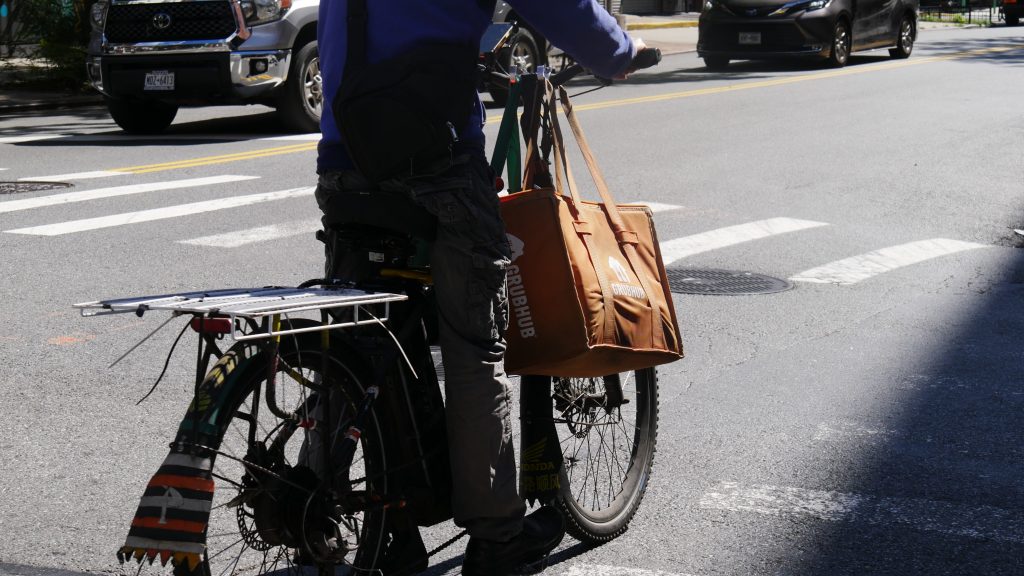
Even at the Worker’s Justice Project headquarters in Williamsburg, where hundreds of delivery workers flock on their bikes to use the organization’s many services, building an outdoor charging cabinet was impossible. There was no place on the large corner lot that fit all of FDNY’s rules, the DOT told Herms.
“At some point the policy needs to meet the reality because if it doesn’t then what happens is you still have people charging indoors because they don’t have any options. Effectively the FDNY policy is don’t charge inside, don’t charge outside. In fact, just don’t have these batteries,” said Herms.
DOT said it is eager to get its public e-bike charging program off the ground. It also said that Question 1 of the mayor’s charter revision ballot proposals would streamline the process by which landlords apply for permission to install sidewalk cabinets.
“Battery swapping is an important solution to support safe, certified electric micromobility, and DOT is eager to advance it through our Public E-Bike Charging Program and the revocable consent process,” said agency spokesperson Vin Barone.
— With Sam Brule
Note on methodology: Streetsblog analyzed two datasets from FDNY and combined them based on multiple factors. The data only includes fires where the investigations were closed, some recent battery fires still have open investigations.

Read More:
Streetsblog has migrated to a new comment system. New commenters can register directly in the comments section of any article. Returning commenters: your previous comments and display name have been preserved, but you'll need to reclaim your account by clicking "Forgot your password?" on the sign-in form, entering your email, and following the verification link to set a new password — this is required because passwords could not be carried over during the migration. For questions, contact tips@streetsblog.org.