‘Taking Your Life In Your Hands’: Residents Outraged At Slow Redesign Of Dangerous Chinatown Crossing
How long must Chinatown residents wait for safety?
In the wake of yet another crash that critically injured a senior, residents of the Lower Manhattan neighborhood are outraged that the city’s redesign of Chatham Square is expected by 2030 at the earliest — a delay orchestrated by car-focused residents who think the project would make the area worse for drivers.
The proposed redesign would move the intersection’s centerpiece — Kimlau Square — from the east side of the Bowery to the west and rework the intersection to prioritize pedestrians.
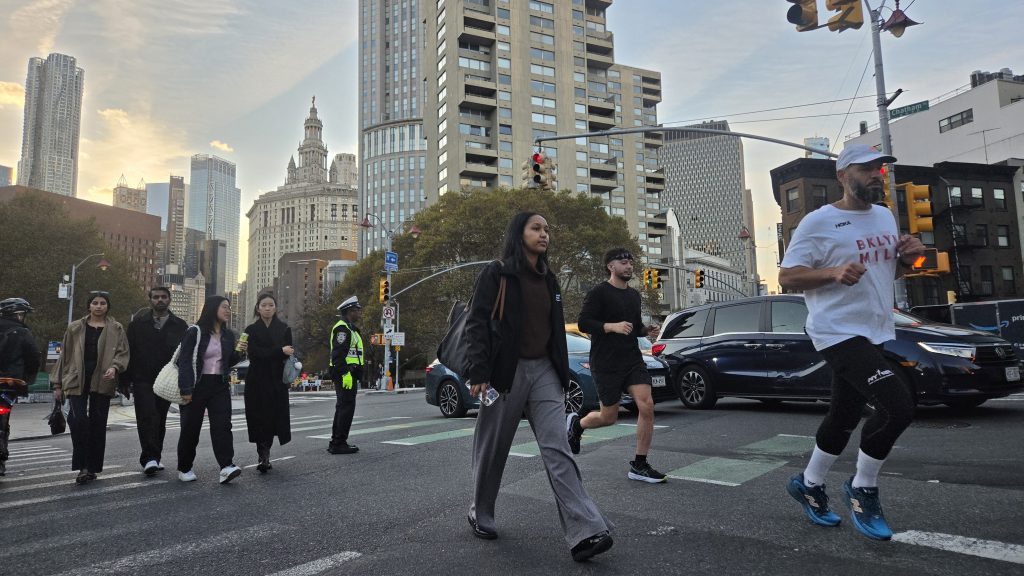
But until it happens, Chatham Square remains a confusing jumble full of cars and long crosswalks, with pedestrians and drivers constantly in conflict, as DOT noted in a September 2025 presentation. It’s no wonder that there have been 64 reported crashes and 24 injuries in Chatham Square since January 2022, including the most recent: An SUV driver struck and critically injured a 74-year-old man crossing the street on Nov. 10.
“You’re taking your life into your own hands as you’re trying to get your dim sum,” said Lydia Polgreen, who lives near Chatham Square. “It’s really awful.”
Those substandard conditions persist even though pedestrians comprise 80 percent of the people using the square, but only get about one-third of the space, according to the city Department of Transportation. The proposed redesign would give walkers a little over half of the space.
Residents and passing pedestrians agreed that the dangerous area needs to be fixed.
“Something has to change,” said Polgreen, the noted New York Times opinion columnist. “They should at least start with changing some of the patterns around the intersection to make it safer for those of us who live and work there.”
For Polgreen, even an interim safety update to fix signal timing would help calm the violent mess of intersections.
“At best, it’s confusing and frustrating,” added her neighbor, Felix Salmon.
The long-overdue, $56-million redesign was introduced by then-Mayor Eric Adams in February 2024, with construction expected to run from 2027 to 2029. DOT now estimates it will be complete by 2030, according to a city presentation that called the crossings “long and dangerous.”

The project mirrors a redesign pushed in 2008 by the Bloomberg administration that Community Board 3 rejected. The panel — seven of whose members are still on the board — argued that three years of construction would be unfair for a neighborhood that, the board claimed, had been already hurt by the post-9/11 ban on cars on Park Row.
The city put the project on hold, and the Lower Manhattan Development Corporation later redirected $30 million that it had set aside for the project.
The current project has been facing similar opposition, especially from car owners who claim without evidence that Chinatown has experienced an economic downturn since the closure of Park Row to most traffic after the Sept. 11 attacks. The redesign plan is seen by such people as a way to make the closure of Park Row permanent, which is likely true, and would cause more congestion, which is likely not.
The Chinatown Core Block Association — a coalition of neighborhood residents and one of the forces fighting on the frontline of the opposition — has focused a lot of energy on reopening Park Row to motor vehicles.
But that’s a non-starter, thanks to a DOT study that found reopening Park Row to cars would increase evening rush traffic in the square by 45 percent and reduce safe pedestrian crossings from 61 percent to 35 percent. Plus, reopening the roadway to cars isn’t popular: In a Park Row Alliance survey of the two co-op buildings on Park Row, 76 percent of residents wanted to keep the street closed to public traffic.
Still, Council Member Chris Marte, who represents the area, has pushed to reopen Park Row since taking office in 2022. Though a frequent supporter of livable streets issues, Marte said keeping Park Row closed to cars must be reversed because it had a negative impact on foot traffic and the local economy.
Other residents of the neighborhood have taken aim at other aspects of the redesign.
One such qualm is that buses will not be able to turn safely in the new layout, a concern raised in 2008, but debunked by the MTA in 2009. “The 60-foot articulated buses, although longer than the 40-foot standard buses, have a shorter turning radius than the standard-sized buses which allow them to make tight turns more easily,” the MTA said in a statement at the time.
Another objection is that the redesign would create traffic bottlenecks, but DOT’s traffic model shows that 76 percent of vehicle trips through the square would get faster as a result of the redesign, while only 16 percent would get slower.
The opposition centers around the alleged impact on car owners. “A lot of people who speak out tend to be vehicle owners,” said Jason Lee, a resident of the area. He didn’t derogate members of the opposition, but merely said that car drivers might simply not be “aware of the complexity and the difficulty the situation is currently presenting.”
But what is clear, is that there is still strong support for a safer Chatham Square. Among residents, Marte also welcomed the redesign when it launched — despite wanting Park Row open to motor vehicles — calling the square “the chaos corner” and saying the plan would reduce bumper-to-bumper traffic. His top priority was improved safety for the chronically messy and dangerous area.
“The intersection is just too big and too complex,” Polgreen said. “Rethinking intersections like this one really needs to be priority.”
But until construction ends, the nearly 10,000 pedestrians who pass through the square at peak hours will have to wait a bit longer for that safety.