Manhattan Community Board: We Want Bus Rapid Transit on First and Second Avenues
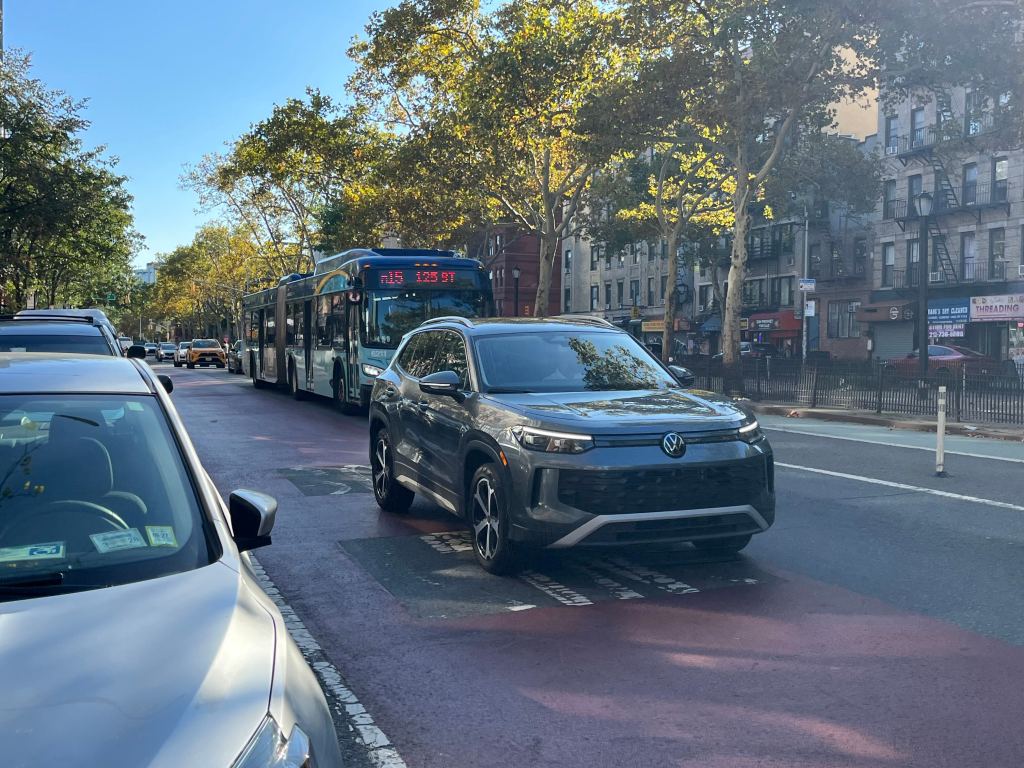
A community board on Manhattan’s East Side wants the Mamdani and Hochul administrations to turn First and Second Avenues into bus rapid transit corridors to speed up and fortify the busy M15 bus line.
Last Wednesday, by an overwhelming vote of 42 to 1, Manhattan Community Board 6 passed a resolution that called on the city and MTA to install a series of preliminary bus-first upgrades on First and Second Avenues and eventually transform both thoroughfares into built-out BRT corridors. Both moves would dramatically accelerate the speed and utility of the M15.
“This is the busiest bus route in the entire United States,” said Barak Friedman, a member of the CB6 Transportation Committee. “If any route is deserving of bus rapid transit, it’s this one.” The M15 and M15 Select Bus Service carry 57,000 daily and 16 million annual riders.
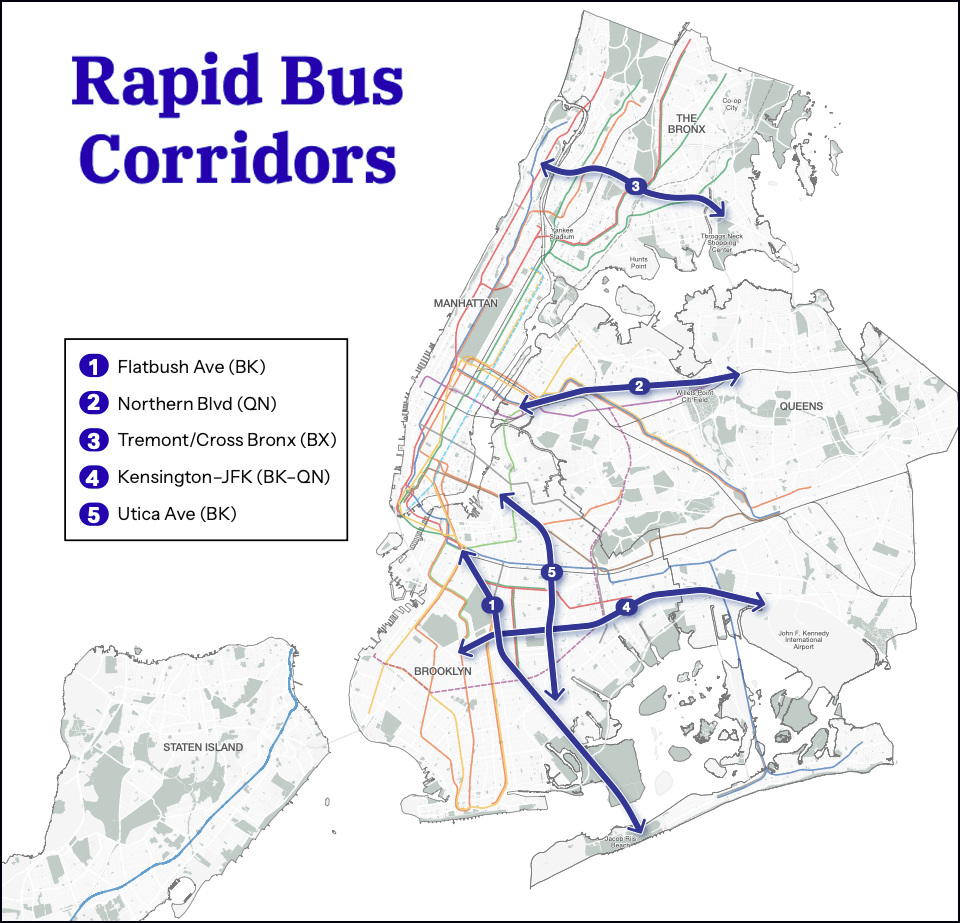
It is an opportune time for community boards to ask for bus rapid transit. In their joint vision for BRT, the Mamdani administration and the MTA identified five corridors around the city that will receive protected bus lanes, boarding stations and limited cross-streets in order to create the most efficient bus service possible.
The two agencies selected several locations — including Northern Boulevard in Queens and Tremont Avenue in the Bronx — to pilot the city’s first bus rapid transit efforts. But they excluded Manhattan and Staten Island from the initial BRT plan, leaving them with less ambitious “bus priority corridors” instead.
CB6 wants the city to fix this oversight: “Manhattan Community Board Six calls upon the City of New York, the Metropolitan Transportation Authority, and the New York City Department of Transportation to expeditiously designate First and Second Avenues as a Rapid Bus Corridor in Manhattan,” its resolution reads.
The resolution also includes specific requests for physically protected bus lanes, center-running bus lanes with boarding islands, all-door boarding, traffic signal priority and retimed lights, safer pedestrian crossings and increased service.
DOT recently upgraded the existing bus lanes on both avenues. In 2022, the agency converted a curbside bus lane on First Avenue between 61st and 79th Streets into an offset bus lane. And in 2024, the agency replaced a curbside bus lane on Second Avenue between 59th and Houston Streets into another offset bus lane. The new configuration sped up buses on each avenue by six and five percent, respectively.
Furthermore, DOT selected the M15 as the first bus route in the city to receive on-board automated enforcement cameras that bust motorists for driving and parking in bus lanes.
But neighborhood residents say their extremely busy bus requires the best possible tools in the transit toolbox.
“We’re looking for all means of improving this bus service,” said Friedman. “We definitely appreciate the offset bus lane to try to speed it up, but we’re looking for full dedicated evaluation of this corridor and all means to speed up the bus, because of how important this bus line is.”
The M15-SBS inches along at 8 miles per hour, which is about as fast as the average speed for local and limited buses across the city. But the non-SBS route runs just 6.5 mph. Even as one of the faster buses in the system, the city and MTA have tried for years to raise the average speed across system above 8 mph, which makes the city’s buses the slowest in the nation.
Manhattan CB6 represents the stretch of First and Second Avenues from E. 59th Street to E. 15th Street, so the call for BRT on the corridors doesn’t include the entirety of the avenues yet. But Friedman said he hopes this resolution will spur action from CB6’s neighbors to the north and south to provide a unified front to ask for BRT on the full corridor.
Friedman also pointed out that CB6 represents an area where residents are extremely bus dependent if they want to go north or south, because the Second Avenue subway only starts at E. 72nd Street.
“The M15 is so important for the east side of Manhattan as transit, because the subway can be quite a bit of a walk from there, so it’s a very important lifeline,” he said.
The CB6 resolution arrives amid the city’s plans to re-evaluate the benchmarks by which DOT will judge its own performance under the Streets Master Plan. Earlier this year, DOT Commissioner Mike Flynn told the city council that he wanted to move away from strict mileage targets for bus and bike lanes in the plan’s next edition — which is due this December — and preferred to look at statistics like deaths, injuries, bus speeds and rider travel time.
Flynn’s wish enjoys the support of multiple transit advocacy groups, including the Riders Alliance, the Regional Plan Association and Open Plans, the last of which shares a parent nonprofit with Streetsblog. On Tuesday, those advocates sent Flynn a letter urging him to stick to his idea of better metrics. They also proposed a few more measurements with which the city could assess the plan’s efficacy. These include bus speed improvements by project, changes in ridership after DOT installs new bus lanes, and time saved by riders on priority corridors.
An MTA spokesperson deferred comment to a DOT spokesperson, who said the agency would review the resolution.
“DOT continues to invest in improving the M15 route since Select Bus Service launched on the corridor,” said agency spokesperson Mona Bruno. “We recently upgraded bus lanes on First and Second Avenues, added new bus lanes on Allen Street and Pike Street, constructed extended bus stops to help speed up passenger pick up and drop off, and added Automated Camera Enforcement. We appreciate the community’s support for faster buses and will review the resolution.”

Read More:
Streetsblog has migrated to a new comment system. New commenters can register directly in the comments section of any article. Returning commenters: your previous comments and display name have been preserved, but you'll need to reclaim your account by clicking "Forgot your password?" on the sign-in form, entering your email, and following the verification link to set a new password — this is required because passwords could not be carried over during the migration. For questions, contact tips@streetsblog.org.