A Chat With John Surico About His New QueensWay Gig
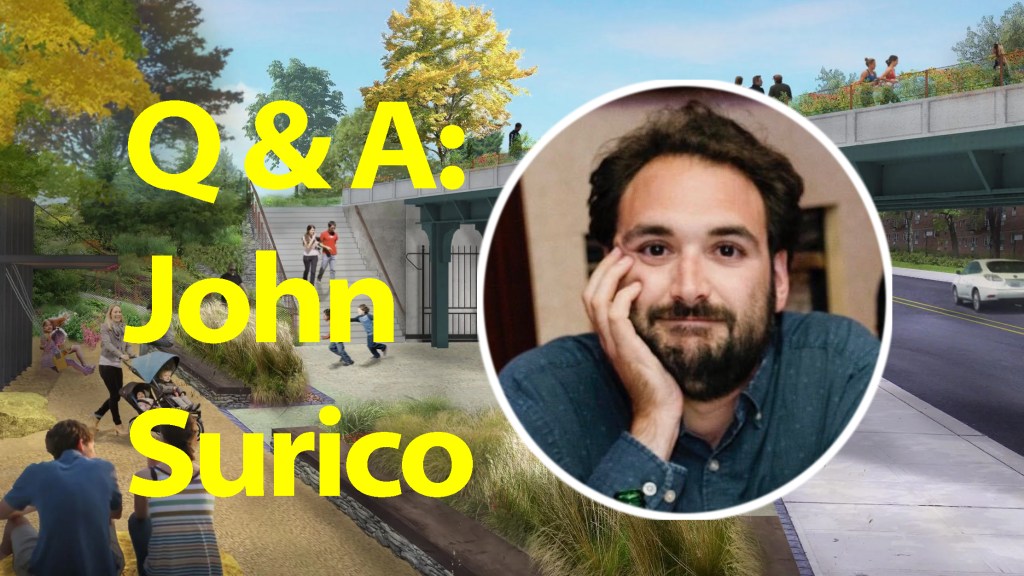
Earlier this year, Mayor Mamdani announced funding for the first phase of the QueensWay, a linear park on an abandoned Long Island Rail Road right of way in central Queens. The mayor’s choice to fund the park upset transit advocates after he previously backed a competing idea for transit on the the right of way.
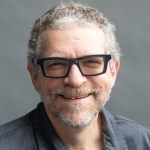
The fight over the future of the abandoned Rockaway Beach Branch received another jolt earlier this month when Friends of the QueensWay appointed John Surico to lead the group’s effort to transform the rail line into a park.
A journalist and urban activist who chairs Astoria’s 31st Avenue Open Street, Surico will lead Friends of the QueensWay amid some uncertainty about the project’s future thanks to the Trump administration’s decision to cancel a major grant that would have funded much of the build-out.
As QueensLink proponents continue to press their case for the rail project and Surico figures out how to get federal support for the park back on track, the new ED told Streetsblog that he believes the park won’t be an impediment to future train service.
“I frankly don’t think that having a park there would be a problem, if you’re going to spend the billions to bring rail back,” he said.
Surico also spoke with Streetsblog about his vision for QueensWay, and how it differs from Manhattan’s High Line and the comparisons around the country he’s looking at to draw on for the future of the park.
This interview has been edited for clarity and length.
Streetsblog: You’ve got this fancy new job title and fancy new job. Tell me a little bit about your vision for QueensWay and this job.
John Surico: I’ve been following QueensWay since it was first proposed. I wrote about it in a couple different instances. I always admired the effort to make it happen. And when the position became available, I had been inching more and more towards doing public space work more recently, outside of the work I’ve done as a journalist and researcher. I chair the Open Street in Astoria on 31st Avenue, and that’s something that really opened my eyes to the power of public space and really being on the ground to build it with an organization.
I came onto this project specifically because my entire family is from this part of Central Queens. I love that it was a project in my home borough. It’s something that I think truly can be this amazing connector from all these neighborhoods that are quite cut off from each other, and also be this catalyst for larger infrastructure investment in the area.
And I always shied away from the comparison to the High Line, I know it gets said a lot: the High Line for Queens. For me, the park is much more similar to other linear parks we see in other cities that have been these amazing greenway connectors. I’m thinking of the 606 in Chicago, the Belt Line in Atlanta, the Joe Louis Greenway in Detroit, and these linear parks that can really be this amazing connector for these different neighborhoods, and really be a way to link neighborhoods that are otherwise hard to get around.
Just around QueensWay, you’ve got six different neighborhoods, you’ve got 12 schools, seven subway lines, soon the IBX just down the road, and the commuter line with Long Island Railroad there. And more recently, as of two weeks ago, you have Citi Bike in the area. So I’m really excited.
Streetsblog: It’s interesting what you said about the comparison to the High Line because the general consensus around this project has been it’s High Line-esque — not a mobility focused park, but more of a nice thing people can stroll in. But it seems like you have a different vision for it. Can you talk a little bit more about how that that differs from what people have had in their minds about it before?
Surico: There are similarities, but also some big differences with the High Line. Friends of the High Line were early boosters of the project. Obviously, I can see why: it’s abandoned rail that would be turned into a park. The main difference is that it’s much wider than the High Line. The High Line is not super wide, so you could basically just walk. QueensWay, on the other hand — if you see EDC’s proposals — there’s a ton of land. It’s wide enough to have a two-way bike lane, to have walking, to have running, and to have some space for programming and outdoor seating. There’s space near the big educational complex to have outdoor learning and things like that. So there’s a lot more space.
And the part that we’re starting this fall, it’s ground level, it’s not elevated, which I think also helps in terms of being able to bike and be able to walk and run on it. And obviously, Chelsea and Meatpacking and Union Square in the West Village is a lot different than what we’re talking about from Rego Park down to Ozone Park in terms of a place lacking connectivity. So that’s the big difference I see, but tons of inspiration has come from the High Line in terms of what’s possible. This rail’s been sitting abandoned for 60 years, so it’s getting New Yorkers to reimagine what’s possible. I think the High Line serves as that source of inspiration, but I think ultimately, what is in the designs from EDC for the Metropolitan Hub Phase One looks quite different.
Streetsblog: For the larger, fuller project, as a mobility connector through the neighborhoods and getting people around: I think people look at QueensWay and they say we’re giving up a mobility corridor, in terms of transit at least. But you’re suggesting that there is a a good mobility aspect with this. Do people who are backers of the park see it like this? Have you talked to them about it?
Surico: I think it’s always been there, but it was less realized until we finally got to really see EDC’s proposals. And I would say EDC has a great track record of making these greenways if you see what they’ve done with the East Midtown Greenway right underneath the Queensboro, they’re doing some great designs. So I’m excited that they’re part of the project, and I think they understand the technical aspects of doing these mobility corridors.
The one thing I’ll push back against a little bit, is this idea of QueensWay as a park within a park — that it’s a park that’s going to be within Forest Park. Most of Phase One is not in Forest Park. It’s right next door to it. There might be part of it that goes into Forest Park later on, or part of Phase One that might go into Forest Park. But ultimately, if you’ve been to Forest Park, it’s not a park that’s really set up for transit. It’s a big loop.
Just recently they had a fight to even keep Freedom Drive open to cyclists and pedestrians. It’s much more of a leisurely place. I wouldn’t say it functions as a transit corridor really at all. As much as I love that park, this to me is a central spine that will run right through it and will have a huge mobility aspect to it, just because it’s going to serve a very different purpose. It’s not meant to go picnicking or something like that, it’s something that’s quite literally linear.
I spent a lot of time at the 606 in Chicago, which is very similar to this project in a lot of ways. You see tons of people bike into central Chicago and run and walk. And that’s largely what we’re going to see here, and it’s something that I’m really angling towards and promoting as part of the value of the project. And I’m really glad to see Citi Bike on Austin Street for the first time as of two weeks ago.
But I do think that once you have this, you can make calls to elected officials and to DOT to say: Can we have connections to QueensWay? Can we can we link this as part of the larger greenway plan, which it currently is not? How can we connect the IBX’s Metropolitan Avenue stop, which is going to be just down the road? What are other ways that we can tie this into a larger network?
Streetsblog: When you got the job, people were asking about the Metropolitan Hub. When the mayor announced that he was going to move forward with it a lot of people who had seen his previous support of QueensLink said, you know, what’s the deal here? And he went with what has been the line generally that building the Hub doesn’t preclude transit. I’ve always found that line a little bit confusing. What can you say about the idea that building the Hub doesn’t preclude transit in a way that explains why that would be the case?
Surico: Phase One of the Metropolitan Hub, which is breaking ground this fall, doesn’t preclude rail. It’s a part of the right of way that’s quite wide. If you wanted to bring rail back, if you’re already spending the billions to bring rail back, it wouldn’t be that hard to move some playground equipment around.
Where the hesitation comes from, I think, is later on when it gets pretty narrow, and when you go further south towards Ozone Park, it gets more narrow. I’m sure you saw the news with the big grant canceled by the Trump administration, the reconnecting communities grant. So without that in hand, part of my job is obviously going to be trying to advocate and get some of that money back.
But we’re far away from that. We’re still focusing on Phase One, and we’re really focused on just Phase One at the moment. Those designs were never even made. Part of the grant was to do the feasibility and do the design of what it would look like and what would be possible. So we don’t really even know what could exist later on. So it’s hard to comment on what that would look like or how much or what would preclude rail in general later on. But Phase One, what’s going in right now, does not.
Streetsblog: You know that there is a lot of passion around QueensLink from the people who are into it and that people are jacked up about since the mayor funded the Metropolitan Hub. I think that there are some people who are a little angry about what they see as passing up the idea of a mass transit link.
You yourself have also been in the transit advocacy world. You’ve called on the MTA to extend the G train to Forest Hills, which is something QueensLink people say their project makes possible. How do you navigate that tension, as someone who’s been in the transit advocacy world who’s now representing QueensWay?
When the announcement was made last week, I wasn’t surprised to get some personal messages from folks. People that like QueensLink or were wondering about it. I was expecting that to happen. I’ve obviously followed QueensLink for a really long time as well, as someone in the transit space. The G train campaign is in the pages of your publication. That was way before I was talking to QueensWay folks about this job.
That being said, part of the pitch for the G train was saying, if the MTA deems the full restoration of the G train as too infeasible or too costly, here is short-term fix in the meantime that restores the G train in Forest Hills. So a lot of it was: What can we get in the ground now? What can be done so we can have something going? And I think you hear the same argument for QueensWay. We have this project that’s happening now. That wouldn’t be years from now. It would be now. And it was the same thing with my pitch for the G train.
I’ve obviously been hit with the criticism that doing QueensLink will zap a lot of the political will later on to do rail. But at the moment, there’s not a lot of political will with the MTA or the governor’s office to do QueensLink. That’s been known, that’s out there. I am focused on Phase One of QueensWay and getting the project done. I’m open to chatting with QueensLink folks whenever. I have a lot of friends that are involved with QueensLink, and I’m happy to have those conversations.
One thing I’m interested in, specifically thinking about everything going on with this area of Queens in the next five to 10 years, is: how can we link QueensWay to it? IBX is not too far down the road. The new bus plan makes has a lot of focus on Woodhaven Boulevard, which is just on the other side of the park. A lot of priority corridors are over here. So how can we link this project? How can we make this project support and complement everything else the city is focusing on?
Streetsblog: That has been the QueensWay line — that there’s not a lot to be gained by holding out hope for 30 years that one day the MTA is going to finally say OK, we want to do QueensLink.
Surico: A pretty defining moment for me was when the MTA and the governor announced the Interborough Express. That to me was a choice that was made. There are real challenges with IBX, to do the tunnel into the cemetery and all those costs and things like that. I think the MTA stands with its decision. I haven’t spoken to Janno Lieber about it, but at the end of the day, this project is funded and in the budget. It’s moving forward, and we’ll continue to focus on that.
Streetsblog: I did a story a couple months ago about rails-to-trails projects in Maryland and Atlanta. When cities wanted to reactivate rails, what they found is that the park presence either killed the project or made the costs go up because people were there as this built-in constituency who said, “We love our park, we don’t want to give up any piece of it.“
Some of my colleagues compared QueensWay to the Elizabeth Street Garden in Nolita. The city wanted to build affordable housing for seniors — the most politically palatable idea in the world — but they still couldn’t get it done. Even this mayor decided that he’s just not going to build the housing after saying he would. Do you think it’s a fair comparison?
Surico: I wouldn’t say I think it’s a fair comparison to Elizabeth Street Garden. I definitely understand the context, though, of course, and why that would be the case, minus the celebrities and all the power that was attached to that. That being said, we’re already talking about a project that would, for QueensLink, cost billions of dollars. It’s something that is a different situation from those other projects to bring rail back.
It’s not an existing freight line. It’s been abandoned for over 60 years. There’s tons of remediation that has to be done. That would balloon a lot of costs in general. I frankly don’t think that having a park there would be a problem, if you’re going to spend the billions to bring rail back. The MTA only has so many billions of dollars to throw around right now, especially when Washington’s not coming in to help anytime soon. And I think they made a choice with the Interborough Express. And to Jon Orcutt’s point — I know he’s written in an op-ed in support of QueensWay — waiting around isn’t really going to help.
Streetsblog: Can you tell me what this pays?
Surico: I will be doing other work on top of this. Not a whole lot. I’ll be teaching, and I’ll be doing some long-term writing projects. I’ll probably pause on writing articles. I think you can kind of glean from that whatever you want to glean from that in terms of income.
Streetsblog: So you won’t become a multi-millionaire from promoting the park.
Surico: I don’t think so, not anytime soon. But I will just mention that even though this is my second week on the job, so many of the lessons that were learned from building the open street organization in Astoria transfer here. I don’t think it’s like building something from nothing. The Friends of the QueensWay have been working on this for 15 years. The open street in Astoria really helped lead to the whole redesign of the avenue. So I’ve been very heartened so far to see how much the lessons I learned with the open street over the last six years are transferring over to this work, and I hope that continues.
Read More:
Streetsblog has migrated to a new comment system. New commenters can register directly in the comments section of any article. Returning commenters: your previous comments and display name have been preserved, but you'll need to reclaim your account by clicking "Forgot your password?" on the sign-in form, entering your email, and following the verification link to set a new password — this is required because passwords could not be carried over during the migration. For questions, contact tips@streetsblog.org.