Maryland, Georgia Offer Cautionary Tales As Mamdani Advances QueensWay
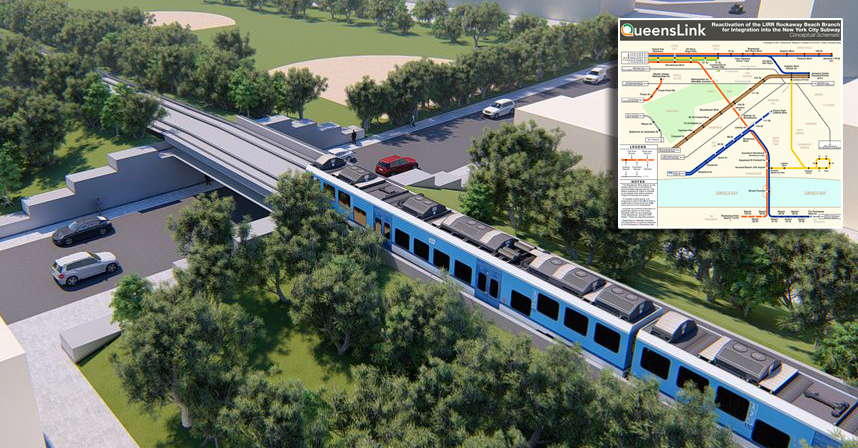
Mayor Mamdani’s decision to build a park over part of an unused rail line in Queens could make it impossible, or at least very difficult, to build a transit line that he’s long supported for the same route — at least according to the depressing trajectories of similar efforts in Maryland and Georgia.
Any attempt to build transit on former rail lines repurposed as parkland will either fail or accrue hundreds of millions of dollars in delays, as shown by two projects to build transit on deactivated tracks in the D.C. suburbs and Atlanta.
“You want to measure once and cut once,” said Eric Goldwyn, a researcher with NYU Marron’s Transit Costs Project. “You don’t want to measure twice and cut twice, and once there’s a park, people will be loath to say, ‘Oh let’s rip it up.'”
Mayor Mamdani has followed in his predecessor’s footsteps by advancing the QueensWay, a “linear park” on a decommissioned right of way in south-central Queens, despite his previous support for the QueensLink project that would reactivate rail service on the same corridor.
Proponents of the park option, including Mamdani’s Parks Department, insist that it won’t block any future effort to replace the park with transit. But examples from similar projects show that while it may be physically possible to restore transit service in parkland, the work is never so simple.
QueensLink supporters say the QueensWay design will kill their vision for bringing transit to the area. Their plan proposes to reroute the M train south from the 63rd Drive-Rego Park station through a tunnel that would come back above ground near the “Metropolitan Hub” where the city plans to build its park.
“Doing anything in the Metro Hub location will end up blocking transit,” said QueensLink spokesperson Noelle Hunter. “It’s pretty much the winch point of the project. It involves the Metropolitan Avenue Station, and we’ve identified it the primary staging grounds for construction. We’re literally going to have to be ripping up that site and excavating down for the tunnel boring machine launch box there.”
QueensLink supporters have offered an alternate design for the park that they say will allow both projects to happen, if the city is willing to build a transit easement orienting the planned walking path slightly to the north of its proposed location.
That, the transit advocates said, would help avoid the costly dramas of Atlanta and suburban D.C.
In Maryland, a light rail project known as the Purple Line — which would connect the northern and eastern suburbs in Maryland to the D.C. Metro — has lingered in planning and construction phases for decades, in part because of a conflict with supporters of the Crescent Capital Trail, a DC-adjacent footpath that local governments carved out of an old freight right of way that belongs to the future Purple Line route.
Trail NIMBYs objected to building light rail on the path and sued. As a compromise, the developers of the Purple Line agreed to build a 12-foot-wide paved trail next to the light-rail. But one analysis pegged the cost of a nearly year-long delay from litigation brought by trail supporters at $200 million.
Meanwhile, in Atlanta, a project to revive an abandoned right of way with trails and rails has only accomplished half the goal. The city originally conceived of its orbital Beltline project as a productive reuse of a disused freight right of way and laid plans to refurbish it as both a trail and a light rail route.
Atlanta has built much of the parkland piece of the project, but the transit aspect has stalled out completely over fears that nearby transit threatens the appeal of the new trail.
“The Atlanta Beltline story is very apropos here, because the original vision was to do both rails and trails,” Hunter said. “When they went to build transit, it created a political impediment to them doing that, and a lot of residents spoke out about that. They saw the park as a good thing and a public benefit that they were benefiting from directly. And any change to that is it’s scary, it’s unknown. And effectively, it ended up blocking any future rail expansion.”
Veterans of the fight over the future of the Beltline see the clear parallels as well.
“Unfortunately, we allowed the trail to get built before we built the transit,” said Ryan Gravel, an urban planner who proposed bringing passenger rail to the Beltline in his 1999 graduate thesis. “And the people who were not necessarily supportive of the transit component were able to stall transit long enough that now 20 years after we should have started building transit, it’s hard to imagine that it’s actually going to happen.”
After Atlanta opened the trail, its residents resisted adding the transit component of the Beltline, even though the plan would have maintained the trail. The prospect of ripping up an active piece of parkland to build a trail, as envisioned by Adams and Mamdani, strikes Gravel as extremely unlikely.
“It’s hard to imagine that if the QueensWay is built, that you’ll ever rip it up for transit,” he said. “People don’t like stuff being taken away from them.”
Still, it’s easy to see why Mamdani would side with the QueensWay once he took office, since the park is a more immediately realistic project and the MTA has repeatedly thrown cold water on QueensLink. The state-run transit agency has never shown any interest in the idea, though MTA Chairman and CEO Janno Lieber recently said that the agency would take a look at a new cost-benefit analysis assembled by the project’s supporters.
And even as the state remains cool to the idea, other transit thinkers have supported the QueensLink. Goldwyn’s Transit Costs Project included it in A Better Billion, a working paper that examined transit expansions the MTA could plausibly execute over 40 years if it had a reliable billion-dollar-per-year influx for capital work.
“Our perspective is that QueensLink provides value and builds off of some of the theory of the Interborough Express, where we’re trying to reuse the existing infrastructure and squeeze more capacity from the system that we have,” said Goldwyn, the head editor on the report. “You’re providing some north-south service that doesn’t exist in Queens. And it helps clean up some of the existing Queens Boulevard line capacity constraints, which allows you to run more more trains more frequently.”
If the city passes on this chance, it will miss an opportunity to improve people’s lives in real ways, Gravel said. “This isn’t some abstract notion, this is our life,” he told Streetsblog. “This is whether people make it to work on time, whether they have economic opportunities. It’s really important, it’s at the core infrastructure of our lives, so it really matters.”

Read More:
Streetsblog has migrated to a new comment system. New commenters can register directly in the comments section of any article. Returning commenters: your previous comments and display name have been preserved, but you'll need to reclaim your account by clicking "Forgot your password?" on the sign-in form, entering your email, and following the verification link to set a new password — this is required because passwords could not be carried over during the migration. For questions, contact tips@streetsblog.org.