NYPD Commissioner Tisch Declined To Punish Cops Who Used Force So Other Cops Could Park Illegally
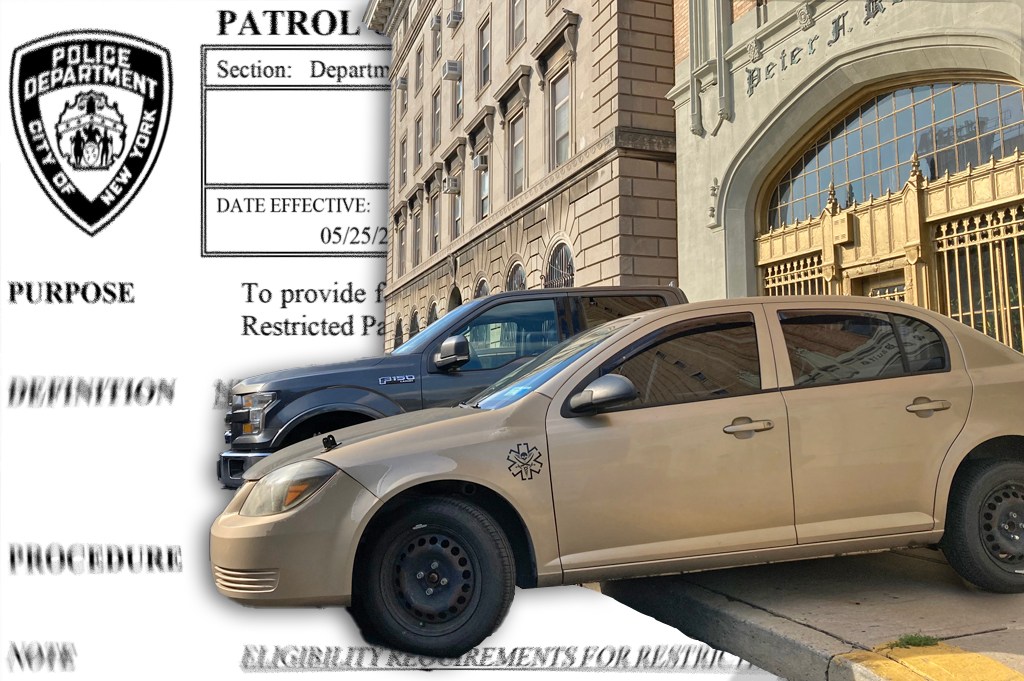
Police officers can rough up civilians to protect their ability to illegally park.
That’s the unmistakable conclusion from a recent decision by NYPD Commissioner Jessica Tisch to not punish officers who roughed up and threatened to run over a cyclist who was blocking other cops from parking on a sidewalk — a decision by the top cop that came even though the NYPD’s patrol guide prohibits both excessive force and bars officers from parking on the sidewalk.
The main details of the initial October 2023 incident are not in dispute: According to the just-obtained Civilian Complaint Review Board case file obtained by Streetsblog, the cyclist stood on the sidewalk on Bergen Street near the 78th Precinct house in Park Slope as Sgt. William McKnight tried to park his personal vehicle on the sidewalk.
The cyclist refused to move, and two officers then pushed the cyclist and used the bike rider’s backpack to pull them out of the way. McKnight, meanwhile, told the cyclist that he should have run them over and “ruined” their day. (The cyclist’s name was redacted in the CCRB file, so their gender is unknown to us).
But in the letter that cleared the officers of wrongdoing, Deputy Chief Michael Baker (who handled the correspondence for Tisch) argued that the officers have a right to use force to help their colleagues, even though the NYPD’s policies (and city and state law) do not allow officers to park on public sidewalks.
“To issue discipline would not be in the interest of justice,” Baker wrote, setting aside the CCRB recommendation that the officers receive discipline for their use and threat of force against the cyclist.
Baker argued that it was the cyclist who was “acting unlawfully” — seemingly by standing on a public sidewalk while a cop tried to park — and thus the officers “had the authority to move the complainant out of the way.”
Baker also wrote that McKnight’s threat to run over the cyclist were comments “not related to his official duties,” excusing them as comments made while “dealing with an individual blocking him from parking prior to starting work.”
And that’s a scandalous misread of the law, said one expert in policing.
“The [Baker] letter claims that the sergeant was off-duty, and acting as a private citizen, [so] in what capacity was the officer actually acting when he parked on a sidewalk? said sociologist Noah McClain, who was a CCRB investigator in the late 1990s. “In what capactiy was he acting when he went into the precinct [house] and had subordinates come out and force the complainant to move? Can just any citizen do that? I sure can’t.”
Tisch’s failure to discipline the cops is not just an example of the failure to crack down on alleged police misconduct, but also an escalation in the privilege afforded NYPD cops as they seek to park wherever they want, however they want.
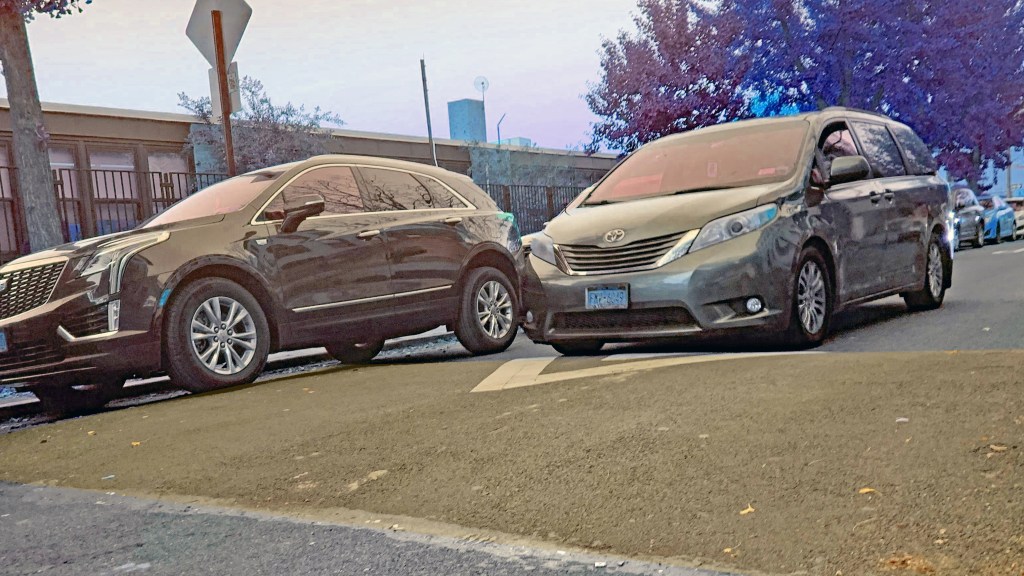
Indeed, McKnight’s decision to park on the public sidewalk is not uncommon. Officers and other municipal employees routinely park illegally in their personal vehicles, counting on their city-issued parking placards to shield from the tickets normal citizens would get for clogging sidewalks, blocking crosswalks, obstructing fire hydrants and impeding bike and bus lanes.
Despite Tisch’s decision, parking is prohibited by official NYPD policy — as then-Chief of Department John Chell reiterated in a 2021 NYPD-wide message included in the CCRB case file. But the agency rarely, if ever, enforces this policy, as Tisch again revealed when she set aside the CCRB recommendation.
Tisch’s decision to allow cops to use force to help their colleagues park illegally has implications outside street safety. The department’s Patrol Guide states that force can only be used to ensure safety, protect life or “place a person in custody or to prevent escape.”
There is nothing in the CCRB case file that suggests that officers on the scene contemplated arresting the cyclist. And the cops did not seem to view the cyclist as a threat — just a nuisance preventing a sergeant from parking illegally near his workplace.
The NYPD spokesperson doubled down on the idea that the officer had a right to use force because the cyclist was antagonizing officers.
“The complainant in question was intentionally hanging out in the area to prevent cars from parking,” the spokesperson said in a statement that reflected blame for the encounter onto the victim. “The complainant set out to engage in a hostile encounter with police officers, as he purposely blocked an off-duty sergeant from parking his vehicle in designated parking for police personnel.”
Self-enforcement zones
The case again shows how the department shields its officers from facing tickets by claiming that areas around precinct houses are “self-enforcement zones” where police police themselves and, therefore, don’t write themselves tickets. So it’s a Catch-22: Officers are not allowed to illegally park, but they are allowed to not write tickets when they see an illegally parked car in one of their zones.
In one notable disciplinary case, a cop argued that the street outside a bar frequented by cops — but nowhere near a precinct house — was part of a self-enforcement zone. No one really knows how these zones work; a city Department of Investigation found that the department has “no written policies or procedures” regarding these self-policed zones.
Top brass have said that self-enforcement is rare: In 2023, then-Chief of Department Chell testified that NYPD issued just 39 officers “command discipline” — a low-level form of discipline — for parking violations in the first four months of 2023. (Top NYPD brass have not since discussed these numbers publicly.)
In 2024, city investigators recommended that the NYPD be stripped of its ability to self-enforce. But the NYPD quietly rejected this proposal in 2025, as Streetsblog revealed.
The cyclist’s experience outside the 78th Precinct in Park Slope fits with the precinct’s particularly troubled history when it comes to street safety. In 2014, under bike-friendly Capt. Michael Ameri, the precinct cracked down on illegal street parking by cops. But by 2021, cars had returned to the sidewalk around the precinct — and a bike rack once championed by Ameri had mysteriously disappeared from outside the precinct house.
The precinct was also seemingly home to one of the city’s most dangerous cops — with 53 speeding tickets and seven red-light tickets — when Streetsblog identified the officer’s personal car in 2017. In 2023, Streetsblog caught two other officers with defaced plates parking outside the station house.
In a statement, an NYPD spokesperson who did not provide a name, described parking around station houses as a “persistent challenge due to our thriving, complex city and the limited space we all must share.” The spokesperson did not answer questions from Streetsblog about how the NYPD enforces its parking and placard policies.
“The NYPD strives each day to achieve a balance as we continue to work toward solutions,” the spokesperson added.

Read More:
Streetsblog has migrated to a new comment system. New commenters can register directly in the comments section of any article. Returning commenters: your previous comments and display name have been preserved, but you'll need to reclaim your account by clicking "Forgot your password?" on the sign-in form, entering your email, and following the verification link to set a new password — this is required because passwords could not be carried over during the migration. For questions, contact tips@streetsblog.org.