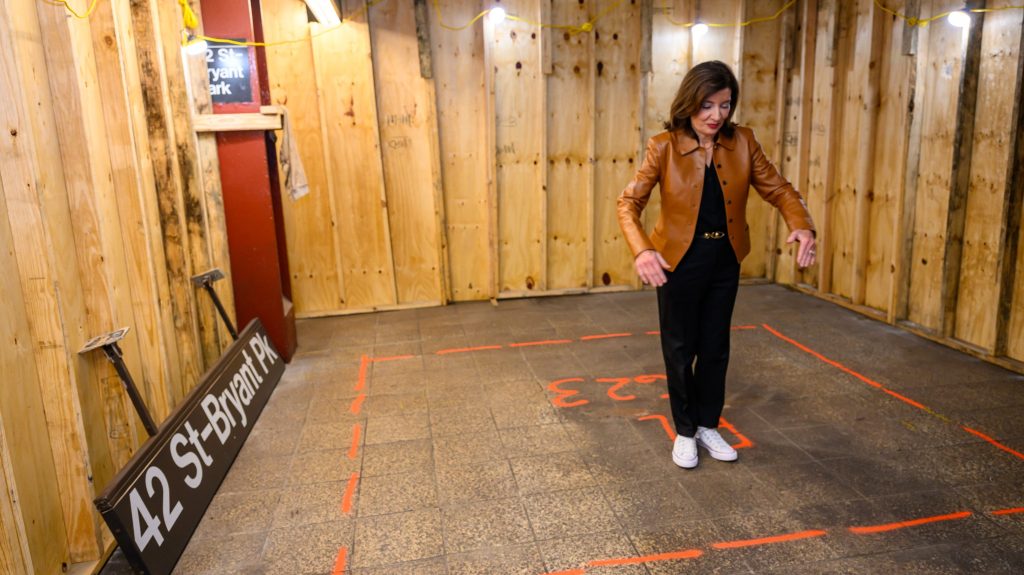
The Mamdani-Hochul Bus Plan: Priority Corridors, Bus Rapid Transit, Lane Enforcement And, Finally, All-Door Boarding
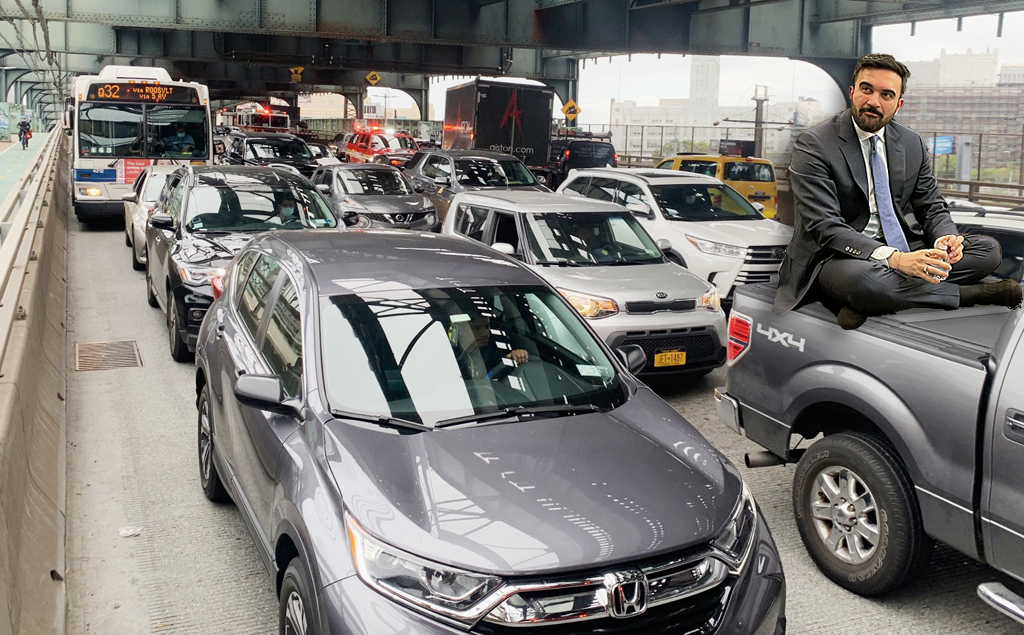
Is New York finally getting its long-sought Bus Mayor?
First-year chief executive Zohran Mamdani will begin the years-long process of answering that question today when he and Gov. Hochul release a joint blueprint to speed up the city’s slowest-in-the-nation buses by creating dozens of bus priority corridors, installing bus rapid transit(ish) treatments along five corridors, adding seating and shelters at hundreds of bus stops, enhancing bus route enforcement via cameras and cops, buying thousands of new buses and improving management of bus maintenance and operations.
Inspired by then-candidate Mamdani’s campaign pledge to make city buses fast (let’s forget the “free” part for now), the “Next Stop: Better Buses, Faster Service” plan to be released this morning also includes a crucial commitment from the state-run MTA to finally allow riders to board buses through the back door — one example of what could be an unprecedented level of city-state coordination for transit riders.
“For working New Yorkers, every minute matters. But for too long, our buses have been stuck in traffic instead of keeping pace with the city that never sleeps,” Mayor Mamdani said in a statement shared with reporters in advance of Wednesday’s reveal at City Hall. “When a commute stretches longer than it should, that’s less time with your kids, less time with your loved ones and less time enjoying the greatest city on earth. … This plan will make it easier to get to work, school and home — and build a city that works better for the people who keep it running.”
The plan’s backbone is a unified effort of the city Department of Transportation and the MTA to identify 50 bus priority corridors across the five boroughs where buses are currently the most delayed, with the goal of speeding up those buses by 20 percent.
Some of those stretches have already seen bus-first road treatments, but the report says that DOT and MTA will add other improvements make buses more reliable through better management, route adjustments, stop spreading, schedule adjustments, improving bus driver availability, among many management options.
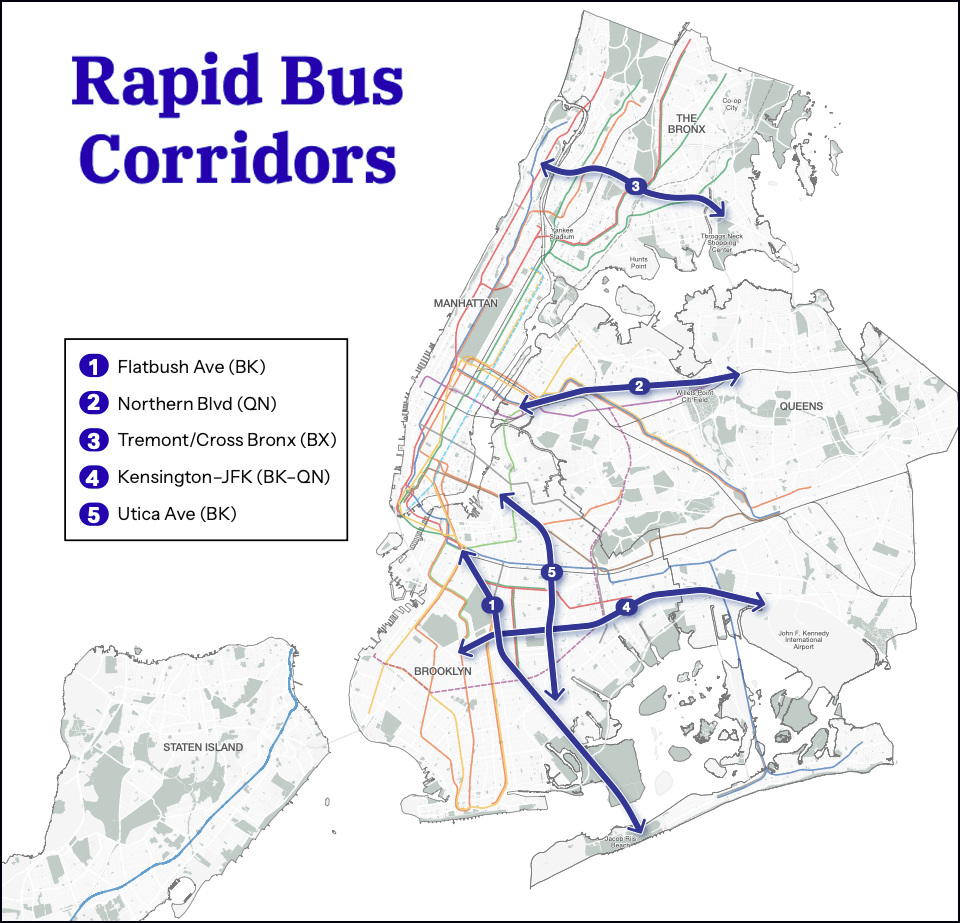
The plan also calls for a bus rapid transit-like system that could be like Select Bus Service on steroids on five full corridors:
- Flatbush Avenue in Brooklyn, set to open in 2030
- Utica Avenue in Brooklyn
- Northern Boulevard in Queens
- Church Avenue in Brooklyn to Conduit Avenue in Queens
- Tremont Avenue in The Bronx
Those stretches will get treatments that emphasize bus speed, frequency and reliability on long straight stretches in areas that don’t have crosstown subway service. Key elements of the rapid bus transit treatments will be “continuous, bus-only infrastructure like busways or center-running bus lanes, bus-boarding islands with level boarding which allows for passengers to just step on to buses instead of having to step up onto them, prohibitions on cross traffic across the corridors, and covered bus stations with seating.
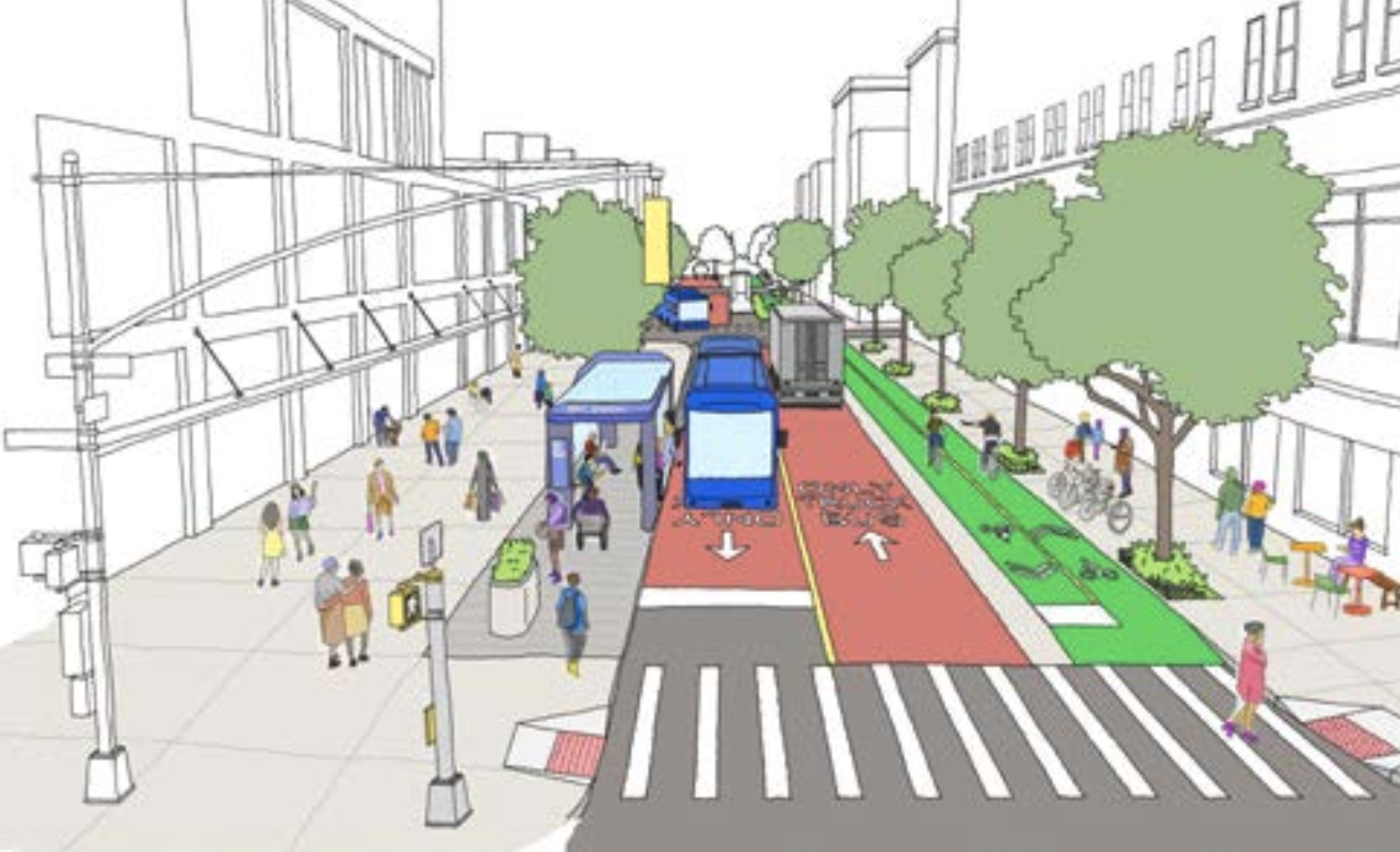
Planning for each of the corridors are supposed to kick off in 2026, and will be joint DOT/MTA productions.
Overall, the agencies have identified 28 specific projects they are installing or advancing in 2026, including busways on Tremont Avenue, 34th Street and underneath the M train in Ridgewood, further improvements to the Livingston Street busway north of Gallatin Place, capital projects on Woodhaven Boulevard and Jamaica Avenue and new bus lanes on Victory Boulevard.
The entire plan is a soup-to-nuts look at how to finally get buses out of their morass that has kept bus service in the city stubbornly the slowest in the entire nation, with a series of operational and rider-focused improvements to speed up buses and make waiting for them less of a miserable experience, including a major repurposing of street space away from cars.
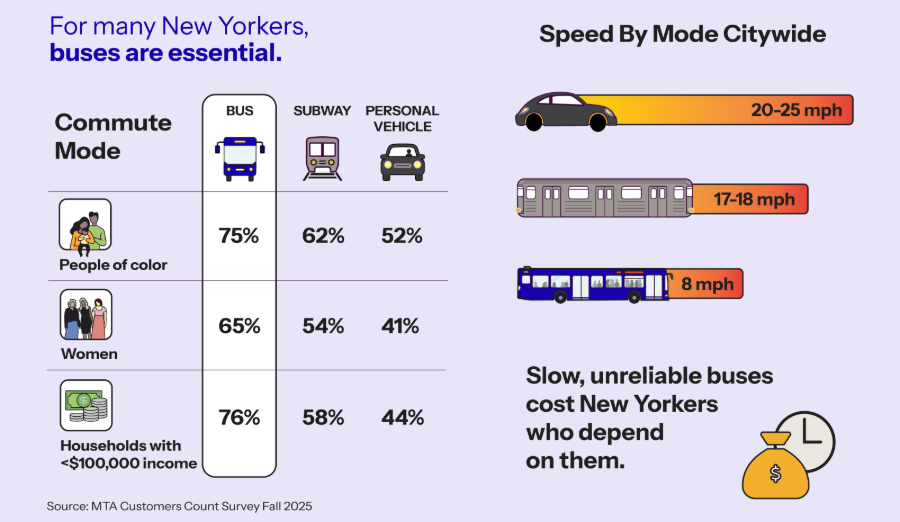
The work is essential if the status quo — systemwide local bus speeds average about 7.5 miles per hour on weekdays. The city has more than 6,000 miles of roadway, yet only 170 miles of bus lanes.
Of course, bus riders have become accustomed to promises from previous mayors that were later broken. Mayor Bill de Blasio had the Better Buses Action Plan, which included a promise to speed up buses citywide by 25 percent in a single year (local bus speeds actually declined over de Blasio’s eight years). Mayor Eric Adams convened a single Transit Improvement Summit early in his single term in 2022 and promised a series of bus lane projects, many of which are still not finished in 2026.
And bus speeds continued to fall, not rise.
The difference between the prior pushes and the Mamdani/Hochul plan on its face is that DOT and the MTA are making specific public commitments to riders and to each other, creating the kind of blueprint and paper trail that allows riders, advocates and other government officials to track the plan and see if it is actually getting results.
They also pointed to the fact that so many of the commitments, like the buses themselves, bus stop upgrades and bus shelters and planning work require and have been given actual resources to get done. DOT has millions of dollars in the city budget for bus planning and bus lane installation, while the MTA has billions set aside for bus purchases and has already announced its plans to try to attract more bus manufacturers to the American market in order to encourage more competition and better prices for new buses.
The biggest, clearest commitment from the MTA side is the promise to phase-in all-door boarding next year, following a successful pilot the agency has been running with its on-board fare inspections on buses.
The MTA’s commitment to allow people to get on the front or back of the bus is the capper on a decade-long journey to get the agency to embrace best practices enjoyed by bus passengers the world over. Advocates predicted that all-door boarding could speed up buses by cutting dwell time — the amount of time a bus stays at a stop while passengers board — by as much as 40 percent.
The MTA did introduce off-board fare payment with Select Bus Service in 2008, which allowed riders to pay with their MetroCard at a kiosk and then board the bus, but riders of local and limited buses remain limited to just the front door even as the agency installed OMNY readers on the front and rear door of every bus in the system.
The MTA originally announced it would pilot all-door boarding in 2021, but Chairman and CEO Janno Lieber put the kibosh on the idea in 2022 as the MTA dealt with fare evasion rates on buses that were as high as fifty percent and a slow uptake on OMNY usage. Since Lieber announced the MTA was rethinking the timing of all-door boarding, he had never set a firm date for the practice to be put into commission.
However, this year the MTA began to pilot on-board bus fare inspection, and also announced that along with the end of the MetroCard that buses would no longer take payment in cash before the end of 2026, setting the stage for riders to finally start using the OMNY readers at the back door of buses.
For its part DOT has pledged to install seating at 875 bus stops per year through 2035 when it pledges to have universal bus stop seating, install 90 new real time bus clock countdowns at bus stops this year and 2900 by 2030, have the NYPD do daily enforcement on 20 bus routes, install 300 new bus shelters by 2028 and install 25 queue jumps, which allow buses to pull ahead of traffic before a light turns green, per year.
Why is this so crucial?
The report makes the case that doing so will specifically help the city’s working class and communities of color, who rely on the bus to get around much more than they do private vehicles or even subways.
As a chart from the report shows, 75 percent of bus commuters are people of color, 65 percent are women and 76 percent live in households that make less than $100,000 per year, all of which are higher figure than commuters who rely on the subway or cars.
As a show of respect to those long-suffering customers, the MTA is buying 2,500 new buses by the end of the 2025-29 capital plan, and will modernize its bus dispatch and maintenance practices to ensure buses run reliably and predictably, improve the real-time bus information, and release the next draft of the Brooklyn Bus Redesign in 2026.

Read More:
Streetsblog has migrated to a new comment system. New commenters can register directly in the comments section of any article. Returning commenters: your previous comments and display name have been preserved, but you'll need to reclaim your account by clicking "Forgot your password?" on the sign-in form, entering your email, and following the verification link to set a new password — this is required because passwords could not be carried over during the migration. For questions, contact tips@streetsblog.org.