DSNY Eyes Top-Loading Garbage Trucks For Better Curbside Waste Collection
The Mamdani administration is exploring buying top-loading collection trucks for its new curbside trash bins, which would offset a forecasted increase in vehicles miles from the Department of Sanitation’s effort to get New York City’s off the sidewalk and into containers.
The Big Apple’s “Trash Revolution,” initially launched during the Adams administration, relies on side-loading trucks to collect street-side containers known as “Empire Bins.” But DSNY said in a recent environmental impact statement that it expects citywide trash containerization to require a stunning 1.2 million more driving miles, based on the need to run an extra vehicle down for each side of every block to empty the new containers.
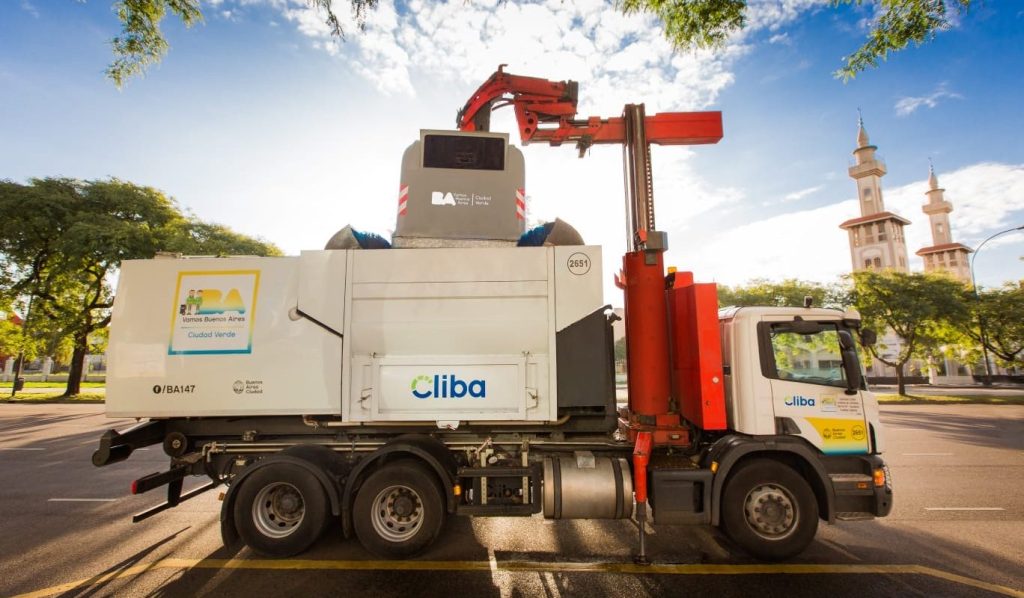
Top-loading trucks could solve this problem by allowing trash haulers to collect trash from both sides of the street. Over the past decade, cities in South America and Europe have pivoted from side-loading trucks to top-loading collection vehicles that only need to perform one run — drastically cutting vehicle miles traveled, or VMT.
City officials are exploring whether New York should follow suit.
“We are looking seriously at whether a top-loading truck would be appropriate for some parts of the city and are actively working with a manufacturer to design and build a pilot hoist-lifting truck to DSNY specs,” agency spokesperson Vincent Gragnani told Streetsblog. “The Department of Sanitation is not locked into any model and is always open to potential changes based on feedback, new information or the results of environmental studies.”
On top of the additional VMT from side-loading, DSNY also estimated a whopping 3.7 million additional travel miles from employees driving to work, as it plans to hire 581 new full-time staff. It’s unclear why the agency assumed such a high number of vehicle trips to work in the nation’s most transit-rich city. Gragnani said the review predicted a “reasonable worse case development scenario,” where the new employees would all drive to their jobs.
As the Mamdani administration commits to rolling out waste reforms citywide over the next six years, experts urged Hizzoner to embrace these top-loaders and experiment with other ways to better containerize waste for the city’s largest buildings.
Instead of installing a wall of permanent on-street bins outside apartment towers, DSNY could also try temporarily staging refuse from large buildings in four-wheeled dumpsters placed in the roadbed.
That concept has shown promise across the Hudson River in Hoboken, and the city should look at what other cities are doing before expanding containerization citywide, according to Clare Miflin, the founder of the Center for Zero Waste Design.
“I really strongly believe now is the time for DSNY to pilot [alternatives],” said Miflin, who worked on the pilot in Hoboken. “Pilot them before you go to other districts in the city.”
Top loaders
Cities like Buenos Aires and Florence are transitioning from side-loading trucks to top loaders — also known as hoist loading trucks or bilateral trucks — which can pick up waste on both sides of the street in one run. These trucks use metal bins that last longer and require less maintenance than the plastic enclosures Sanitation has already deployed.
DSNY will mandate Empire Bins for all buildings with 31 or more units, and make them optional for 10-to-30-unit dwellings, whose owners can choose between the street-side containers and wheelie bins on the sidewalk. Residential buildings with one-to-nine units must use wheelie bins for now, but the city is experimenting with letting smaller buildings share the curbside bins as well.
The historic effort to containerize New York’s mountains of trash bags began under then-Mayor Bill de Blasio with small-scale pilots. During the Adams administration, DSNY launched citywide plans, starting in West Harlem last year, and Mayor Mamdani vowed to fully fund its roll-out.
Some parts of the city have long had trash systems, such as Roosevelt Island’s 16 residential buildings that use pneumatic tubes and compactors to store and move waste, and the state-managed neighborhood of Battery Park City, which uses compactors and large containers.
Until recently, New York’s Strongest planned to rely solely on side-loading collection for curbside collection, where a truck has its arm on just one side of the vehicle, so Sanitation would have to run two vehicles down each street.
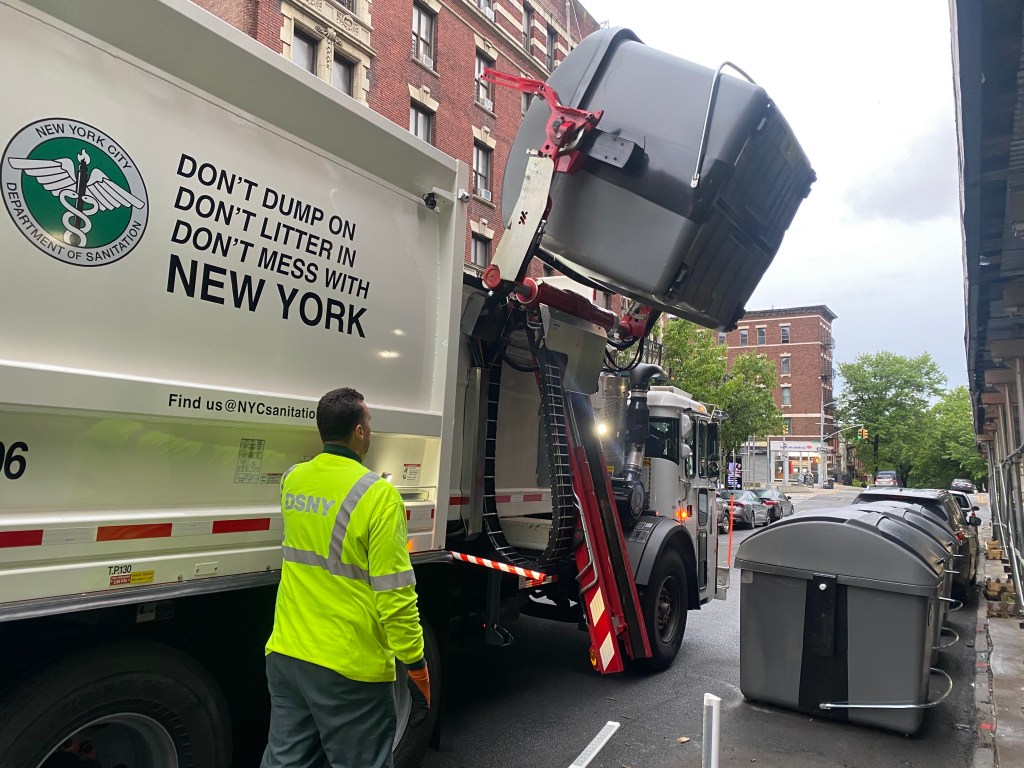
The agency has begun implementing the waste reforms uptown and in west-central Brooklyn. According to the draft environmental impact statement, DSNY aims to bring the new form of waste collection citywide by mid-2032. It will be up to either Mamdani during his second term, or his successor, to see the program through.
Officials forecast an increase of 1.2 million miles of collection truck trips to pick up trash from the 66,817 stationary on-street containers at mid-size and larger buildings. The agency plans to add 270 collection trucks, a 19-percent increase of the fleet. The extra trips could spew nearly 5,300 metric tons of more carbon dioxide.
It doesn’t have to be that way, though. In Buenos Aires, for example, city officials saw the light of top-loaders after initially relying on side-loaders, according to a senior official at a company contracted to collect waste there.
“The [bilateral] crane has many huge advantages over the side loaders,” said Alexandros Polijronopulos, an industrial engineer and project manager at the company Cliba, a major waste collector in Argentina.
Buenos Aires’s city government contracted Cliba in 2014, starting with side-loaders before the company decided to try out top-loading trucks. Polijronopulos said they stuck with top-loaders, not least because their bins are also more robust and easier to maintain than the plastic ones common for side-loaders.
“It really looks good on the streets,” Polijronopulos said. “I mean, it’s like a wealthy container. It’s not something ugly to see, so that’s also important, because you would flood the city with containers.”
Several cities on the European continent — including Paris, Florence and Rome — are already transitioning from side-loaders to top-loaders as well, Miflin said.
Those cities’ bins occupy less street space because the cities can pack them closely together, while side-loader bins require space between them for the truck’s arms to grab the bins.
In years past, Sanitation officials largely ignored the top-loading model. In a 2023 report DSNY published with help from McKinsey consultants, agency personnel wrote that lifting bins over cars and people would pose “untenable safety risks,” that many streets don’t have the needed 20 feet of clearance, and that hoist trucks “cannot handle loose bags” around containers.
Polijronopulos said lifting bins over cars is not an issue in Buenos Aires, because the bins are very rarely blocked by parked cars — and if there is an obstruction, the city just sends another truck on a later shift.
“The ones which we cannot serve are less than one percent each night,” he said. “We operate in the next shift, for instance. Usually, that’s not a problem for us.”
Each truck carries two sanitation workers: a driver who also operates the crane arm, and another worker who cleans up leftover waste, so loose bags do not pose a serious concern for the Argentinian system, either.
Buenos Aires maintains a mix of waste collection systems across its seven zones serviced by different companies, including side-loading and rear-loading trucks. Top-loading trucks and bins might cost more upfront, but they’re more efficient and last longer, Polijronopulos added.
“What the city of Buenos Aires should do is ask for 100 percent of the city to use this bilateral system,” he said. “I mean, of course, they are expensive, but in the long term, it’s the cheaper alternative.”
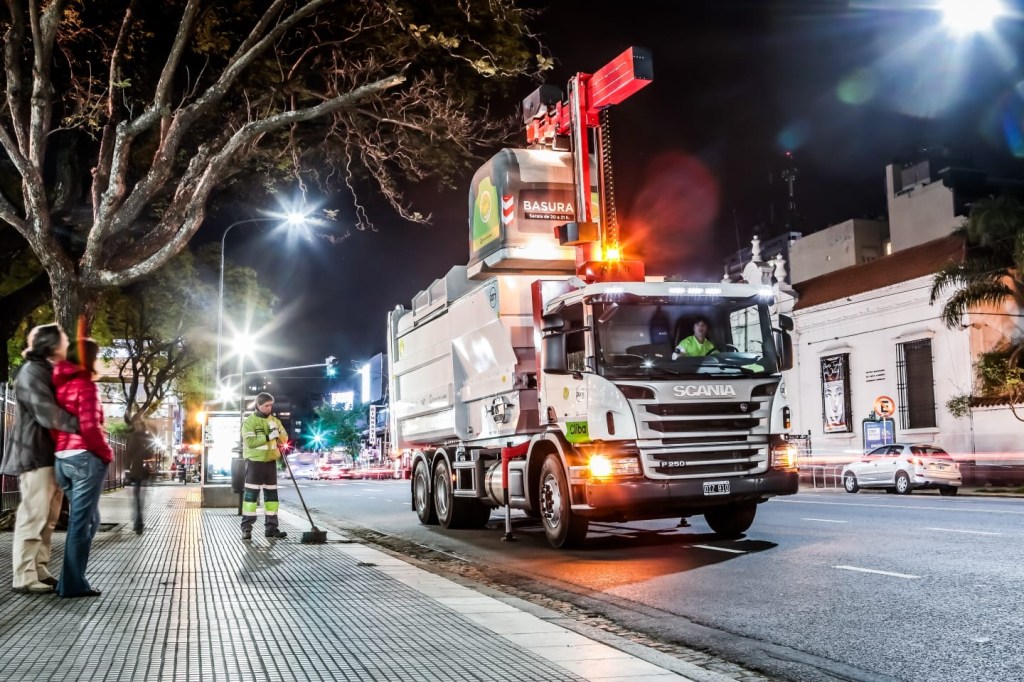
Polijronopulos urged his New York City counterparts to take a good look at hoist trucks before committing to the nearly 67,000 bins DSNY estimates will be needed citywide. “That is a huge number,” he said. “So you can really make huge mistakes if you don’t pick up the right technology.”
Miflin said the city should also let New Yorkers place recycling and organics into stationary on-street containers, so the city doesn’t discourage waste separation by making it easiest to dispose of trash.
“I just firmly believe we should not be doing trash-only infrastructure, that’s going to harm our diversion rate,” she said, referring to the share of waste that gets recycled and doesn’t end up in landfills.
Four-wheeled dumpsters
Empire Bins threaten to gobble up a lot of curb space outside of the city’s larger buildings, an issue DSNY will still have to figure out once it rolls out the program in denser neighborhoods around the city.
In its 2023 report on the future of waste management, the agency raised concerns that curbside containerization could be “non-viable” in areas like Midtown, the Financial District and Downtown Brooklyn. The dense housing stock in those neighborhoods would require repurposing more than 25 percent of the curb for bins — which officials set as their upper limit at the time — even if DSNY doubled its collection frequency.
DSNY cut down the number of containers somewhat by continuing to allow residents to leave their recycling in bags on the foot path rather than in Empire Bins. Public schools, which also get DSNY service, are required to place their waste in stationary on-street bins.
Miflin has long advocated for DSNY to test out four-wheeled containers that sit on the street only during collection hours, which would not take up the space 24 hours a day, seven days a week. She believes that containerization doesn’t need to relinquish so much of the public realm for the waste storage of large properties, especially in newer buildings that the city could require to carve out space for waste compacting and storage.
Building staff could roll those out from trash compactor rooms straight to the curb — as they do now before piling their bags onto the sidewalk — and wheel them back inside afterward, freeing up the space for other uses outside of collections such as deliveries, passenger drop-offs, rain gardens or parklets. Many buildings in the city already have staff bring their trash out in wheeled dumpsters like that, but then they empty the bags onto the sidewalk.
In fact, Miflin worked on a pilot last fall and winter in Hoboken, New Jersey that showed promising results. During the pilot, property managers at two buildings used four-wheeled bins in a marked staging area in front of their building. A sidewalk that routinely featured piles of garbage bags now hosts an orderly row of containers.
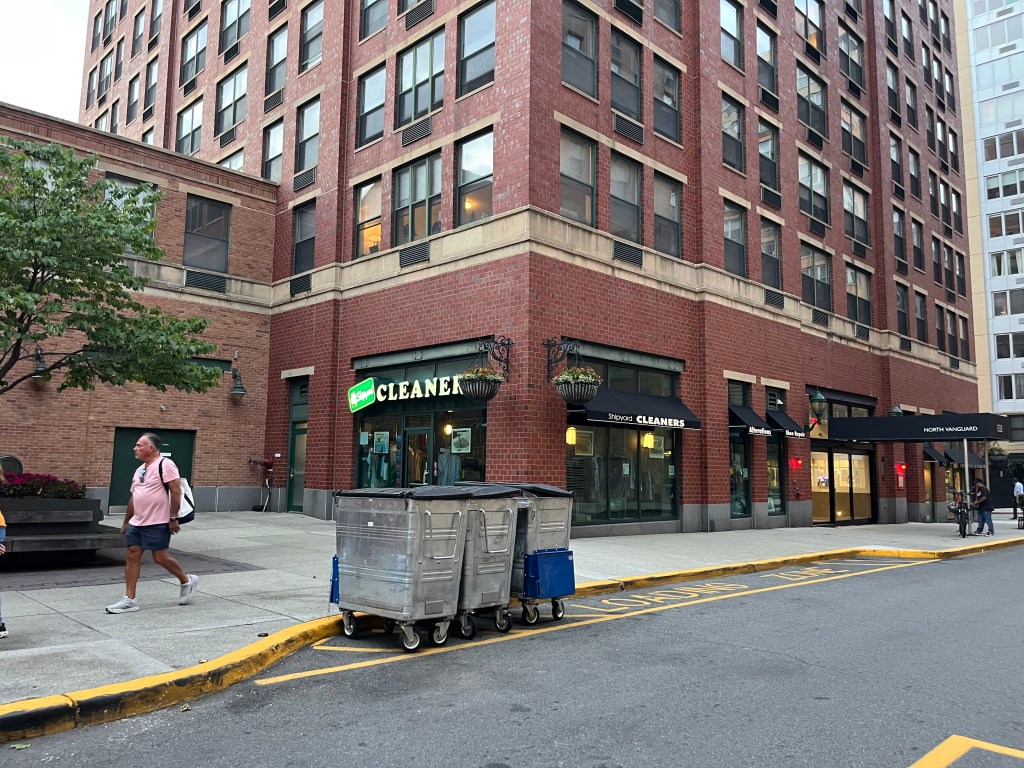
Last year, Hoboken passed an ordinance to require all buildings with 50 or more units to set their waste out in movable containers in the street. However, DSNY officials have expressed more skepticism of staging trash in the road, since New Yorkers routinely ignore other parking regulations for street cleaning, while happily eating the $65 fine.
“New York City already has temporary restrictions on parking for cleanliness — called alternate-side parking — and they are routinely ignored,” said Gragnani, the DSNY spokesman.
In response to City Council legislation, Sanitation recently resurrected its hard-to-remove “shame stickers” for drivers who don’t move their cars on designed days, on top the existing fines for blocking sweepers.
Gragnani said DSNY plans to send a deputy commissioner and its operations team across the river to look at Hoboken’s pilot. He noted, however, that the municipality has a population that’s smaller than most New York City neighborhoods, at just over 60,000. (Storing trash in wheeled street dumpsters is also common in larger cities like London and Vienna, Miflin noted.)
Despite its size, the New Jersey city has repeatedly eaten New York City’s lunch when it comes to the public realm. It maintains a internationally recognized daylighting program, which prevents drivers from parking near intersections and blocking the visibility of pedestrians and cyclists, and successfully enforces bike and bus lane restrictions with traffic cameras.
The Mamdani administration should take note from its tiny neighbor to the west, and not miss the opportunity to improve the city’s garbage policies and curb use, said one advocate.
“Trash containerization is one of the most impactful policies the city is currently pursuing,” said Jackson Chabot, director of advocacy and organizing at Open Plans (which shares a parent organization with Streetsblog. “It will have the noticeable effect of eliminating trash piles from our sidewalks and curbs, and also marks a major step towards a broader reimagining of the curb away from private vehicle storage and towards public usage.”

Read More:
Streetsblog has migrated to a new comment system. New commenters can register directly in the comments section of any article. Returning commenters: your previous comments and display name have been preserved, but you'll need to reclaim your account by clicking "Forgot your password?" on the sign-in form, entering your email, and following the verification link to set a new password — this is required because passwords could not be carried over during the migration. For questions, contact tips@streetsblog.org.