Hoboken’s Camera Program Got Drivers Out of Bike and Bus Lanes — But New Mayor Won’t Commit
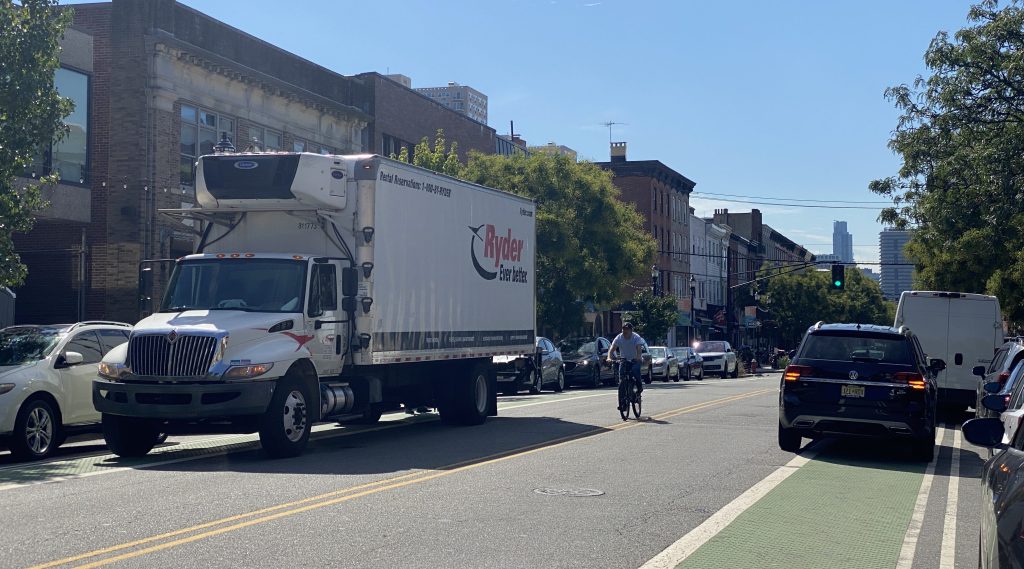
Parking enforcement cameras successfully cleared drivers from bike and bus lanes on a busy commercial strip in Hoboken, according to new data — but the lapsed three-month pilot program’s future is uncertain under the city’s new mayor.
The initiative — known as Camera-based License Plate Enforcement for Access and Response times, or CLEAR — cut the time that Hoboken drivers blocked bike lanes by nearly 22 hours less per day, and obstructed bus stops about 11 hours less daily, on the eight blocks of Washington Street where the city installed overhead cameras to catch scofflaws.
Businesses along the strip benefitted from increased foot traffic and easier deliveries, too, according to retail data from the strip.
These results burnish the Mile Square City’s reputation as a local and national model for safer streets, but its new Mayor Emily Jabbour declined to commit to reviving the program, citing “mixed feedback.”
“The CLEAR pilot highlighted improvements in safety and provided valuable data about how enforcement and curb management affect mobility and access along downtown Washington Street,” Jabbour told Streetsblog in a statement. “At the same time, I have heard a wide range of feedback from residents and businesses, including some input about aspects of the program that did not work as well.”
The city launched the camera pilot in October and targeted some of the most congested blocks of the commercial strip with rampant double parking, between Eighth Street and Observer Highway near the bustling Hoboken Terminal.
It made a very clear difference. “I was shocked at how transformational the change was and how quickly it worked,” Andrew Wilson, the executive director of the advocacy group Bike Hoboken, told Streetsblog. “For the first time that I’ve lived in Hoboken, the bike lanes are finally usable.”
The good news went beyond bike lanes. The new cameras reduced the number of car drivers who blocked bike lanes by 59 percent, and reduced those who blocked bus lanes by 44 percent. They yielded a 66-percent drop in loading zone violations. Those same loading zones saw a 67-percent increase in use by freight vehicles and a 32-percent bump overall. Retailers said longer customer visits rose as much as 60 percent, and eateries logged as many as 95 percent more short-term visits. Overall travel times on the corridor decreased by an average of 20 minutes.
Car drivers adjusted their behavior, too. Hoboken said 93 percent of drivers who received a citation did not receive a second one.
Automated camera enforcement of curb regulations has succeeded in other cities, including Pittsburgh, Philadelphia, and Fort Lee. Double-parking plummeted by a whopping 95 percent in the Steel City, and by 43 percent in Fort Lee.
Hoboken’s program offers a potential lesson to nearby New York City, where fixed cameras ticket drivers who speed and blow through red lights, and bus-mounted cameras catch drivers that double-park, occupy bus stops or block bus lanes. By contrast, CLEAR’s stationary cameras comprehensively tracked all parking infractions on a particular street.
CLEAR’s success is particularly noteworthy because it had to work around New Jersey’s state-wide ban on any form of automated enforcement. So even though the cameras caught misbehaving drivers, city traffic officials still needed to manually issue a violation and fine them, with tickets ranging from $55 for a loading zone violation to $63 for blocking a bus stop and $150 for parking in a bike lane.
The pilot’s success, abbreviated length and its unusual involvement of human traffic cops did not insulate it from political backlash. In early December, Hoboken’s nine-member City Council voted 5-to-4 to freeze the program until Jan. 15 — when Mayor Jabbour took office — even though CLEAR was already scheduled to sunset on Dec. 31.
Jabbour, who served on the Council at the time, voted against the freeze. Her colleagues who voted for it said they wanted to “allow the businesses breathing room” during the holiday season and claimed, without evidence, that they don’t “see bikers … spending money.”
“As a new administration, we are taking the time to evaluate the full picture so we can understand both the successes and the shortcomings, as well as work with the City Council to determine the best path forward,” Jabbour’s statement said. “Our goal is to improve safety and mobility without creating unintended burdens for the community.”
Jabbour’s predecessor, Ravi Bhalla, vetoed the pause in the last days of his term. He told Streetsblog that the pilot should become a permanent part of Hoboken’s streetscape.
“Crossing the street, riding a bike on Washington Street, getting off the bus, and driving along our main commercial corridor were all made substantially safer through camera-assisted enforcement,” said Bhalla in a statement. “Washington Street has never been more efficient than it was during the CLEAR pilot, and it is my hope that this program will be refined and continued to prioritize the safety of our residents and visitors in the months and years to come.”

Streetsblog has migrated to a new comment system. New commenters can register directly in the comments section of any article. Returning commenters: your previous comments and display name have been preserved, but you'll need to reclaim your account by clicking "Forgot your password?" on the sign-in form, entering your email, and following the verification link to set a new password — this is required because passwords could not be carried over during the migration. For questions, contact tips@streetsblog.org.