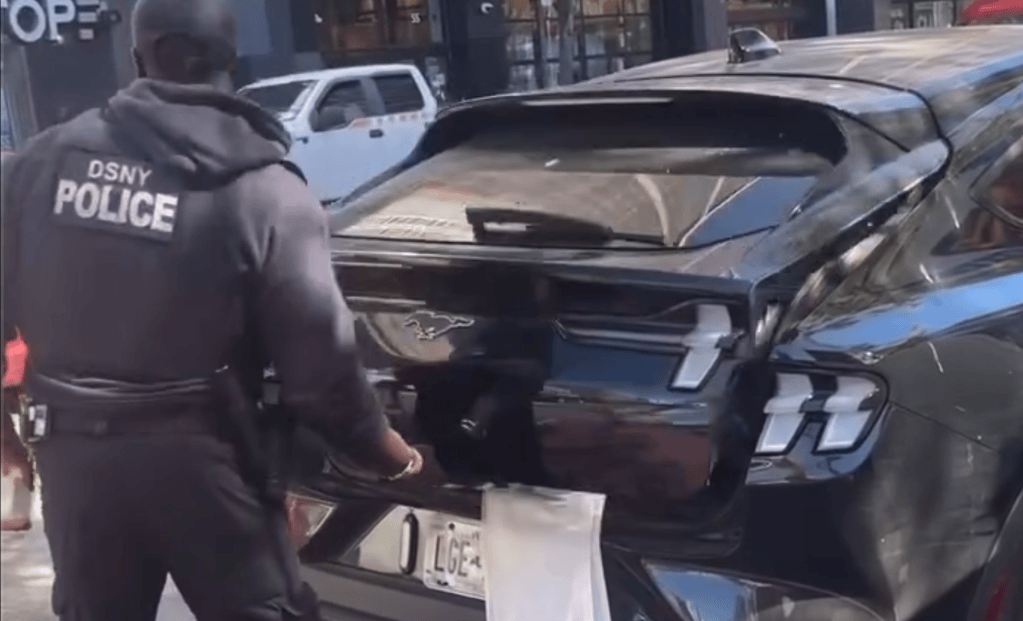
Komanoff: Congestion Pricing Was Never About Air Quality
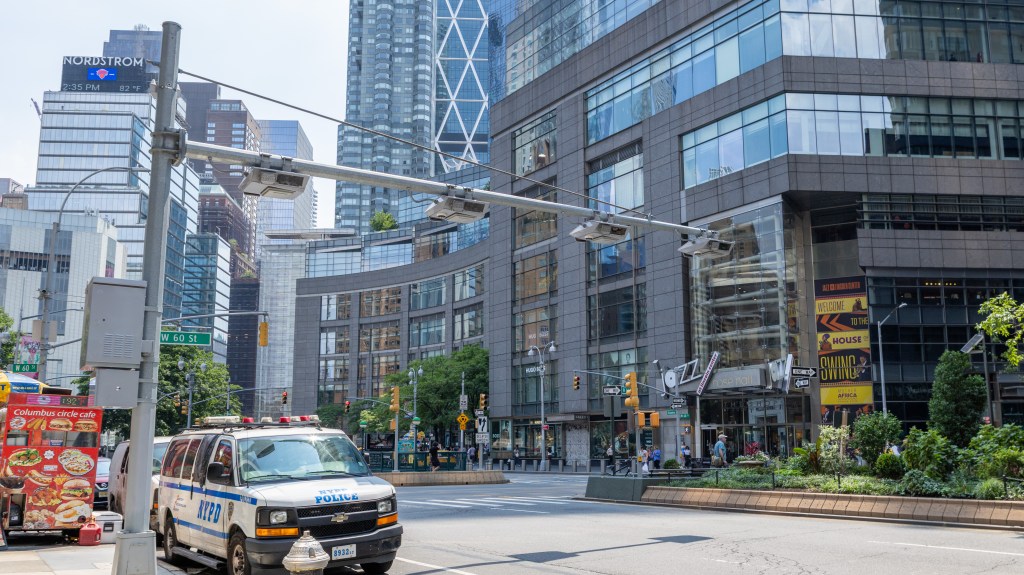
A comprehensive new report from the NYC Department of Health and Mental Hygiene on congestion pricing’s air quality effects is good news for the toll program and ― if I may ― vindication for this writer and traffic modeler and others who questioned the MTA’s forecast for increased pollution as a result of the toll.
Released last Friday, and aptly titled “Air Quality Impacts of Congestion Relief Zone,” the report finds that “Generally, pollution at all locations held steady or improved slightly.”
The health researchers break this down in two ways.
- “Inside the Congestion Relief Zone, pollution decreased slightly or stayed the same” in 2025 ― the first tolling year ― compared to 2024.
- At so-called environmental justice neighborhood sites, “congestion pricing didn’t increase pollution.”
“That’s all?” you say. “Wasn’t the point of congestion pricing to cut air pollution?”
No. Congestion pricing’s purpose was and is to improve travel ― directly, by unjamming streets and highways as a meaningful sliver of car trips get priced off the roads ― and indirectly, by generating a revenue pool to finance improved transit (subways, primarily), which will speed up transit commutes and also further unjam roads by offering drivers better travel alternatives. A secondary benefit was to shrink motor vehicles’ physical and psychological imprint on the urban landscape, ushering in wide-ranging gains in New Yorkers’ quality of life extending far beyond cleaner air.
Congestion pricing’s air quality benefit was always going to be slender ― well, not quite “always.” Had congestion tolling gotten underway in the early 1970s, when every car was an inescapable, in-your-face polluter, and giants like Bill Vickrey, Ted Kheel and Brian Ketcham were importuning NYC Mayor John Lindsay to toll the city’s East River bridges, the air quality benefits would have been gigantic. But today, half-a-century later, per-mile tailpipe emissions of “criteria” pollutants ― lung-wrecking carbon monoxide, nitrogen oxides, volatile organic compounds and, above all, dangerous fine particulate matter (PM2.5) ― have fallen more than 90 percent. Tailpipe emissions aren’t the only detrimental air quality impact of driving, but they are a big one – more damaging than PM2.5 from brake and tire wear. With those gains, congestion pricing’s air quality benefits have shrunk accordingly.
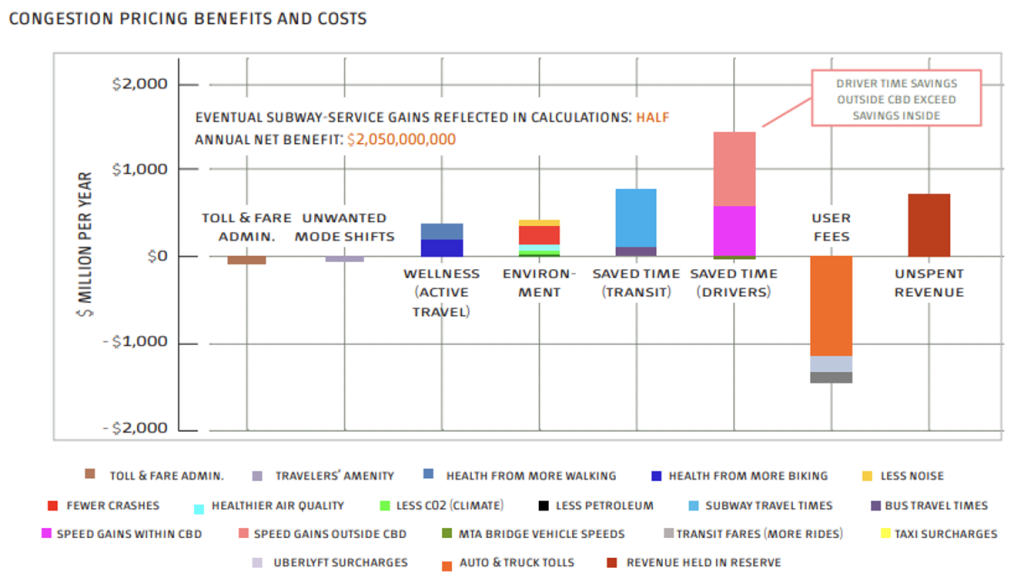
When I last tried calculating the economic value of congestion pricing’s air quality benefits, several years ago, I concluded it came to only around $50-60 million a year. The “only” is in relation to New Yorkers’ huge travel time savings from congestion pricing, which I pegged at $1.4 billion annually for drivers and another $750 million for transit users.
In effect, for each dollar’s worth of saved travel time, the prospective air quality benefits added just pennies. Even the separate health benefits I forecasted from increased physical activity (as fewer vehicles on the road engender more cycling and walking) outweighed the health benefits from reduced pollution six-fold. (See graph.)
All of which is to say that the Health Department’s finding of unchanged or slightly better air quality from congestion pricing isn’t at all deflating. It’s confirming.
What’s unconditionally validating is the report’s finding that in environmental justice neighborhoods, “congestion pricing didn’t increase pollution.” The Health department folks deemed this “good news,” which I heartily second. From 2022 until recently, “Gridlock” Sam Schwartz and I expended considerable effort critiquing extreme MTA modeling scenarios and pushing back against local activists who worried that “diverted traffic” unleashed by the toll plan could more than offset reduced through-traffic, leading to higher localized emissions and worsened air quality.
The MTA even took the unprecedented (and ethically far-sighted) step of committing to offsite mitigations (e.g., electrifying diesel-fueled 18-wheelers at the Hunts Point Food Distribution Center) to offset the worst-case decline in local air quality.
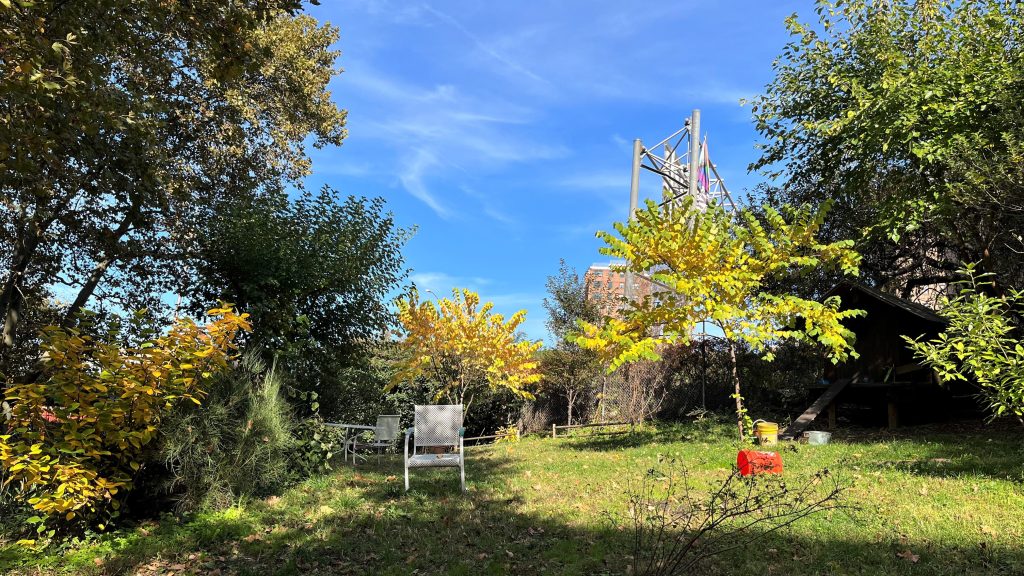
In a chef’s kiss of sorts, one of the Health Department’s air pollution monitors used in the report is sited in the Maria Sola Community Greenspace ― next to by the very highways (Major Deegan Expressway, Bruckner Boulevard) that would have borne the brunt of the feared truck diversions. The space’s creator, South Bronx Unite, saw the MTA’s now-unrealized forecasts as yet another instance of New York’s leaders funneling pollution through their borough. Now the absence of any measured uptick in air pollution should finally put to rest the canard that congestion pricing only benefits the better-off at the expense of the disadvantaged.
The Health department report is more evidence – if it were needed – that congestion pricing is the marvelous unicorn its proponents envisioned for New Yorkers: So many winners, so few losers.

Read More:
Streetsblog has migrated to a new comment system. New commenters can register directly in the comments section of any article. Returning commenters: your previous comments and display name have been preserved, but you'll need to reclaim your account by clicking "Forgot your password?" on the sign-in form, entering your email, and following the verification link to set a new password — this is required because passwords could not be carried over during the migration. For questions, contact tips@streetsblog.org.