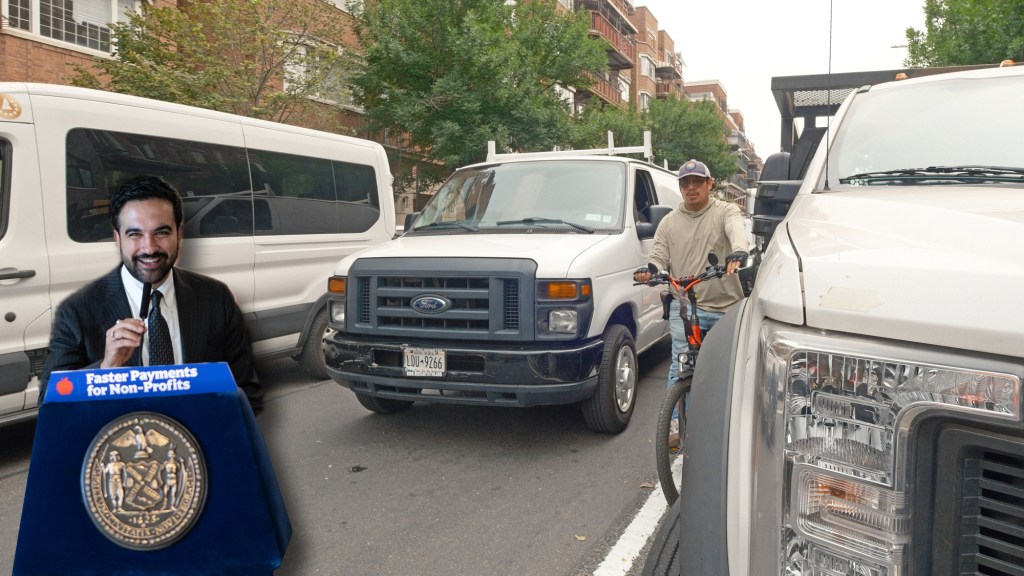
‘Insulting’! To Avoid Disrupting Car Traffic On The FDR, DOT Forces Parks To Scale Back Greenway Fix
Maybe you guys want to take this outside?
Parks and economic development officials were forced to water down a nearly $300-million reconstruction of bike and pedestrian paths along the East Harlem waterfront because transportation officials working in the very same Mamdani administration refused to close part of the FDR Drive during construction, Streetsblog has learned.
Because of that refusal, construction workers will have to set up a platform in the East River to rebuild the Bobby Wagner Walk — a switcheroo that so ballooned costs that officials with the Parks Department and Economic Development Corporation removed half the length of upgrades to the walkway, along with a planned bathroom, city reps recently revealed at a community meeting.
The project is part of a de Blasio-era $732-million plan to close the gaps in Manhattan’s waterfront greenway network on the East Side, but a push from advocates to fix the pathways uptown dates back about 15 years, according to locals.
“I cannot even express how insulting that is, particularly to the East Harlem community,” Jennifer Ratner, who chairs the group Friends of the East River Esplanade, said of the city scaling back its work. “After all these years East Harlem should really get a reinvented waterfront, not just patchwork.”
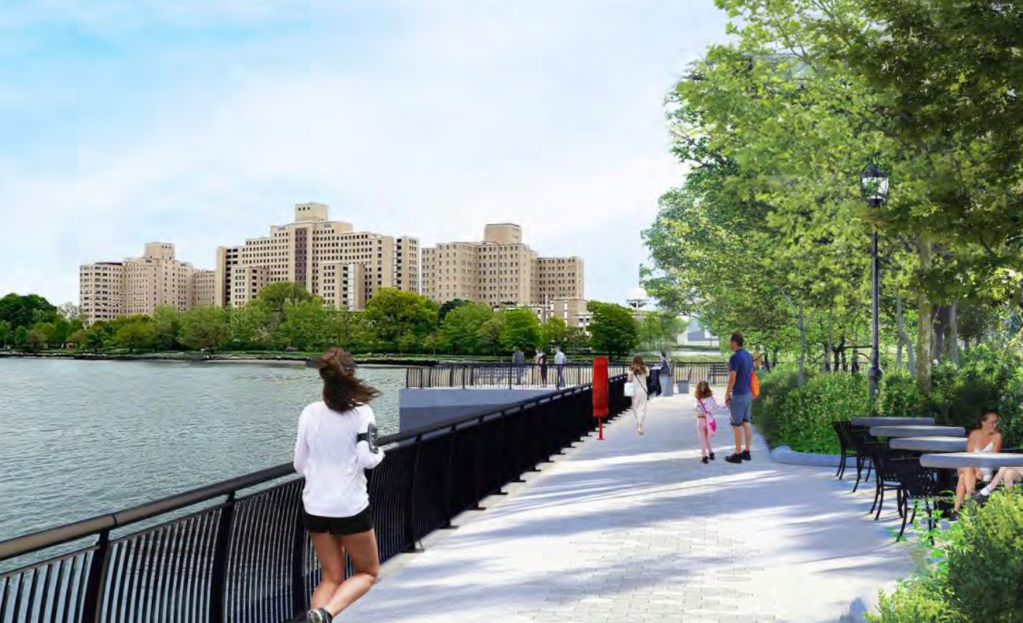
The quasi-public EDC and the Parks Department unveiled designs in 2024 to reconstruct 20 blocks of crumbling path along a section of the East River esplanade known as the Bobby Wagner Walk, named after the son of three-term Mayor Robert F. Wagner.
The work covered two sections, between E. 94th and E. 107th streets, and between E. 117th and E. 124th streets. Officials also planned to rebuild the shuttered pier at E. 107th Street.
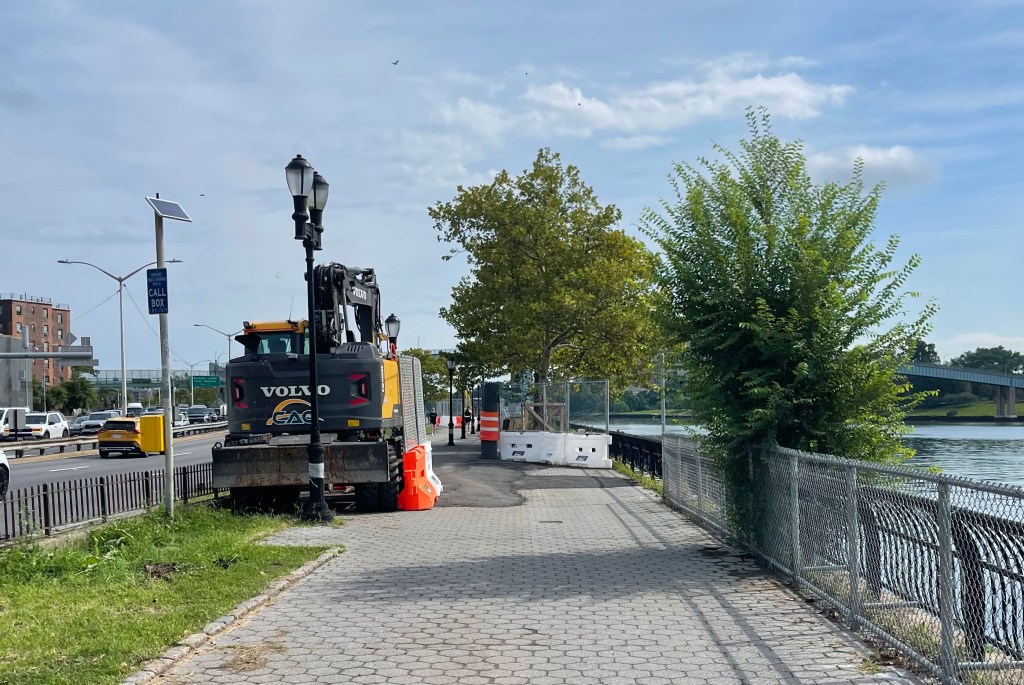
But EDC and Parks last month said that they would no longer rebuild 11 blocks between 94th and 105th streets and that the new pier won’t get a promised restroom, which Patch previously reported. Instead, the agencies will merely patch up holes along that stretch like these.
EDC officials told Community Board 11 in July that the $294-million budget for the work was no longer enough to cover the whole job in light of the Department of Transportation’s failure to grant enough staging zones on the adjacent FDR Drive.
The DOT would have only allowed workers to set up in one lane of the FDR and only on nights and weekends — even though that stretch of the highway has six lanes for motor vehicles, plus as many as six service road lanes flanking the highway at ground level.
“DOT said that we would be allowed to close down one lane of the FDR Drive, but only at night and on weekends, which means we would have to mobilize and de-mobilize. That’s helpful, but it’s not really what we needed,” Len Greco, a landscape architect and senior vice president at EDC, told CB11 on July 16.
The water next to the walkway is too shallow to bring in barges, so the city will have to build costly temporary platforms, Greco added.
“The overwhelming majority of the project is going to have to be constructed from the water side,” the rep said. “That’s an added cost, added timeline here.”
The decision to not install a restroom on the new pier will undercut the city’s efforts to make the space a gathering spot for East Harlemites, one CB11 member said.
“There’s people who just — I’m going to say it in the bluntest way possible — can’t hold it,” said Asher Rodriguez. “That’s going to end up causing a lot of people either not going there, it’s not being utilized the way it should, or it’s just going to end up being a mess.”
The city’s backtrack came just weeks after Mamdani touted nearly $100 million in new money for greenways in the city’s budget, but that money only goes so far if city transportation bureaucrats set up costly roadblocks.
It also stood in stark contrast to the city’s approach to highway repairs. Last week, Mamdani announced his plans to drop a cool $4 billion to rehabilitate the crumbling Brooklyn-Queens Expressway, extending its lifespan for another half-century.
That announcement disappointed livable streets advocates for doubling down on the 1950s-era Robert Moses Highway, not least because the mega-project will include a double-decker temporary highway tearing through several parks and playgrounds at the Brooklyn waterfront.
But unlike car-ways, greenways have long been the forgotten child of city transportation infrastructure, despite their massive popularity — the paths along the Hudson River are the busiest in the country.
Mayors have long delegated most of these paths to the Parks Department, which lacks staff to advance piles of projects in the pipeline or do basic maintenance.
“It’s just been dragged on through administration after administration,” Ratner said of the uptown renovations.
The city plans to wrap up design this fall on the three year construction project, but they did not give a timeline for when they would break ground beyond “as soon as is possible,” according to presentation slides [PDF].
In wealthier Midtown, EDC opened a scenic $217-million, eight block greenway section, which took four years to build, also next to the FDR Drive atop remnants of a bypass highway.
One greenway booster worked on pushing for a better Bobby Wagner Walk a decade-and-a-half ago, and was baffled that little had changed since then.
“It’s kind of amazing that 15 years later we’re still talking about deterioration of the East River Esplanade in this very location,” said Hunter Armstrong, co-chair of the New York City Greenways Coalition. “It’s incredibly frustrating how little progress has taken place and it feels like the same issues.”
DOT spokesperson Vin Barone wrote in an email that it would be false to blame the cost “solely on FDR closures,” but referred further comment to Parks.
A Parks rep cited “tariffs,” but also blamed the “maritime construction costs” for the shortfall, adding that a restroom would be “prohibitively expensive,” because the city would have to build it high enough to be above the floodline and it would require new sewer lines under the highway. But such requirements have long been known.
“We are working with our partners to begin construction as quickly as possible to deliver the first tranche of work using the funding available and explore options to bridge the funding gap,” said Kelsey Jean-Baptiste in a statement.
After initial publication of this story, DOT Chief Communications Officer Nick Benson disputed its contents:

Read More:
Streetsblog has migrated to a new comment system. New commenters can register directly in the comments section of any article. Returning commenters: your previous comments and display name have been preserved, but you'll need to reclaim your account by clicking "Forgot your password?" on the sign-in form, entering your email, and following the verification link to set a new password — this is required because passwords could not be carried over during the migration. For questions, contact tips@streetsblog.org.