Opinion: Queens Needs Fewer Cars For Less Traffic
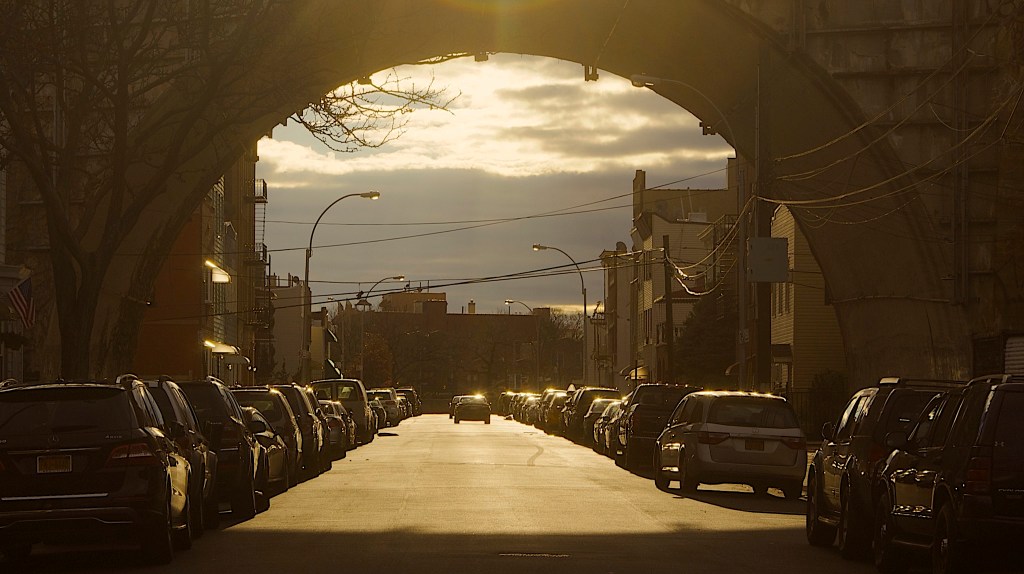
New York City is home to 2.1 million cars. If our cars transformed into people, they would form the nation’s fifth-largest city, sitting just behind Houston. Queens alone has 760,000 cars, larger than the entire population of Washington, D.C.
Local politicians always promise they can reduce congestion. They tell constituents that change can be created by keeping things exactly as they are. Free parking can remain untouched, transit expansion can be stalled.
Every solution is thrown out except for one: reducing the number of cars competing for space on our streets. The dirty truth is that reducing traffic congestion means reducing car ownership. Street space is finite; the more cars we add to our local streets, the worse our congestion becomes.
Here’s the thing: 75 percent of our street system is reserved solely for cars, in a city where 70 percent of folks commute by transit. It is the mismatch of how New Yorkers get around versus how we actually use our street system that creates the gridlock we all hate so much.
We’ve already experimented with 50 years of highway expansion. The New York City metropolitan area has 7,400 miles of highway, the most of any metropolitan area in America. If more highways were the answer, traffic would have disappeared long ago.
But what would Queens or New York look like if we had 20,000 or 40,000 fewer cars? How could we use our street system differently?
Our 6,000-mile street system isn’t fixed in amber; we decide how to use it. Our public street network is one of our most valuable resources. If we choose to use it differently, we could dramatically reduce car ownership and upgrade our quality of life.
Western Queens is one of the best places to test out this idea, where already low car ownership could be driven lower, and where the city can quickly invest in piloting low-traffic neighborhoods.
Why Western Queens is different
Obviously, I love Queens, but I’m not just suggesting we’re uniquely transit-brained because of my biases. The data support the idea that we could become a low-traffic neighborhood.
According to the Census, nearly 63 percent of workers in Western Queens already commute by transit, only about 14 percent commute by car, and 60 percent of households have no car at all. It makes sense! Within a 30-minute transit commute of my apartment, I can reach more than 1.3 million jobs; in other parts of Astoria, the figure is closer to 1.6 million. The challenge is making it possible for more residents to take advantage of that accessibility without owning a car.
Queens Community Board 1 — which encompasses a broad swath of Western Queens — contains roughly 44,749 cars. That’s about 0.49 cars for every household. If Western Queens matched Manhattan’s car ownership rates, there would be 21,000 fewer vehicles on local streets, enough to fill more than 80 football fields of parking space.
This is a huge amount of space that could be reclaimed for housing, moving people, and creating public space, rather than for storing vehicles. Imagine Western Queens with over 4 million square feet of road space reclaimed? To put the newly freed-up space in perspective, that’s nearly twice the size of Astoria Park.
What would this look like?
The push for safer intersections, traffic calming, better transit service, bicycle infrastructure, and new open space isn’t a niche issue. Community Board 1 has repeatedly fought and called for those same improvements. What if we had 80 football fields’ worth of additional room to pursue those goals?
Here’s what that might look like. Curbside parking becomes rain gardens, and sidewalks are expanded. Some streets become permanent pedestrian plazas. Instead of hearing cars as you walk on busy streets, you hear your neighbors’ voices.
Medians turn into community gardens, and every intersection has finished crosswalks. All of this is possible. Other cities and countries have already done it.
The goal isn’t a city without cars. It’s a city where owning a car is a choice rather than a necessity. Western Queens already has many of the ingredients needed to make that possible. The question is: will we make the reforms we need to get there and, as New Yorkers, choose to use our streets differently?
This story originally appeared on Civic Pulse, which hosts a monthly gathering called Nerd Night. The next event, on July 20 at Heart of Gold in Astoria, will focus on Open Streets.

Read More:
Streetsblog has migrated to a new comment system. New commenters can register directly in the comments section of any article. Returning commenters: your previous comments and display name have been preserved, but you'll need to reclaim your account by clicking "Forgot your password?" on the sign-in form, entering your email, and following the verification link to set a new password — this is required because passwords could not be carried over during the migration. For questions, contact tips@streetsblog.org.