Shallower, Smaller Stations Could Cut 125th Street Subway Costs In Half: Report
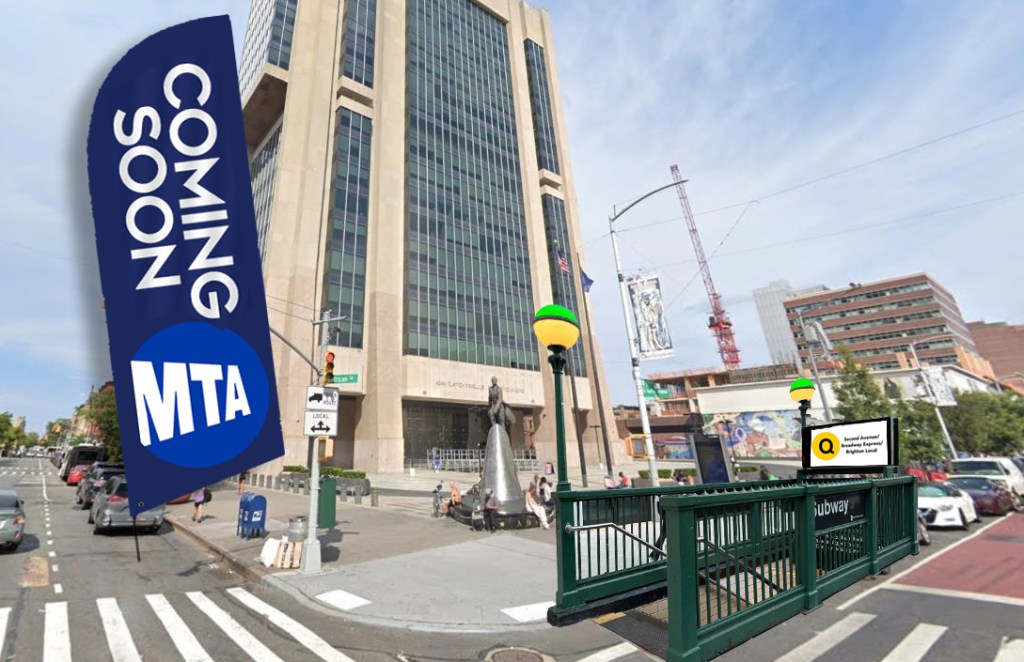
The MTA could halve the $7.7 billion price tag for the planned subway extension along 125th Street — but only if its leaders have the will to use “cut-and-cover” techniques to build shallower and smaller stations more in line with peer cities, according to a group of transit advocates and academics.
“Cut-and-cover,” which involves ripping up the street to build a subway tunnel just beneath it and then covering it all back up, could combine with other strategies for building smaller stations to save the agency billions of dollars on the westward phase of the Second Avenue Subway, and lay the groundwork for more savings in the future, the Effective Transit Alliance argued in a report released on Wednesday.
“We’re very, very early in this project, where there is still time to change this,” said ETA Executive Director Blair Lorenzo. “That’s going to change very quickly if it keeps going as fast as it has. But the longer you wait to fix it, the more expensive it gets to fix. The sooner you make these changes, the better off you are and the more money you can save.”
Lorenzo’s group, which previously persuaded the MTA to abandon its proposed street-running segment for the planned IBX light-rail, believes that cut-and-cover constitutes the MTA’s best chance to reduce the cost of the Second Avenue Subway’s expansion to West Harlem. The group also thinks the agency could save even more cash by building stations with narrower subway platforms and without the extensive and duplicative non-passenger areas that characterized the first phase of the Second Avenue Subway — even if the agency eschews cut-and-cover.
But if officials do choose shallower stations and other design choices envisioned by ETA, the advocates think the MTA can build the 125th Street extension for the same $3.4 billion price tag that the Marron Institute’s “A Better Billion” transit expansion proposal put on the project.
“If, for example, the stations can be built an average of 60-70 feet deep based on the international precedents, then the cost can follow … $770 million per station and a total of $3.4 billion for SAS West in 2025 prices,” the ETA wrote in its report entitled “Digging Out of a Very Deep Hole: Saving Billions on 125th Street.”
The ETA report comes out fresh on the heels of a feasibility study for the 125th Street subway, and as MTA speeds towards design and environmental review of the project. The group hopes that sounding the alarm early on could help knock down the construction cost for the project before things get too far down the tracks.
In January, Gov. Hochul announced that the MTA was starting design and engineering on a westward expansion of the Q train to begin construction once its planned northern terminal at 125th Street and Lexington Avenue, where it will connect to the 4, 5 and 6 trains. The proposed 125th Street extension of the Second Avenue subway would bring three new Q train stops to 125th Street, allowing riders to transfer to the 2 and 3 trains at Lenox Avenue and the A, C, B and D trains at St. Nicholas Avenue and 1 train at Broadway, greatly opening up transit connections to and from Harlem.
But transit advocates question the cost of the project even as they cheer the decision to expand the subway west, noting that spending $7.7 billion for three subway stations was a huge sum of money — even for a project that will serve an estimated 163,900 daily riders per year.
“The city and region have massive transit needs, from the installation of elevators to commuter rail electrification to subway extensions to underserved areas and more,” the ETA said in its report. “But if New York cannot build a mile of subway and three stations for less than $7.7 billion, then there is no way the city will ever be able to meet all of its transit needs.”
According to the transit costs watchdogs, the MTA could find its biggest potential savings in reversing its decision to bore the three stations deep underground, below even the existing subway stations it will connect to.
Indeed, the feasibility study for the 125th Street extension suggested the MTA build stations as deep as 130 feet underground, to avoid utility relocation expenses, fights over street-level impacts and because the new tunnel will pass by active subway stations.
This will hurt the project in two ways: Building so deep will make the new train line much more expensive, based on research by the Transit Costs Project that found every additional foot underground raises the costs of a tunnel; and such extreme depth could hamper ridership on the line in the future when it opens, simply because it will take so long to navigate to and from the platform.
The MTA’s own study on the western extension found that the riders would need five additional minutes to reach the surface after disembarking from the proposed stations. The stations could wind up so deep that they actually discourage people from taking the train.
“If you’re trying to make a connection between Saint Nicholas Avenue and the Lexington Avenue line, if you’re going from Inwood to somewhere in the in the East Bronx — that’s really difficult to do now,” Lorenzo said. “These lines should allow it. But if you’re adding ten minutes, five minutes to go down and make a transfer and another five minutes to come back up to each direction of a trip, that’s a long time for not being on a train.”
With that in mind, the report forcefully argued that the MTA should embrace cut-and-cover construction on 125th Street. This comes with its own challenges, some of which are political: working with ConEd to relocate utility lines; coordinating with the city to manage traffic; managing complaints from businesses and residents about a ripped up crosstown street.
Deeper construction is in theory a way around things like noise impacts and complaints about construction pits, but Lorenzo noted that any kind of visible construction draws complaints from residents.
“If you look at what happened on Second Avenue, they built these very deep, expensive stations with the exact idea that it would lower complaints. But people had very similar complaints,” Lorenzo said. “It’s kind of difficult to tell if you’re not a construction expert, is this an access pit or a staging area, or is this actually a cut and cover pit? So is it better to have comparatively smaller staging areas and pits on the street for a few years? Or is it better to have a few months and a year of significant construction activity, and then everything is back to normal?”
Other issues are more tied up in the physics of digging closer to the surface, like dealing with softer ground closer to the water table that makes it more difficult to shore up tunnels and stations, and working closer to active subway lines that cross 125th Street.
But the ETA noted that cities around the world have figured out how to deal with soft ground and its challenges. The practice is so common in Italy, in fact, that people have taken to calling it “the Milan method.” Similarly, the report points out that China built a new train line only two feet underneath an existing subway station in less-than-ideal soft ground conditions.
“None of this is exactly cutting-edge technology, these are all standard construction techniques from across the world,” said Lorenzo. “Some of them haven’t been used by local contractors, but at the same time, a lot of the contractors that they’re going to hire and and use are have a lot of international experience, especially the consultants who are planning this.”
If the MTA learns more about these techniques now, it could help subway expansions down the line, Lorenzo said.
“This could be a good time to consider bringing in some international consultants to help train local contractors and help give them the expertise in doing this,” she said. “The problem is not just that this project ends up costing so much more than it should cost. It’s, what does that mean for the next project and the project after that? You need to start to learn how to do things better and to do things at a reasonable price if New York is going to build the subway system it needs in the future.”
Beyond bringing the stations up closer to the surface, the ETA report also noted that the agency has other ways to improve on the problem of overbuilt stations. During the first phase of the Second Avenue Subway, the MTA caught flack for building stations up to more than twice as long as the actual platforms themselves, so that the agency could build out non-public areas like break rooms and storage areas. Even worse, individual departments inside New York City Transit received separate non-public back of house areas, which made the stations even larger and more expensive.
The second phase of the long-delayed Second Avenue Subway — which will bring the Q train from 96th Street to 125th Street — will feature smaller stations, but the ETA report said these are still overbuilt when compared to their international peers.
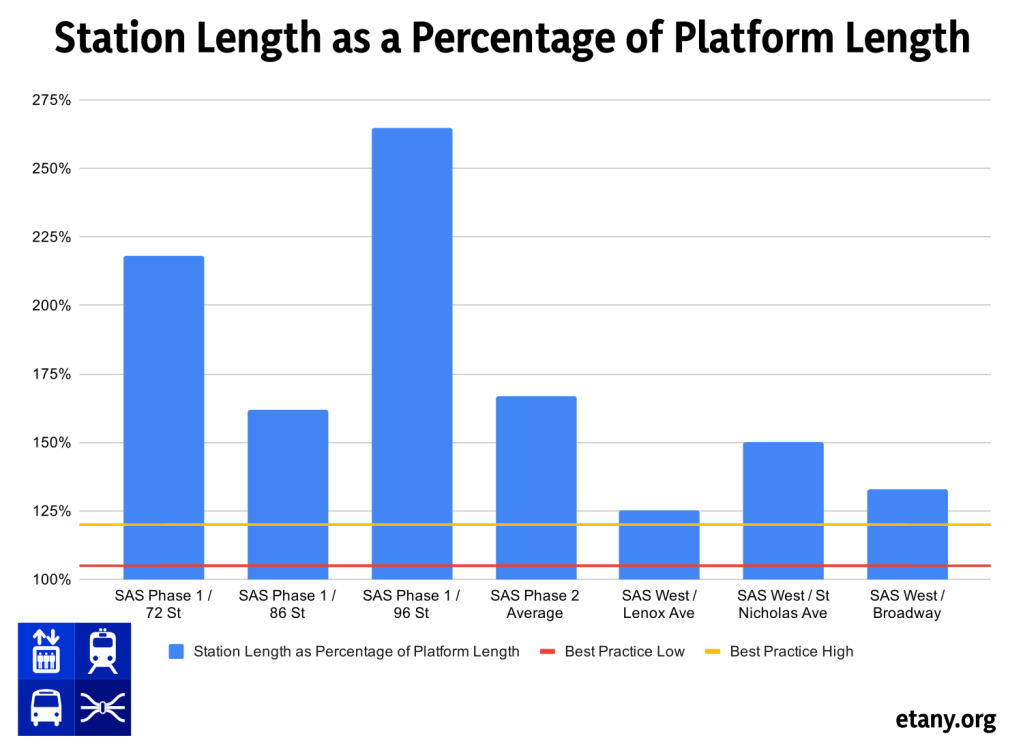
The ETA report acknowledged that the “Q-West” 125th Street stations come in smaller than the Phase Two’s. Still, the group urged the MTA to build even smaller in order to match international standards, and to design the smaller stations earlier on. The MTA redesigned the stations for Phase 2 of the Second Avenue subway after preliminary engineering, and will be able to save money in construction costs thanks to their smaller size. But the ETA emphasized that altering stations after the design and engineering phases costs money the MTA would have saved if the agency had planned for smaller stations from the very start.
Similarly, the report harped on the need for the agency to resist building the station widths to the size that the feasibility study suggested. That study suggested the agency build 75-foot wide station boxes, which are larger even than the 63-foot wide Lexington Avenue/125th Street Q station planned for Phase Two of the Second Avenue subway. That would require much more excavation work and drive up the price tag for no apparent reason.
“I really don’t know what they’re thinking with the width,” said Lorenzo. “We’ve all been to Second Avenue. Those stations are very big, they handle lots of people. They can handle a lot more people very well. There really doesn’t seem to be a call for this.”
The transit group also noted that the project’s “soft costs” — which include design costs, legal costs, other non-construction costs and a federally mandated “contingency fee” that transit agencies must hold in reserve for any cost overruns — currently account for 43 percent of the projected cost, more than twice as much as Phase One of the Second Avenue line.
The MTA could save billions before tunneling even starts, if it manages to lower its design costs and its contingency fee, which the federal government set at 40 percent of the total cost for this project.
A spokesperson for the MTA said the agency will hear out anyone who has ideas for more effective capital project delivery.
“We will explore all options to deliver this project better, faster and more cost-effectively,” said the rep, Michael Cortez.
MTA officials also stressed that the feasibility report from AECOM was not a bible or a final design for the crosstown subway, and characterized some of its assumptions as trying to answer basic questions of whether the 125th Street line could be built in quick succession after Phase Two of the Second Avenue line.
With the study calling the work feasible, if expensive, MTA leaders said the agency’s engineers are trying to design down the cost before moving forward.
The agency has also found some success recently coming in both under-budget and faster than scheduled on a stretch of a Metro-North Park Avenue viaduct repair the agency recently did in Harlem, which MTA Chairman and CEO Janno Lieber has credited to a new-to-New York construction method that was suggested by the contractor who worked on the project.
Rather than ruling out something like cut-and-cover entirely, or mandating a specific station size, MTA officials said they are focused on hearing from potential contractors about how to best build the stations along a line that could accommodate close to 200,000 riders per day.
“I think part of the success of [Construction and Development] has been stripping away being prescriptive,” said Sean Fitzpatrick, the deputy chief of staff at MTA Construction and Development. “So what are the things we actually need to require, what are the safety code things that need to happen? And what are the things that are our opinion about how we think they should be done? And the more we can strip out that last piece and have as simplified and streamlined a set of specifications and requirements as possible, the more it creates the space for additional creativity and cost-saving ideas.”
Timing is crucial. The good news for the project is that the agency is moving fast: It is lining up environmental review and design to ensure that, by the time the tunnel boring machines working up to 125th Street reach Lexington Avenue, they can keep heading west.
That money-saving move will at least ensure work crews can keep going without being sent home and called back to the project. The MTA could set itself up for even more and better work in the future — but only if it manages able bring down the costs of the Second Avenue Subway’s third phase by adopting cut-and-cover.
“If this is what it takes to build a subway, the problem becomes then we can’t build the subways we need elsewhere in the city,” ” said Lorenzo. “They’re projecting more than 160,000 riders. That’s great and you have a lot of wiggle room there to make it look worthwhile per rider.”
“But,” she continued, “you have a lot of places … like Utica Avenue and Nostrand Avenue, that you know aren’t going to get that level of ridership but certainly get enough ridership to deserve a subway. And if you’re not learning these techniques, if you’re not building them right, you’re not going to be able to build those.”

Read More:
Streetsblog has migrated to a new comment system. New commenters can register directly in the comments section of any article. Returning commenters: your previous comments and display name have been preserved, but you'll need to reclaim your account by clicking "Forgot your password?" on the sign-in form, entering your email, and following the verification link to set a new password — this is required because passwords could not be carried over during the migration. For questions, contact tips@streetsblog.org.