Hochul Budget Deal Gives $175M Speed Boost To 125th St. Subway Expansion
Push it real good.
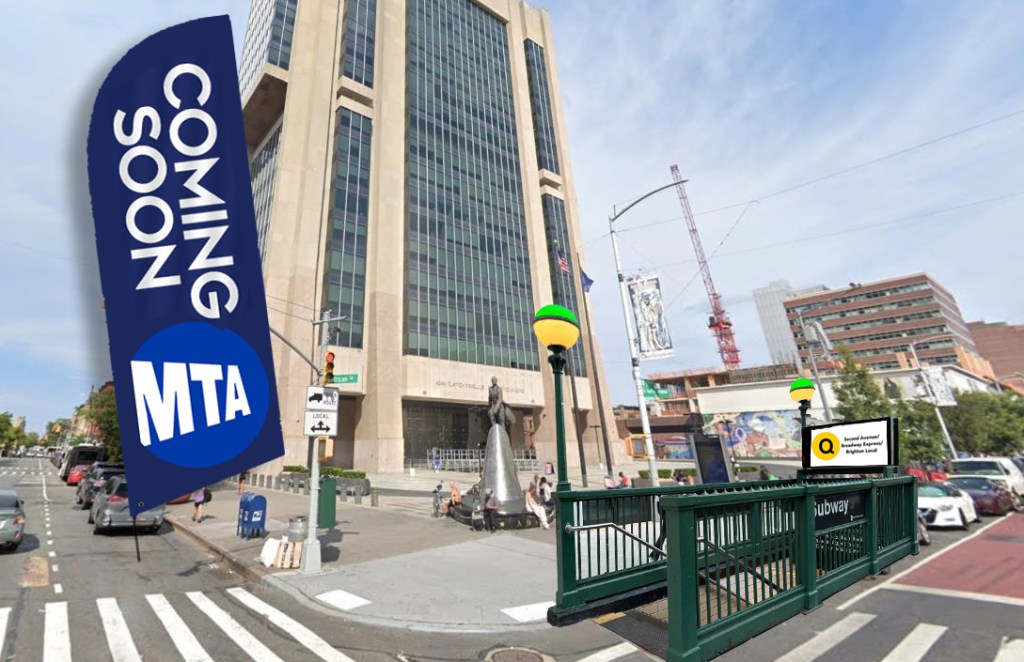
The budget passed last week by Gov. Hochul and state lawmakers contains one-off language that transit officials hope will save the MTA money and speed up the extension of the Second Avenue subway west across 125th Street.
The legislation allows the MTA to conduct the $7.7-billion project’s state-required environmental review in segments — first for just the crosstown tunnel, then for the tracks and stations — rather than one single review for the entire project.
The practice, known as segmenting, will let the MTA keep the tunnel boring machines currently digging out the Second Avenue subway up to Malcolm X Boulevard and 125th Street to then dig the crosstown extension west to Broadway, known as the Q West extension.
The MTA also got $25 million to advance the early design work and engineering on the tunnel while the environmental review is ongoing, all part of what the governor said is a push to keep momentum on the project going at full speed.
“Expanding the Second Avenue Subway even further across 125th Street is an extraordinary opportunity, and I am not going to waste any time advancing this project,” said Gov. Hochul. “By securing funding to design the tunnel and accelerating environmental review, we have set the MTA up to deliver this project as soon as possible and save hundreds of millions of dollars in potential project costs.”
Allowing the MTA to do its crosstown tunneling work regardless of the status of the rest of the project is a move that the consultants at AECOM said should save money. An MTA official recently pinned the potential cost savings at $175 million or more.
“There’s a big advantage to moving as quickly as you can and in the ability to overlap this with the Second Avenue Phase Two contract,” said Sean Fitzpatrick, the deputy chief of staff at MTA Construction and Development. “It puts it years ahead of where we would otherwise be.”
That feasibility study looked at a few different ideas for tunneling across the city, but outside observers said simply reusing the machines the MTA already has in the ground was always the most reasonable choice.
“The feasibility study proposed several different runs of the TBM, which were all insane cockamamie ideas, except the one where it just continues,” said Eric Goldwyn, a researcher with NYU’s Transit Costs Project. “The only thing that makes sense is the tunnel boring machines go into the ground, start tunneling north and west and then you just continue going west.”
MTA officials will have to do the same level of environmental analysis as before, but in segments, according to the legislative tweak to the State Environmental Quality Review Act — which applies exclusively to the 125th Street project.
Goldwyn said the SEQRA change could be “everything” needed to make the project “viable” if it succeeds in allowing the MTA to keep tunneling uninterrupted.
MTA officials are confident they can hit the schedule necessary to take advantage of the boring machines, which they expect to reach the terminus of its current phase in the third quarter of end of 2028.
In addition to saving money by not having to restart a huge machine or rehire a team to run that machine, the quicker timeline for environmental review and design will save time, another crucial factor in keeping costs down.
“I think it’s a very conservative estimate,” Fitzpatrick said of the $175 million expected savings. “What that doesn’t factor in is the potential of having a crew that’s already experienced and already firing on all cylinders. It’s a hugely beneficial thing that has the potential to make that number even more significant.”
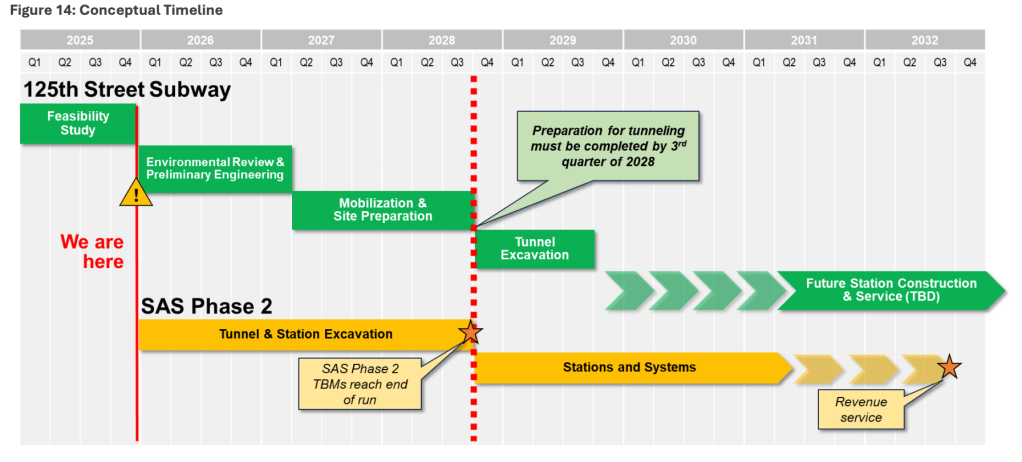
Officials expect to have the environmental review and preliminary design of the tunnel finished by halfway though 2027, Elisa Van Der Linde, the agency’s director of alternatives analysis and environmental reviews, told MTA board members in April.
With future federal funding an open question, the MTA will have keep finding ways to knock money off the price tag of the “Q West” project.
When AECOM’s feasibility study first came out, Goldwyn and others pointed to station design and the passenger circulation as places where the agency could save cash.
“It’s not a function of hundreds of millions of dollars that need to be cut, it’s billions of dollars in order for it to seem viable,” Goldwyn said. “Maybe if there’s a change in the next election, there’ll be an opportunity, but the MTA needs to find a way to get those numbers down and to get a truly a constructible project.”
Creative problem solving has not always been a hallmark of Albany’s transit policies, but MTA executives said it’s becoming a more regular occurrence.
“This is an example of the governor and the legislature taking the minutiae of government very seriously and making a very technical tweak that allows this project to move forward,” Fitzpatrick told Streetsblog. “I think it’s a sign of the seriousness with which they’ve taken transit over the last few years, and that’s a very gratifying thing for us.”

Streetsblog has migrated to a new comment system. New commenters can register directly in the comments section of any article. Returning commenters: your previous comments and display name have been preserved, but you'll need to reclaim your account by clicking "Forgot your password?" on the sign-in form, entering your email, and following the verification link to set a new password — this is required because passwords could not be carried over during the migration. For questions, contact tips@streetsblog.org.