Brooklyn Pol Calls for Fewer Trucks After Her Bill Inadvertently Expanded Truck Routes
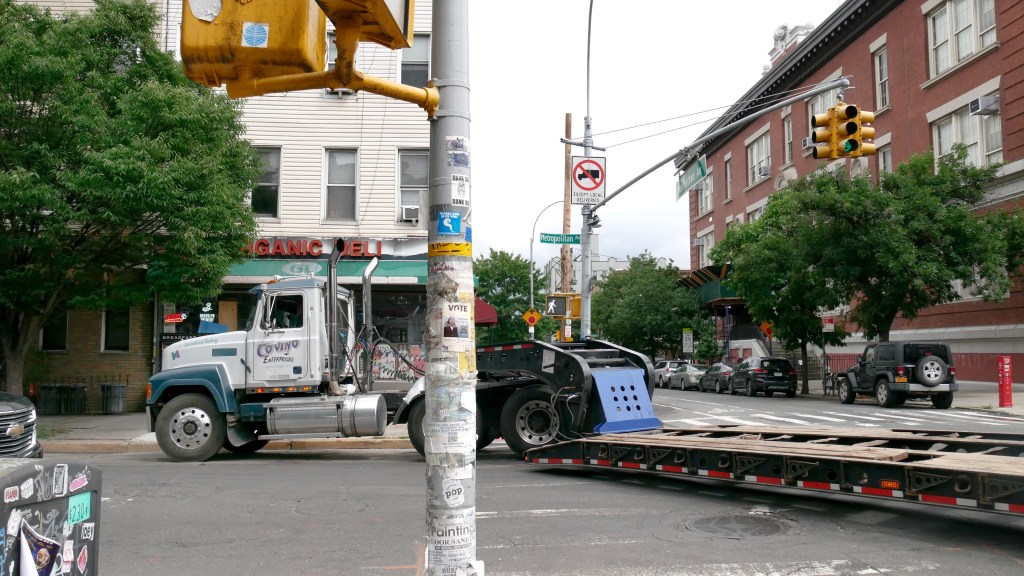
Mayor Mamdani must reduce truck traffic and enforce rules banning big rig haulers on most streets as his administration moves forward with a plan to add new truck routes, according to a fellow Democratic Socialist whose bill inadvertently led to the 43-mile expansion.
“We want to see a removal of trucks from the streets,” said Council Member Alexa Avilés (D-Sunset Park), who sponsored the 2023 bill requiring the city to study and redesign the truck routes, at a rally on Monday. “[This bill] was never done with the intention of adding more [truck routes] to the network.”
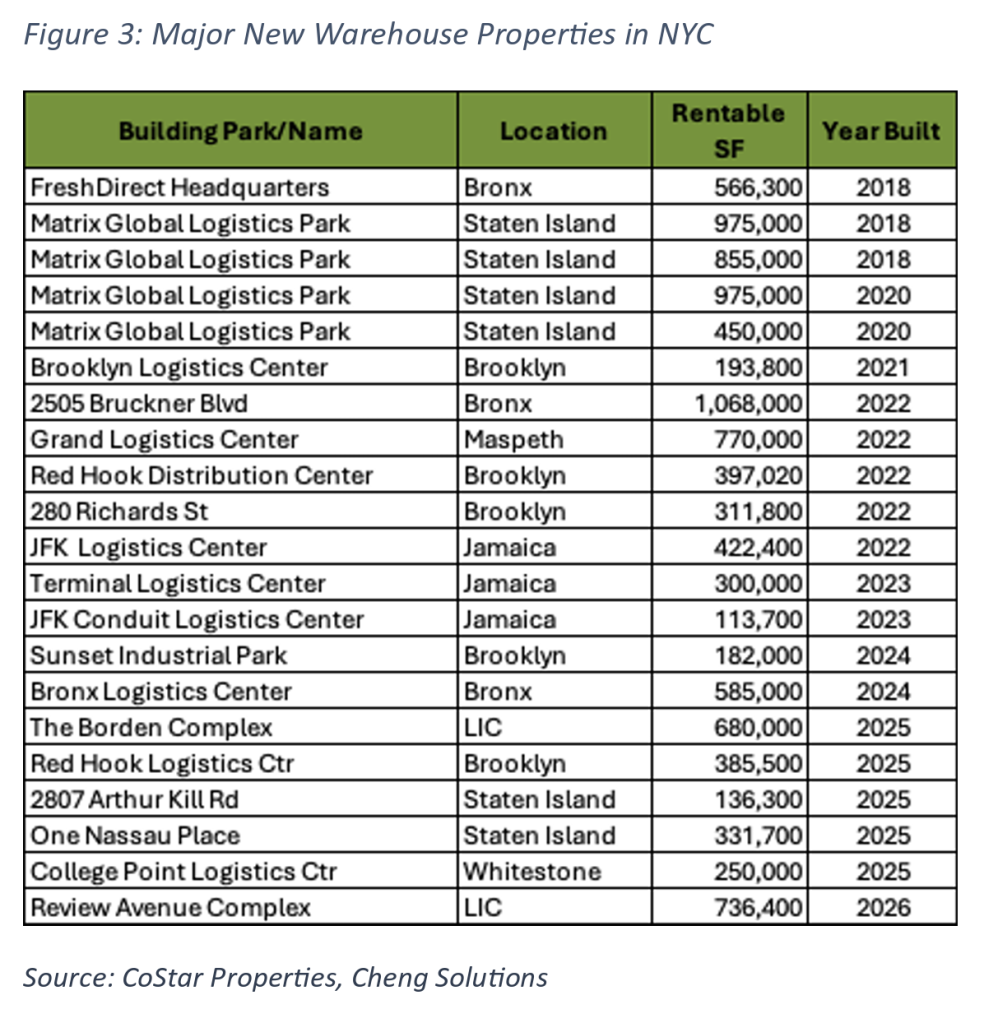
In New York City, 90 percent of goods reach their final destination by truck, while a growing number of “last-mile” warehouses feed New Yorkers’ insatiable demand for same-day and next-day delivery. Since 2018, distributors have opened 21 new warehouses in Brooklyn, Queens, the Bronx and Staten Island.
The city proposed the truck route additions last year, when it published a report that looked at the state of its freight network. On Monday, the Mamdani administration confirmed it would continue with the expansion plan and initiate the official rulemaking process for the new truck route map.
That process would add two miles of truck routes in Manhattan, four miles the Bronx, 13 miles in Brooklyn, 14 miles on Staten Island and 16 miles in Queens.
Streetsblog could not find evidence that adding or subtracting miles from the truck route map impacts total big-rig-miles-traveled, which was one of the stated goals of Avilés’s legislation. Investing in new freight systems — such as maritime blue highways, microhubs and smaller last-mile delivery vehicles — will accomplish that goal, however.
Avilés’s 2023 bill prompted the city to evaluate its freight network and redraw its truck route map for the first time since the 1970s. But the Council member now expresses skepticism that merely updating a decades-old map will magically end the city’s toxic relationship with trucks.
To Avilés’s point, New Yorkers are ordering more and more delivery. Manhattan has the highest concentration of package deliveries per square mile of any city in the U.S., and the five boroughs receive an average of over 2.3 million packages per day — compared to 1.8 million daily deliveries before the pandemic.
The city opened its first “blue highway” route in December 2025, but still has a long way to go before maritime freight makes a dent in surface deliveries. The Department of Transportation also runs a “microhub” pilot, which designates centralized delivery hubs for larger vehicles to distribute parcels to workers on cargo bikes, who will then deliver to residential neighborhoods. The hubs have had limited success; last summer, Streetsblog documented UPS workers ignoring a hub their employer paid for.
“There’s a basket of different types of interventions,” said Travis Fried, a research engineer at University of Washington’s Urban Freight Lab. “[They] range from things that private companies can do, things that local and state policy can do, to things that consumers ourselves can do.”
The international perspective
Fried, who studies equity in freight systems, said not to knock the city too much. Within the U.S., New York has served as a testing ground for a lot of freight-related innovations, even if the maps haven’t evolved since the 1970s.
“From the U.S. perspective, I think New York has been really innovative in terms of the programs and projects,” said Fried. “Not just regulating the trucks, but considering other and alternative modes of transportation, from cargo bike micro hubs to blue highways to parcel lockers.”
New York may be leading the way in the U.S., but European cities have taken bolder steps to manage freight and change the age-old dynamic of polluting warehouses in poorer, peripheral neighborhoods bringing goods into richer city centers.
In 2020, Paris began building e-commerce “hôtels logistiques” in neighborhoods without industrial zoning. Merchants use trains and trucks to move parcels from logistics centers outside of the city to these facilities. The city subsidizes the space and requires participating delivery companies to adopt low-emission modes. Parisians can then retrieve their packages directly from the hotels or arrange for a home delivery via a smaller vehicle or cargo bike. Some of the hotels feature community amenities like tennis courts and rooftop gardens, making them a hub in more ways than one.
Barcelona maintains more than 1,300 package collection points, with 98 percent of the population living within a quarter mile of a collection point. The Spanish city taxes businesses, such as Amazon, that deliver large quantities of goods using public rights of way.
Amid the explosion of e-commerce in New York City, experts and researchers have been thinking about ways to diversify the city’s freight system for years. In a 2017 report, the Regional Plan Association argued that New York City region has not taken full advantage of its seaports and freight network — even though the Port of New York and New Jersey is the second largest in the U.S.
“Nearly all the goods imported through the seaports are carried to their final destinations by truck, despite record congestion on roads and highways,” the report said. “Freight rail could provide a more reliable and efficient alternative—a single freight railcar can eliminate four truck trips.” Little has changed since the report’s publication.
Few consequences for ignoring the routes
DOT may plan to add truck routes, but officials insist they share Avilés’s goal of removing big rigs from local streets. But in industrial business zones, which are saturated with these last-mile warehouses and truck traffic, a lot more will need to be done to realize that goal.
In its aforementioned report, DOT emphasized a central problem with the truck route system: a dramatic decline in enforcement. In 2011, cops wrote nearly 9,100 summonses to drivers who illegally deviated from designated truck routes. That number has since plummeted, hovering around 1,500 in the last five years, with a slight uptick in 2023, according to the NYPD.
The report stressed that the Department of Sustainable Delivery office — which former mayor Eric Adams initially pitched as a separate agency to regulate the delivery app industry and whose functions DOT has since absorbed — will write tickets to scofflaw truckers.
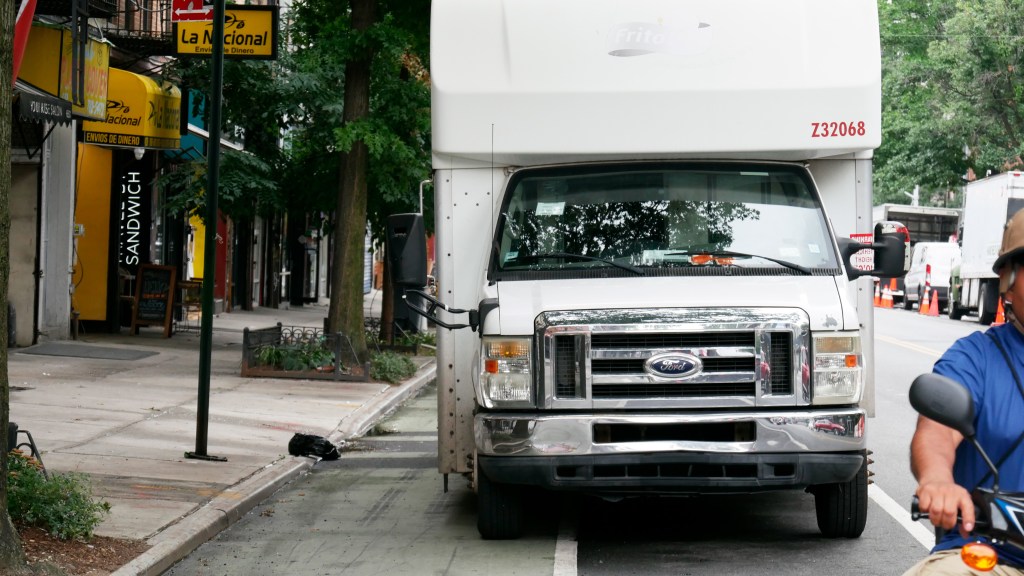
“DOT’s forthcoming DSD Division will also be able to enforce, independently of NYPD, illegal parking behavior such as parking on sidewalks and in bike lanes, which create dangerous environments for vulnerable users,” the report said.
But when Streetsblog asked DOT and the NYPD about coupling the new truck routes with better and more consistent enforcement, the two agencies did not comment further and refused to clarify the DSD Division’s exact role.
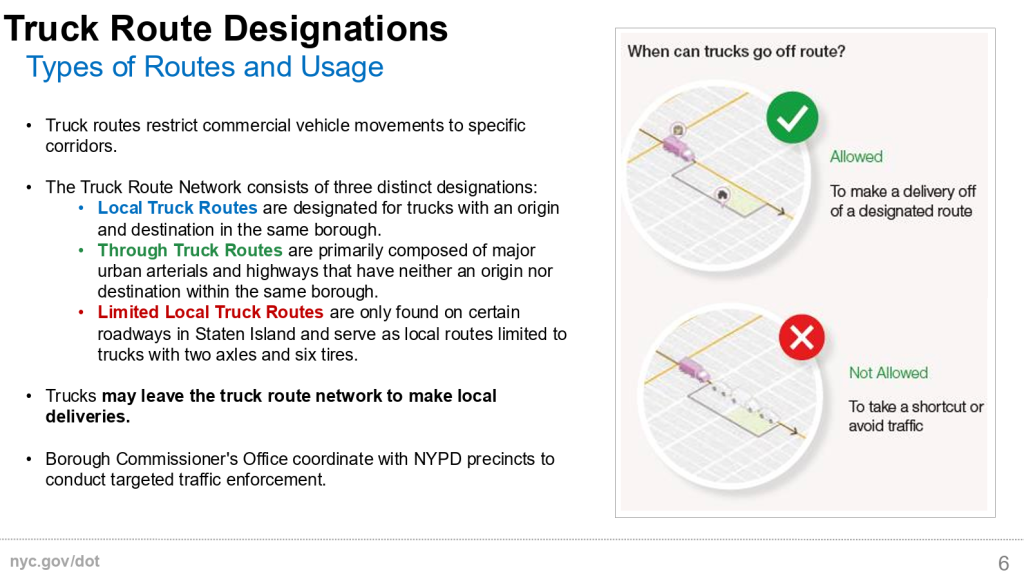
New York City’s truck route network consists of through truck routes, for trucks that are passing through the city, and local truck routes, for trucks that need to deliver goods. Enforcing these routes is tricky, since truck drivers are permitted to stray from local truck — but only to complete a delivery, and only via the shortest possible path between their destination and the nearest route.
Truckers are not allowed to leave a through or local route for any other reason, such as bypassing a traffic jam. But anecdotal reports suggest they do: In 2025, New Yorkers submitted 1,530 complaints to 311 for truck route violations.
Hell Gate profiled one New Yorker who has filed hundreds of complaints about trucks illegally turning onto Clinton Street in Manhattan after exiting the Williamsburg Bridge. The official truck route dictates that big rigs turn on the wider and less residential Allen Street.
Avilés acknowledged that enforcement is a challenge, but she stopped short of directly calling for more NYPD involvement. Instead, she wants to “make sure the city workforce is the right workforce for the job” and pointed to the potential role of automated enforcement.
“We definitely have to address it, because it is a pervasive problem across the city,” Avilés told Streetsblog. “We have to figure out how we can use tech for good, but not just surveillance tech, like how can we do things to help communities and streets?”
Enforcement would be simpler if the city made it far easier for truckers to follow the rules, Fried said.
“I would assume that, if there was the available space and infrastructure, [truckers] would choose to not get that ticket and choose to not park in the middle of the street,” he said. “I think some of it is enforcement, but some of it is infrastructure availability. Freight behaviors are a product of infrastructure conditions.”
Avilés’s law also mandated a public comment period. DOT received more than 2,000 comments from New Yorkers fed up with oversized trucks that dominate public space and endanger pedestrians and cyclists. Safety was the top concern for commenters. Almost 500 of the comments concerned “pedestrian and truck conflict.”
DOT said it would pair the new routing with fresh street redesigns and new loading zones. The department reiterated that, although the new design adds miles on paper, it intends to reduce truck traffic on local streets.
“This truck route network redesign will help reduce the overall truck miles traveled on local streets by providing more direct connections to industrial zones and shifting more trips onto highways that previously weren’t part of the network,” said DOT press secretary Vin Barone. “We look forward to implementing the new design and tying it to new street redesigns that will improve safety for everyone, as well as new loading zones to better manage New Yorkers’ home delivery needs.”
DOT had already proposed some design improvements for at least one truck route. In March, the department presented street safety upgrades to Queens Community Board 1, where it will reclassify Astoria Boulevard between 21st Street and 29th Street as a through truck route and mark 33rd Street from Hoyt Avenue South to Hoyt Avenue North as a new local truck route. The improvements will include curb extensions, potential raised crosswalks and plastic Qwik Kurb bollards.
Avilés stressed street design as a solution.
“[DOT] can’t just keep creating truck routes on residential streets,” she said. “We’ve got to look at our design of our streets, because trucks are everywhere, even the roads that they’re not supposed to be on.”


Read More:
Streetsblog has migrated to a new comment system. New commenters can register directly in the comments section of any article. Returning commenters: your previous comments and display name have been preserved, but you'll need to reclaim your account by clicking "Forgot your password?" on the sign-in form, entering your email, and following the verification link to set a new password — this is required because passwords could not be carried over during the migration. For questions, contact tips@streetsblog.org.