Sunset Park To Mamdani: Make Third Av. Safe After Adams Abandoned Deadly Corridor
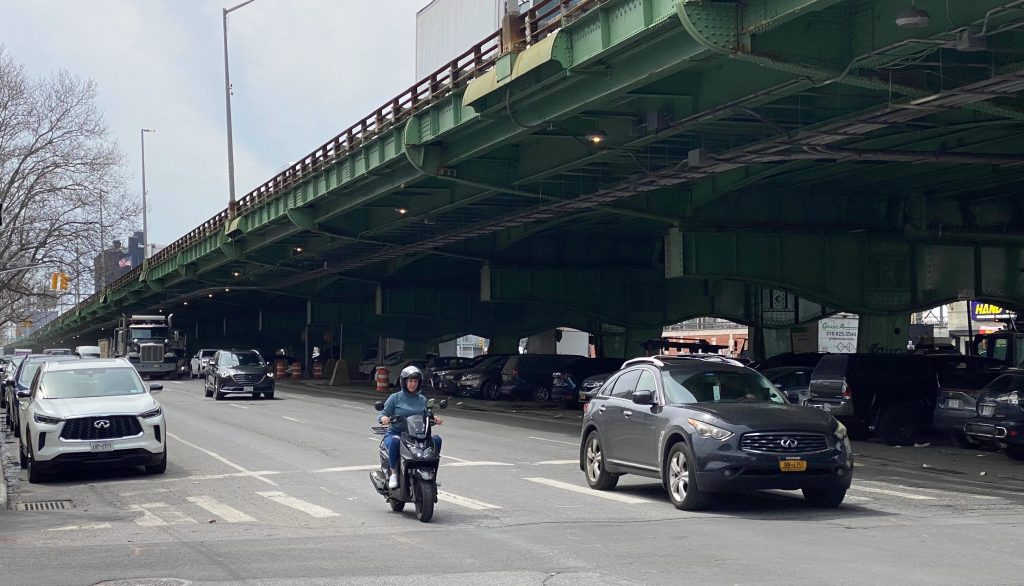
Mayor Mamdani must fulfill his campaign promise to redesign dangerous Third Avenue in Sunset Park, one of many street safety projects that former Mayor Eric Adams stalled at the behest of special interests, residents and advocates demanded on Monday.
Last year, the Department of Transportation postponed its revamp of the lethal road in western Brooklyn after business bigwigs balked. But locals are now imploring the new mayor to finally deliver a safer corridor beneath the Gowanus Expressway.
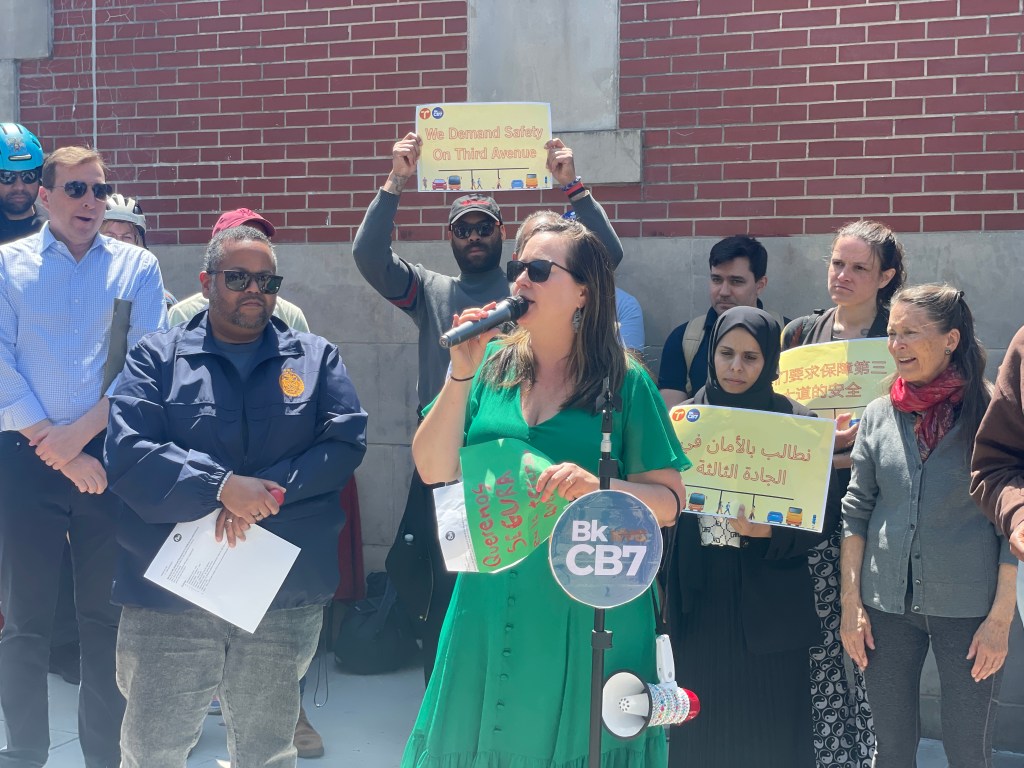
“The last administration squandered their time,” said Katie Walsh, who chairs the Transportation Committee of local Community Board 7, at a press conference. “They didn’t want to take it on, but we’re going to see this now happen under this administration.”
Politicians and longtime bike lane boosters gathered at Third Avenue and 23rd Street on Monday to celebrate the opening of a separate project that recently created a raised two-way bike path on the west side of Third Avenue between Hamilton Avenue to 29th Street. However, that project did not remove any lanes of traffic or car storage.
The raised bike lane dates back to the Bloomberg administration. Hunter Armstrong, the executive director of the Brooklyn Greenway Initiative, said the city should not wait another decade-plus to extend hardened cycling infrastructure along Third Avenue.
“Let’s not wait another 12 years or 14 years for this to happen,” he said. “Let’s keep pushing for this to move more move more quickly so we have safety, so we have clean and healthy ways to get through Brooklyn, and through Sunset Park, and to Red Hook, and across New York City.”
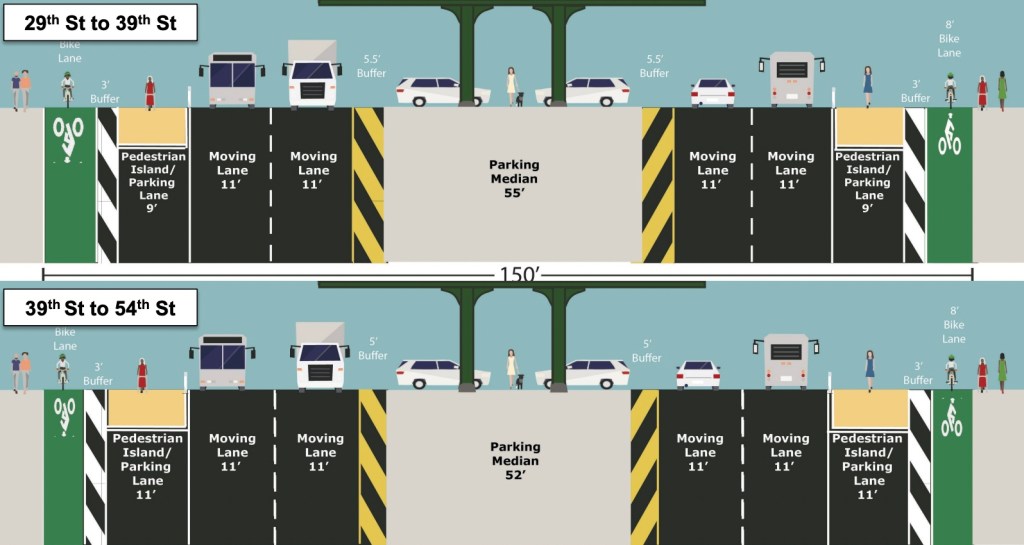
In late 2023, DOT unveiled an ambitious vision to overhaul more than 40 blocks of Third Avenue between Prospect Avenue and 62nd Street. One of the department’s proposed options would have replaced a lane of traffic in each direction with a parking-protected bike lane.
Furthermore, the project would have shortened crossing distances for pedestrians, who currently must traverse eight lanes dedicated to the movement and storage of cars — while passing underneath the exceptionally noisy Moses-era expressway, which has another seven lanes. For those counting, that’s a total of 15 lanes of private motor vehicles.
CB7 endorsed a road diet and protected bike lane in early 2024, and city officials said they could implement it as soon as that summer. But opposition from groups like the Brooklyn Chamber of Commerce and the Southwest Brooklyn Industrial Development Corporation repeatedly delayed the project’s timeline, most recently until sometime this year.
Safety upgrades along the avenue are long overdue: More than 80 people died or received serious injuries in crashes over the past seven years, according to the advocacy group Transportation Alternatives. That averages out to a life-altering crash every single month.
Those deaths include 30-year-old cyclist Em Samolewicz, whom a driver struck in 2019, and Clara Kang, 31 who was also riding her bike when a motorcycle rider slammed into her in 2020. After Adams stalled the project last summer, a speeding driver blew through a red light and killed two men crossing the dangerous roadway — two deaths that advocates said said were preventable.
“This is a street where children walk back and forth every day to get to and from school,” said Rose Uscianowski, a Brooklyn organizer for Transportation Alternatives. “How can you allow Third Avenue to continue looking the way it does?”
Brooklyn Chamber leader Randy Peers – who also fought against a safety redesign on McGuinness Boulevard – personally showed up to dress down community board members two years ago after they backed the plan he slammed as the “most disruptive and radical option.” The business group then bolstered its opposition by circulating a biased web survey that listed evidence-free concerns that the overhaul would worsen business operations.
However, empirical research has shown time and again that bike lanes are good for businesses’ bottom line — while owners routinely oppose them because they drive themselves to work. Road diets have reduced the number of people killed and seriously injured by around 30 percent, according to DOT.
DOT launched a near-identical redesign in 2012 on nearby Fourth Avenue, and pedestrian injuries dropped by as much as 61 percent, according to city data.
Before becoming mayor, Adams had claimed that addressing the safety issues on Third Avenue was “at the top of our list.” After he won, however, he caved to the business interests — forming a larger pattern of outside groups interfering in street redesign work that eventually resulted in federal bribery indictments against his closest closest aide and two soundstage moguls over a separate bike lane project on McGuinness Boulevard in Greenpoint.
On the campaign trail, Mamdani vowed to finish the slate of street redesigns stalled by Adams, and he has relaunched some of those, including McGuinness Boulevard, Flatbush Avenue, 31st Street, Ashland Place, and a Fordham Road bus lane.
But the new mayor has yet to announce plans for Third Avenue, or for another contested project that would restore three blocks of protected bike lanes on Bedford Avenue in Williamsburg. Adams ripped those out to curry favor with Hasidic leaders in the area that opposed them.
DOT spokesman Vin Barone promised “more information to share soon” on Third Avenue. He also touted the agency’s completion of a protected bike lane on Court Street from Schermerhorn Street to Hamilton Avenue, a precursor to more work in Red Hook that will connect Court Street to the portion of the Brooklyn Waterfront Greenway that the city is finishing along Hamilton and Third avenues.

Read More:
Streetsblog has migrated to a new comment system. New commenters can register directly in the comments section of any article. Returning commenters: your previous comments and display name have been preserved, but you'll need to reclaim your account by clicking "Forgot your password?" on the sign-in form, entering your email, and following the verification link to set a new password — this is required because passwords could not be carried over during the migration. For questions, contact tips@streetsblog.org.