Hochul’s Insurance Push Follows Uber’s National Playbook — As The Company Spends Big on Her Re-Election
Gov. Hochul’s re-election campaign is raking in cash from Uber as she follows the tech giant’s nationwide playbook to erode the rights of car crash victims one state at a time.
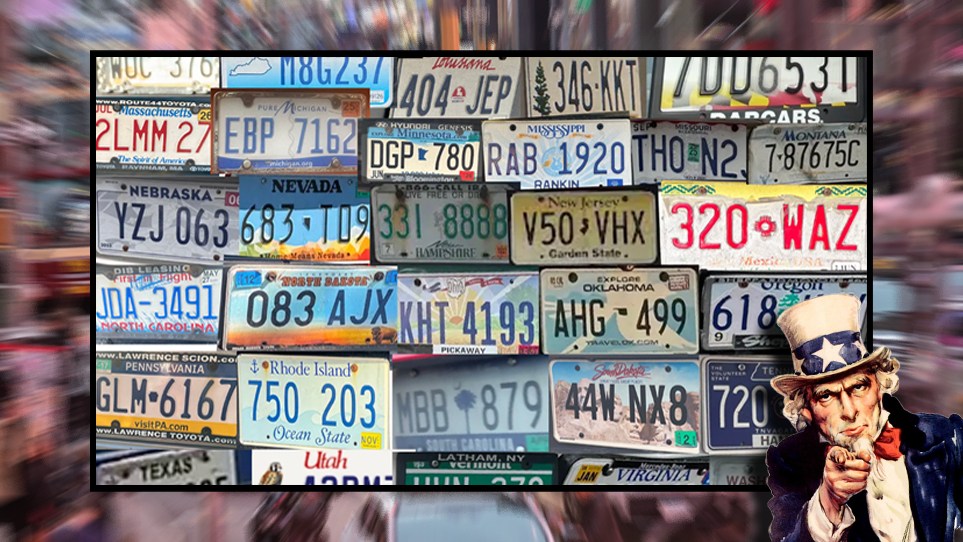
New Yorkers are just the latest target of a multi-state effort by Uber to diminish the amount of money crash victims can recover when they do go to court, the Lever previously reported. The company is flooding politicians across the country with cash and “affordability” talking points to sell policy changes that will boost its profits by making it harder for people injured and maimed by its drivers to sue the company for damages.
“I’ve seen a lot of companies – I’ve been doing this for 35 years – and this is as greedy a company as there is,” Jamie Court, the president and chairman of Consumer Watchdog, a California-based consumer advocacy organization, told Streetsblog. “This is a company that’s zealously pursuing a radical rewriting of the motor vehicle laws.”
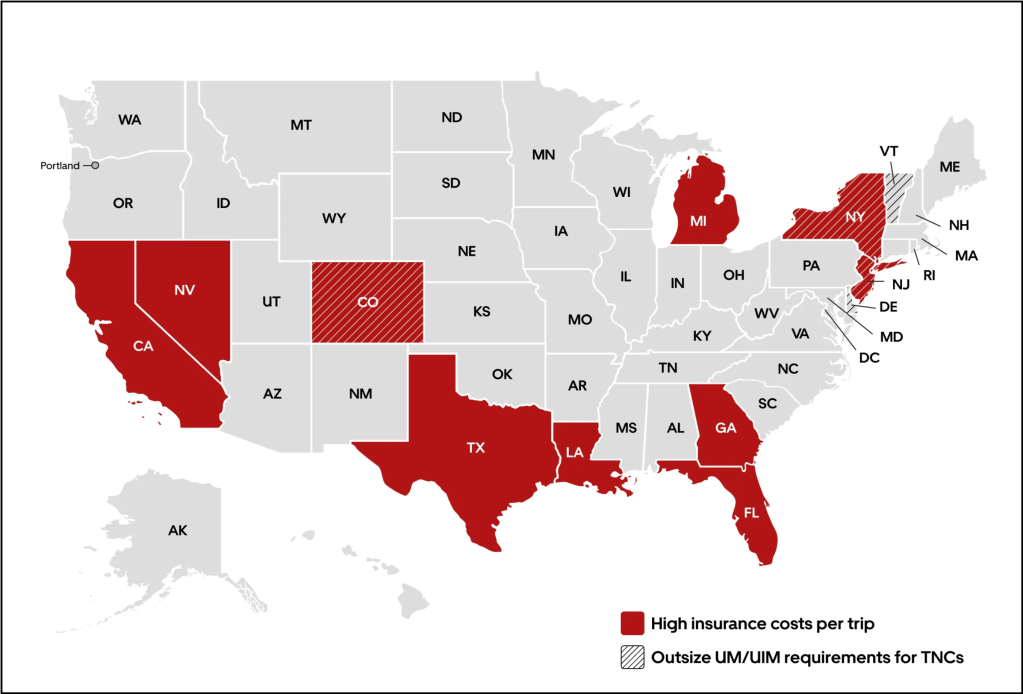
Uber is dropping big bucks to back laws in several states that would make it harder for crash victims to sue, or otherwise shield it from accountability. In California, Uber wants to cap attorneys fees following a similar, albeit unsuccessful, bid in Nevada. The governors of Florida and Louisiana signed laws in recent years year cutting compensation for people found over 50 percent at fault for crashes. Another bill in Indiana would have protected ride share companies from liability lawsuits.
And in New York, Uber has spent more than $8 million this year alone in support of Gov. Hochul’s proposal that would also dismantle many people’s ability to recover damages for their pain and suffering above the minimum $50,000 no-fault insurance coverage.
Like her Republican counterparts in the Sun Belt, Hochul wants to disqualify compensation for people found by a jury to be more than 51 percent at fault in a crash. She also wants to narrow the state’s definition of serious injury and limit damages for the uninsured and people under the influence of drugs or alcohol or caught committing a felony at the time of the crash.
Uber acknowledges it is “leading advocacy efforts across the country,” while urging customers to “get involved” in states where it claims “unfair” insurance regulations drive up costs for its riders and contracted drivers alike. But Uber’s approach to “tort reform” is familiar — it’s a playbook used by Big Tobacco, oil companies, auto manufacturers and Big Pharma to alter laws to carve themselves out from liability when their products cause harm.
Companies routinely set up of support groups with “consumer-friendly” names like Citizens Against Lawsuit Abuse, a tobacco industry front back in the 1990s, according to a review by the Center for Justice & Democracy, a national consumer organization at the New York Law School. Uber’s group of choice in New York is called Citizens for Affordable Rates, or CAR.
“They’re following a playbook that is decades old,” said Joanne Doroshow, the executive director of the Center For Justice & Democracy at New York Law School. “Large corporations and industries hide behind front groups in order to pressure mostly state lawmakers to make it more difficult for people to sue or to reduce compensation to victims, which also makes it more difficult for them to find attorneys to take their case.”
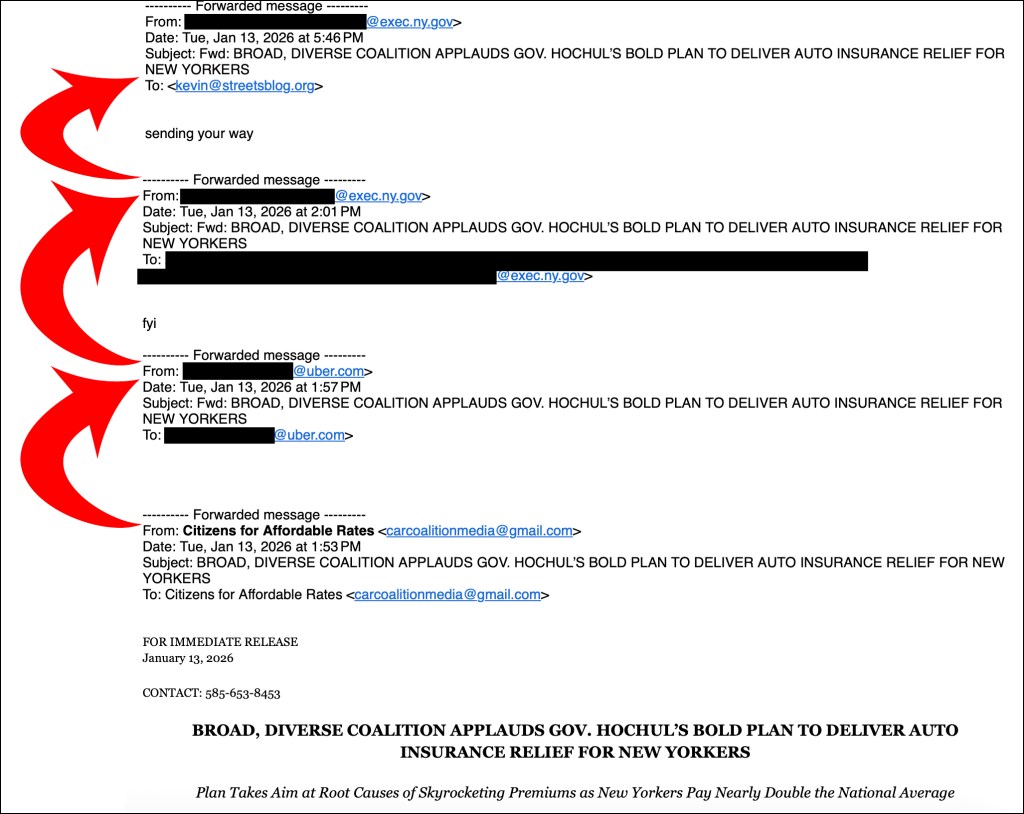
Hochul has taken up Uber’s cause quite literally. In January, her press officer actually forwarded CAR talking points, with an Uber spokesperson on the original email thread, to Streetsblog in defense of her proposals. Hochul has since spent outsized resources to promote the push, which she disingenuously frames in terms of affordability.
Coast-to-coast
The governor says her car insurance reduction push is being waged on behalf of everyday New Yorkers, including those she meets in diners, but her talking points and proposals mimic Uber’s nationwide efforts.
The governor cites supposed success stories in other states like Florida. However, the effects of those changes are mixed, according to independent local reports. And it’s not even clear whether Hochul’s moves will deliver savings. The governor has claimed that fraud and staged crashes are out of control, yet Streetsblog has found that Hochul and her surrogates have blown the issue way out of proportion by focusing on reported instances of fraud, not the vanishingly rare confirmed cases.
Safe street advocates and crash victims have slammed the campaign as “slopulism” that does little to hold insurers accountable via state regulators, or addresses the key reason for rising costs: chronic car dependence and the state’s nearly 400,000 annual car crashes.
Let’s start in California, Uber’s home state, where voters will weigh in this year on a batch of competing ride-share-adjacent ballot proposals — including one to cap attorneys fees and make it harder for vehicle crash victims to recover damages for medical expenses. Uber has dropped at least $32.5 million in support of the measure, including $1 million for a Super Bowl ad. The Golden State group’s messaging targets “billboard lawyers” — as Hochul and MTA Chairman Janno Lieber have done in New York. (It’s worth noting that the MTA’s buses and subways are covered with ads from the same lawyers that Lieber mocks.)
Uber also backed a controversial law change in the Golden State last year to drop the amount of damage coverage required of drivers from $300,000 to $60,000 in exchange for bowing to a campaign to give ride-share drivers collective bargaining rights.
Florida Gov. Ron DeSantis signed changes to the Sunshine State’s insurance laws in 2023. DeSantis’s efforts focused on home insurance costs, but also affected auto insurance. The revisions cut compensation for people found to be more than 50 percent at fault for a crash, shortened timelines for people to file personal injury lawsuits, and made it harder for people to hold insurers accountable for denying claims in bad faith.
Much like Hochul, DeSantis blamed frivolous lawsuits for driving up costs, calling the Sunshine State a “litigation hellhole,” while his chief financial officer said the changes “cut out the waste, fraud and abuse.” The former Republican presidential candidate promised double-digit percentage decreases in a recent press release that cited praise from Uber.
Florida’s top five insurers said they will lower their rates by an average of 8 percent this year, according to its insurance commissioner. Progressive began giving out rebates of $300, but that was because their profits exceeded state thresholds that already required them to reimburse policyholders.
It’s unclear whether those checks will be a one-time event or if costs will continue to go down for Floridians, which is one of the most dangerous driving states. Insurers’ increased profits came from “lower-than-anticipated costs for losses” for “certain types of personal auto claims” and due to a lack of hurricanes in Florida last year — not necessarily from the reforms, the Miami Herald noted.
“It’s too soon to tell whether these changes will have long-lasting impact,” the paper reported.
For example, home insurance rates actually increased again in some cases after the reforms, the South Florida Sun Sentinel reported.
Florida personal injury attorneys have also warned, as have their colleagues in New York, that they will start rejecting cases because they won’t be paid if a jury finds their client to be more than 51 percent at fault. Another Uber-backed bill in Tallahassee would cut liability requirements for for-hire drivers between accepting a trip and picking up a rider.
In Louisiana, another state with relatively high insurance costs, Gov. Jeff Landry signed a package of laws last year that barred recovery for plaintiffs found to be more than 50 percent at fault for a crash, while also adding cruel measures like barring undocumented immigrants from being compensated for their injuries. The measures aimed to tackle the “skyrocketing insurance costs and frivolous lawsuits.” Uber tagged Louisiana as one of its “biggest winners” for the changes.
Meanwhile, a bill in Indiana, backed by another Astroturf group called the Indiana Alliance for Legal Reform, proposed to shield businesses like Uber and Lyft from liability lawsuits. Lawmakers ended up cutting those portions.
In Nevada, Uber spent $5 million on a ballot initiative capping attorneys fees, which opponents also argued would make it harder for victims to find legal representation, but the state’s Supreme Court blocked the proposal.
Limiting liability — to mixed results
Michigan was among the earliest states to make changes to its insurance framework in recent years, and its results have been mixed. In 2019, the Wolverine State passed reforms that led to an average overall savings of $357 per vehicle, or 18.8 percent, according to an independent report.
But that was largely driven by repealing its unique “unlimited” no-fault insurance, which covered any “reasonable charges incurred for reasonably necessary products, services, and accommodations for an injured person’s care, recovery, or rehabilitation.”
The study did note likely losses for crash victims, and admitted that it did not include rising out-of-pocket health insurance expenses in its calculations due to “limitations, contingencies and uncertainties involved.”
“The reform reduced the amount paid to providers who care for auto accident victims, which may have initially impacted access to care experienced by some auto accident victims — particularly more severely injured auto accident victims requiring attendant care services,” the report author’s wrote.
It is unclear if Uber lobbied for the measure, but the company’s blog post about state regulations did deride Michigan’s system for inviting “litigation abuse, where a cottage of trial attorneys target [transportation network companies].”
What’s Uber’s game?
Uber’s efforts to reduce its liability come as the company faces increased risks of lawsuits while it expands its business that puts more drivers on the road.
Uber also faces a thousands of sexual misconduct lawsuits after a federal judge earlier this year found it liable for a sexual assault case by one of its drivers, part of an an epidemic of cases against both its drivers and its passengers.
The company wants to save on expenses it has to set aside to investigate claims against its motorists, and costs of hiring attorneys to go through court battles, according to its reporting with the Securities Exchange Commission.
“Even if these claims do not result in liability, we will incur significant costs in investigating and defending against them. As we expand our products and offerings, this insurance risk will grow,” Uber wrote in its most recent SEC filing. “We may be subject to claims of significant liability based on traffic accidents [sic], injuries, or other incidents that are claimed to have been caused by drivers who use our platform.”
The filings make no mention of “billboard lawyers,” but note that legal cases can draw “negative publicity, which could harm our business, financial condition, and operating results.”
Companies generally want to avoid trials at all costs because they can expose bad practices, said Doroshow of the Center for Justice & Democracy.
“It forces disclosure of documents into the mainstream, things that they would prefer to keep quiet,” Doroshow said. “Litigation has been critical for exposing safety problems in vehicles.”
Uber has set aside $12.5 billion in insurance reserves, according to the SEC filing, and Court said the company will spend that money elsewhere if it can cut its exposure to claims.
“They’re sitting on that money, and the minute they don’t have to and can use it they can pay for robotaxis,” Court said.
Court’s organization recently published report titled “License to Kill,” which argued that the latest California ballot proposal lays the groundwork for Uber’s $1.25-billion investment to roll out autonomous vehicles, effectively turning around on its recent agreement to let drivers unionize by making them redundant. Hochul abandoned a push to expand testing of autonomous vehicles outside of New York City in exchange for more support behind her auto insurance proposal, the Times reported, while self-driving car company Waymo’s permit to test them in New York City just expired.
“They want to roll out their robotaxi fleet really quickly,” Court said. “One of the quickest way to roll it out is to not have liability when they hit someone or kill someone. It’s kind of an evil genius thing.”
Uber spokesperson Josh Gold said that the company continues to have “at least” $1 million in liability insurance on every trip in the United States, adding that is “considerably more than almost every other vehicle on the road, and we’re not advocating to reduce or remove that.”
A rep for Hochul maintained that the governor was working on behalf of New Yorkers, while claiming that issues with the state’s insurance regulations are endangering people on the roads.
“New York’s broken car insurance system makes our roads less safe and causes premiums to skyrocket for millions of hardworking New Yorkers,” Sean Butler said in a statement. “This system desperately needs reforms, and Gov. Hochul’s proposal will bring real relief to New Yorkers who play by the rules while cracking down on the fraud and abuse that make everyone less safe. Millions of New Yorkers need lower costs, and that is who Gov. Hochul is fighting for.”
Meanwhile, members of the state legislature — who did not include Hochul’s insurance plan in their budget proposals — are waiting for proof. Lawmakers, legal professionals, crash victims and members of the press have yet to find a connection between narrowing legal rights from crash victims and lower car insurance prices, turning what could have been a quiet election year budget into a protracted debate over affordability.
“[Gov. Hochul] has put forward her proposal and we are as interested [as] anyone in making sure that we are not overcharged and subjected to fraud,” state Sen. Majority Leader Andrea Stewart-Cousins told reporters last month.
Streetsblog asked if Stewart-Cousins wanted the governor to explain what promise there is insurance companies would actually lower their rates.
“Yes, sir,” she said.
The rank and file are also rankled. On Monday night, at an unrelated Upper West Side community board meeting, state Sen. Erik Bottcher blasted Hochul for “wanting to make it more difficult for people to get awards from accidents [sic].”
“We want to make sure that we come up with something that doesn’t hurt actual victims,” Bottcher added. “So we’re working through that.”
The debate is heating up as the budget season grinds on, with the state financial plan already a week overdue. On Wednesday, Gov. Hochul will journey to the New York International Auto Show to announce “new action to crack down on auto insurance fraud,” according to her office.
— with Max White

Read More:
Streetsblog has migrated to a new comment system. New commenters can register directly in the comments section of any article. Returning commenters: your previous comments and display name have been preserved, but you'll need to reclaim your account by clicking "Forgot your password?" on the sign-in form, entering your email, and following the verification link to set a new password — this is required because passwords could not be carried over during the migration. For questions, contact tips@streetsblog.org.