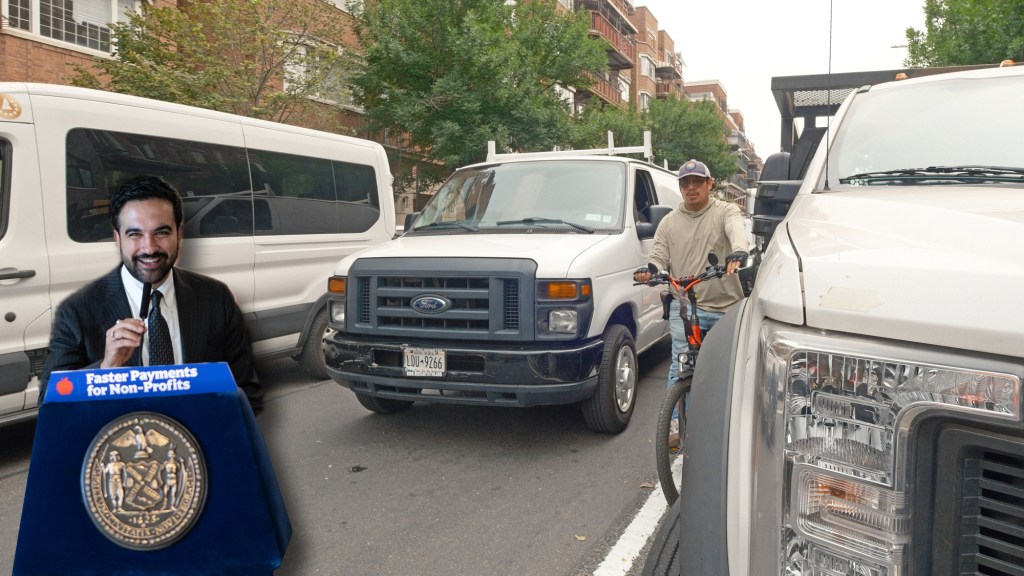
‘Slopulism’: Cheaper Driving Is Hochul’s Key ‘Affordability’ Issue
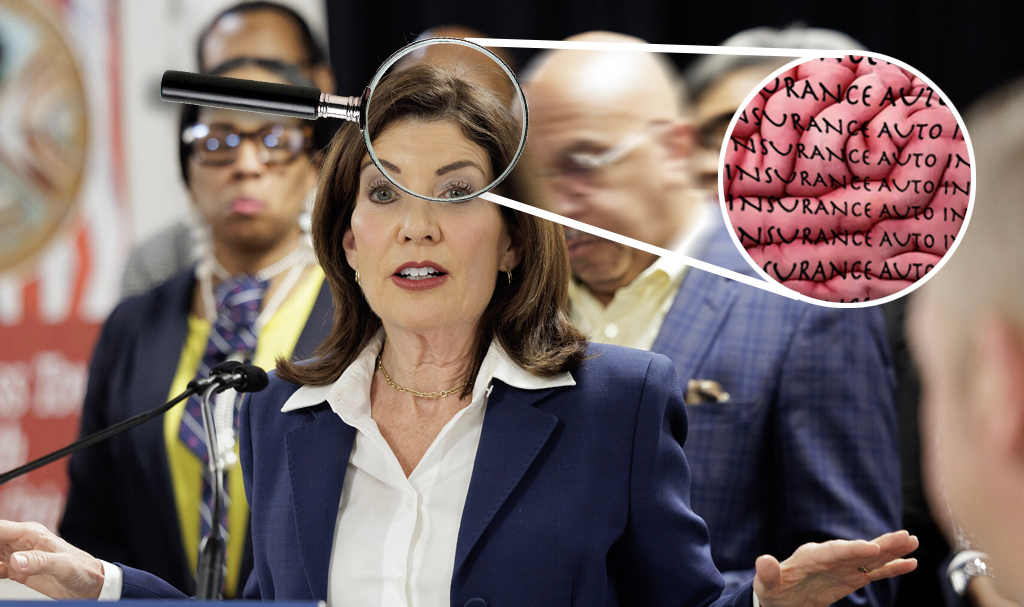
Gov. Hochul’s Big Tech-backed bid to lower car insurance costs by eroding crash victims’s rights has emerged has her signature “affordability” issue — consuming extensive government time and resources despite failing to address a key reason for rising costs: widespread car dependence and the nearly 400,000 annual crashes that it causes in New York State.
Hochul’s made the campaign central to her public messaging ahead of this fall’s gubernatorial election — talking about it more than every other issue on her “affordability” agenda after child care. But universal childcare is a position she has full-throated since Mayor Mamdani campaigned on it last year, making car insurance rates Hochul’s signature current issue.
And her own administration approved a double-digit car insurance premium hike just two years ago.
The governor has held far fewer events and posted far less on social media about other cost-of-living items, including her push to relax environmental reviews to allow for more housing construction.
Instead, she’s focused on auto insurance, according to a Streetsblog review of her public schedule and Albany watchers, with repeated trips across the Empire State, dozens of press publications and a polished social media blitz – all while an Uber-backed group spent upwards of $8 million in support of her in recent weeks. Of 23 “affordability” themed appearances since the governor outlined her priorities for this year’s budget in her Jan. 13 “State of the State” address, seven, or 30 percent have focused on auto insurance — second only to childcare.
Advocates accused the state’s chief executive of masking her corporate-friendly agenda with the political buzzword of the moment, “affordability,” and using the state’s budget negotiations to bolster her re-election this year.
“Pocketbook issues resonate with anyone, but that doesn’t mean that disguising some special interest gambit as one, makes it one,” said Danny Pearlstein, the policy and communications director of the transit-focused group Riders Alliance.
“It’s Slopulism,” added Pearlstein, using a portmanteau of “sloppy” and “populism” to describe efforts by politicians and online influencers to seize on lowest-denominator ideas to appeal to a broad political base. “It’s such a sloppy approach for appealing to people.”
Crash victims have cried foul that Hochul’s push will decimate compensation that people struck by drivers need to cover extensive medical care. These include a Brooklyn teen who slammed Hochul’s proposal a “financial death sentence” for New Yorkers struck by motorists and implored Hochul to abandon her corporate-friendly agenda to erode people’s rights to recover damages for their suffering.
“If Gov. Hochul’s proposed revisions to auto insurance laws pass, then I will be left struggling to cover the lifelong medical care my injuries require,” victim Marilena Athineos, 16, wrote last week in amNY. “That’s why so many street safety groups are speaking out. Because this plan doesn’t protect people like me. It protects insurance companies.”
Driving the schedule
Besides auto insurance and childcare, Hochul has devoted only five appearances to the Trump administration’s tariffs, four to her “Let Them Build” platform to deregulate environmental reviews and allow for more housing construction, and three to her more recent effort to delay state climate protection laws.
Her office has put out a dozen press releases for auto insurance, along with the same amount for child care, 11 for tariffs, and nine for “Let Them Build.”
The governor’s social media team, meanwhile, has posted about auto insurance 18 times on X, starting on Jan. 22 – a rate of more than twice a week. That’s compared to 19 times for universal childcare, and 11 for Let Them Build.
Hochul’s posts included several highly produced videos mimicking 1980s used car sales commercials and explainers, campaign-style montages of her visits to auto body shops, and edited photos mocking so-called “billboard” lawyers — the ones who advertise on city buses and subways, by the way.
“Hey, New Yorkers, are you sick of paying too much for car insurance? Have your premiums gone up, even if you haven’t been in an accident [sic],” Hochul says in one recent video. “Well buckle up, because I’ve got a deal for you!”
Another post on X shows fake personal injury lawyer billboards reading, “They game the system,” and “You pay the price,” with a giant picture of the governor next to “Gov. Hochul is driving down car insurance rates.”
What’s left unsaid is that New Yorkers hit by motorists will actually “pay the price,” if her policies succeed.
Hochul has mobilized multiple state agencies to stump for her unpopular platform: The Metropolitan Transportation Authority, the Department of Transportation, and the state’s insurance regulator, the Department of Financial Services, have all promoted Hochul’s insurance proposals.
Hochul claims she will trim insurance costs by an average of $25 per month by limiting who can sue for damages. She wants to narrow the state’s definition of a serious injury, cancel compensation for people a jury finds to be even slightly more than 50 percent at fault, and cap damages at $100,000 for uninsured drivers, those driving impaired, or people committing a felony.
The governor has argued this change will cut back on fraud, such as staged crashes, but the number of confirmed cases like that are actually vanishingly rare. Lawmakers have questioned whether her legislation will even lower rates.
Remarkably, however, Hochul has not held a single public event about the Stop Super Speeders bill, the marquee street safety legislation that she included in this year’s budget to require dangerous drivers to install speed-limiting devices in their cars.
The public schedules offer a glimpse into Hochul’s activities, but more detailed public accounting of her daily whereabouts, travels and who she meets with have not been updated since 2024, which advocates for government transparency have called “truly incredible.”
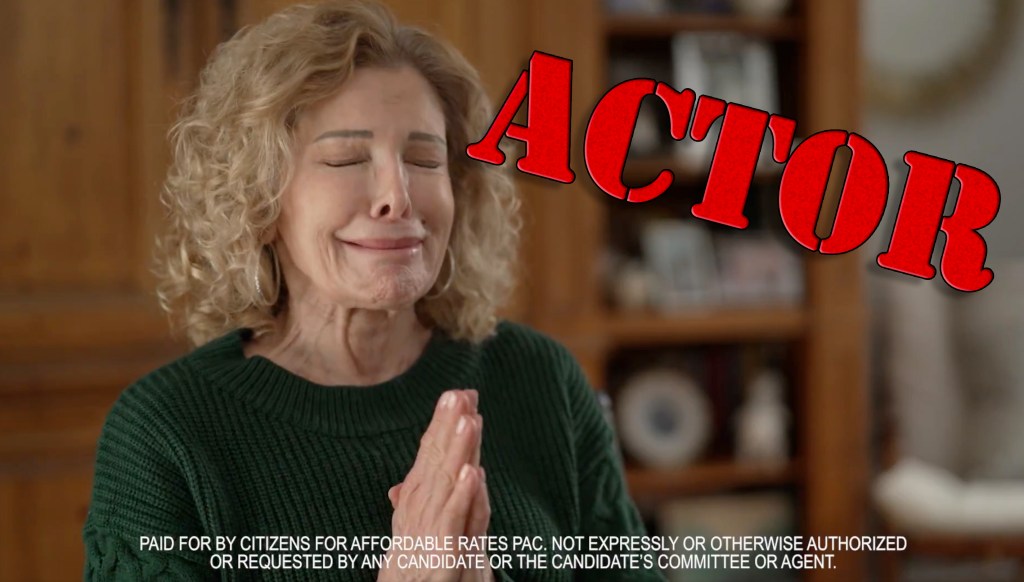
Hochul’s statewide insurance tour has benefited from millions of dollars in lobbying and ad spending by outside interests like the Uber-supported astroturf group Citizens for Affordable Rates, or CAR, which produced commercials with “testimonials” from professional actors complaining about the cost of driving.
Hochul is leveraging her power over the state’s annual spending plan in order to amplify her platform, according to Blair Horner, senior policy adviser at New York Public Interest Research Group, who has long followed state politics. He’s been following the state’s opaque budget process for since the mid-1980s, which he calls “an insult to sausage.”
Governors have routinely used their power during the backroom negotiations to enact and draw attention to their priorities, but Hochul is especially prone to using the process to highlight her agenda, Horner said.
“In the past three years, she’s held up the budgets for like a month to focus on non-budget items that she believes are politically popular,” said Horner. “It’s another way to brand herself as on the side of the voter.”
“People don’t like paying [for insurance] and the governor’s branding herself as the force for trying to lower premiums. That Uber is providing some of the public relations muscle behind it doesn’t hurt.”
Tapping into ‘affordability’
Ahead of Wednesday’s April 1 budget deadline, the governor stumped for her platform under the “affordability” banner at several rallies upstate and on Long Island last week.
“Affordability” has gained currency among politicos across the political spectrum in recent years, tapping into concerns about the surging cost of living since the start of the Covid-19 pandemic. But Hochul’s message downplays her own role in those rising costs in her time in office since 2021.
For example, the Department of Financial Services, which Hochul’s administration oversees, approved auto insurance rate increases by as much as 22 percent in late 2024.
“Most people are thinking about how to survive on a day-to-day basis and not that she’s been governor for the last four years and what has she been doing,” Horner said. “The state is responsible for overseeing insurance products in New York, and premiums have been going up since Covid – she’s been governor since Covid.”
The car insurance efforts line up with Hochul’s history of centering drivers in her politics, even in transit-dense New York City, where the majority of residents don’t own a car.
In her first year as governor, Hochul gave motorists a seven-month “gas tax holiday,” costing the state $609 million — which not only didn’t help residents who don’t drive, but also made roadways less safe and air less clean for all New Yorkers. She infamously paused New York City’s decades-in-the-works congestion pricing program for months in 2024. Citing input from people at diners, Hochul claimed the toll would hurt working-class motorists before restoring it — at a 40-percent lower cost — and reducing its effectiveness.
Transportation experts and advocates said Hochul erred by focusing so heavily on insurance. Instead, the state’s top pol must focus first on creating safer streets and expanding mass transit, which reduces crashes, thus drives down insurance costs for all, and allows people to choose cheaper options to get around.
“This [insurance push] kind of felt like it came out of nowhere and doesn’t seem to recognize the potential unintended consequences of putting more liability on people who are affected by a crash,” said Renae Reynolds, executive director of Tri-State Transportation Campaign. “We need more clarity from the governor as to why she thinks this is such an important issue.”
But Hochul has been uninterested in other proposals to lower prices that wouldn’t undermine victims’s rights, like pay-per-mile insurance, or banning insurers from discriminating based on ZIP code or credit history.
Rather than blaming those injured in crashes, she could also get serious about out-of-state and phony license plates that have proliferated across New York City, said Eric McClure, executive director of StreetsPAC.
“You just have to walk down a street in Brooklyn and see all of the cars [with out-of-state plates],” McClure said. “They’re not here visiting. … If there were more people buying their insurance in New York State, that would bring down rates for everybody.”
A spokesperson for Hochul said that the governor is simply focused on making life less expensive for New Yorkers, and that she is a big supporter of public transit.
“Breaking news: Gov. Hochul really cares about putting money back into people’s pockets,” Sean Butler said in a statement. “And for those keeping score at home, under her leadership, New York State has done more to support transit than it has in generations.”

Read More:
Streetsblog has migrated to a new comment system. New commenters can register directly in the comments section of any article. Returning commenters: your previous comments and display name have been preserved, but you'll need to reclaim your account by clicking "Forgot your password?" on the sign-in form, entering your email, and following the verification link to set a new password — this is required because passwords could not be carried over during the migration. For questions, contact tips@streetsblog.org.