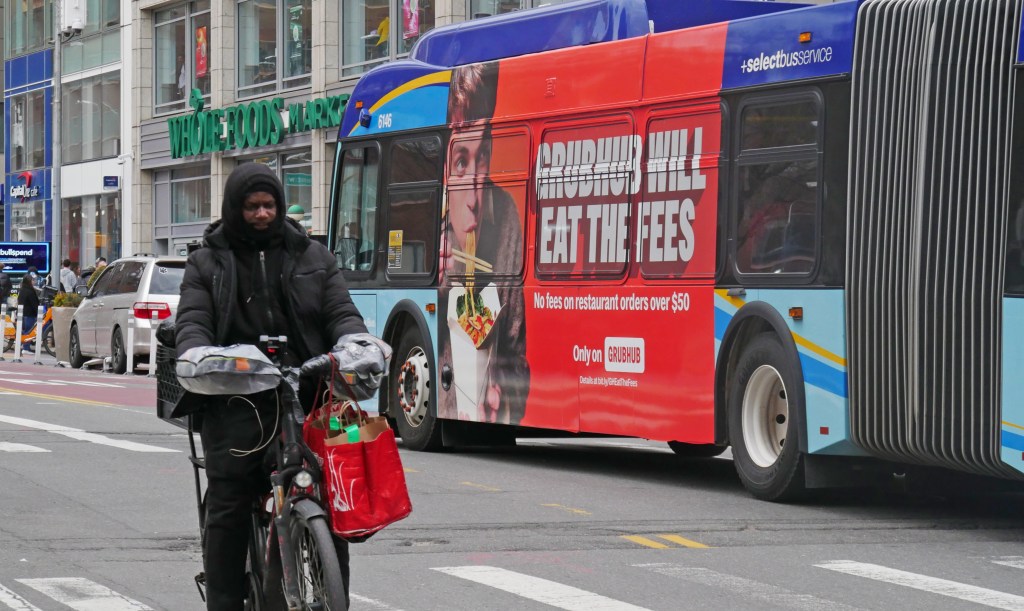
Grubhub ‘Outsourced’ Delivery Work To Skirt City Minimum Wage, Docs Show
Grubhub subcontracted many deliveries to another company in order to circumvent New York City’s minimum wage laws, according to internal company documents obtained by Streetsblog and interviews with former employees of the food delivery app.
Grubhub, which also owns and operates Seamless, “outsourced” to Relay, another delivery platform, “to stem elevated driver pay costs,” according to an internal email distributed to Grubhub employees in or around May 2024.
The “partnership” began in January 2024, according to documents reviewed by Streetsblog. Former employees to whom Streetsblog spoke said anywhere from 20 to 30 percent of Grubhub orders could have been sent to Relay, the company confirmed that an average of “less than 20 percent” of all Grubhub orders were outsourced, and added that while the percentage fluctuated, 20 percent is the “average, most representative number.”
“We’ve partnered with Relay Delivery, a third-party delivery as a service company, in New York City to outsource some of our fulfillment responsibilities to them,” the internal email to Grubhub employees said. “This partnership arises primarily to stem elevated driver pay costs in NYC, which have more than doubled since the new driver pay law was introduced.”
Since December 2023, New York City’s landmark minimum wage law has required app delivery companies to pay workers a guaranteed hourly rate that takes into account the cost associated with being a private contractor. DoorDash, Uber, Grubhub and Relay sued the city to stop the law, but Relay’s business model differed enough for a judge to grant an injunction that allowed the company to ignore the law until it dropped the suit in June 2025.
That created the loophole that Grubhub exploited by subcontracting with Relay, which paid its private contractors just $13.35 per hour by October of 2024, according to court filings. Delivery workers covered by the pay standard initially received $17.96 per hour, and the wage increased to $19.96 on April 1, 2025 and is now $21.44 per hour.
Wonder did not dispute the $13.35 number, but said that Relay’s couriers made more than the minimum pay rate once tips were added in, on average — though the city’s minimum pay rule does not allow a company include tips against the company’s minimum pay obligations. The Department of Consumer and Worker Protection told Streetsblog that Relay was counting tips in an attempt to hide how low its pay was.
“Grubhub wanted to use Relay because they wouldn’t have to pay for the workers’ time. Since Relay was not subject to the pay standard, they could take advantage of free labor that way,” added New School economist James Parrott, who helped write the minimum pay standard law. “It’s a pretty obvious move to sidetrack the pay requirement.”
The practice took advantage of a legal loophole, but also raised ethical concerns. At the merchant level, restaurants that paid high fees to list their offerings on Grubhub did not know that Relay delivery workers sometimes ended up completing their orders. These restaurants could have used Relay, the lower cost option, themselves.
At the customer level, the email, which a former employee shared with Streetsblog, cited beta testing results where the company measured how often consumers noticed the difference between a Grubhub worker and a Relay worker. Those ordering through the Grubhub app thought the worker bringing their food was paid minimum wage, but due to the subcontracting, that was often not the case. At the same time, Grubhub reduced the range for suggested tips in New York City to 0-10 percent from 10-25 percent.
“Testers report[ed] that the tracking, handoff and timing were all consistent with what they expected from a Grubhub delivery,” the internal email said. Grubhub expected to save 39 percent in cost for each order sent to Relay, around $5 million annually, according to the document.
While Grubhub was offloading orders onto lower-paid workers, it was also, along with the other major app companies, being accused of deactivating workers who had spent years doing consistent deliveries for the company, for no apparent reason.
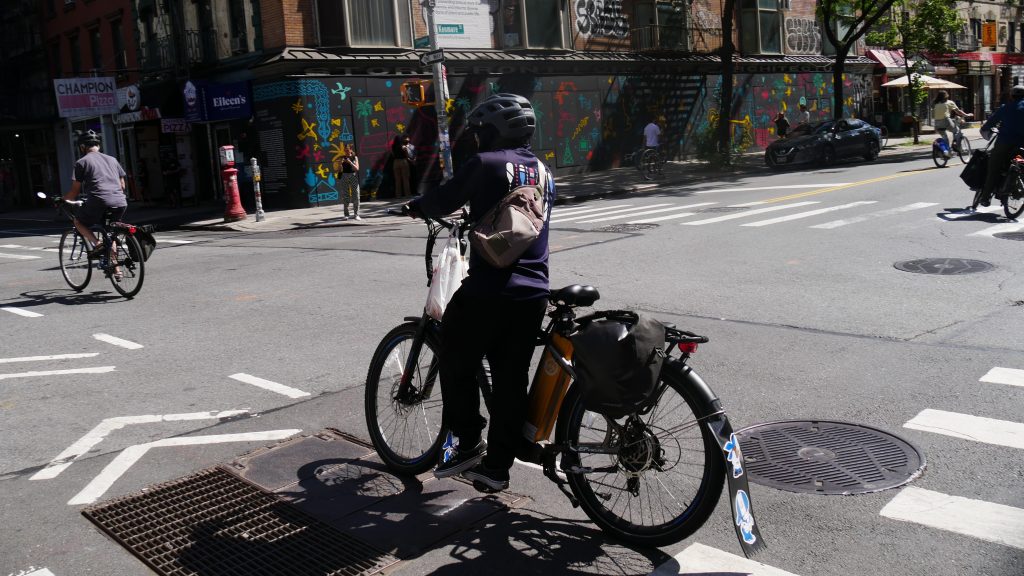
Emael Ramírez, who is referred to by a pseudonym, started working for Grubhub in 2020 after losing his restaurant job at the start of the pandemic. One day in December 2024, at the height of Grubhub and Relay’s subcontracting relationship, Ramírez found he could no longer log in to his Grubhub account. The deactivation pushed him to open an account with Relay. He noticed at the time that the majority of Relay orders he was doing originated from Grubhub, and that they were all long distances. Because of the subcontracting, Ramírez could have been doing the exact same work for lower pay.
“It is not fair,” Ramírez said in Spanish. “The majority of the orders that we took were from Grubhub, and they were very far distances. From four miles to seven miles, they were very far and we used bikes.”
Ramírez said he received no notice from Grubhub telling him why his account was deactivated. He later tried to re-submit his social security number and work authorization, but the company wouldn’t accept it, he said.
Grubhub said that without visibility into that courier’s specific situation the company couldn’t speak to the circumstances around the loss of account access and added that a number of factors went into determining which orders were outsourced to Relay.
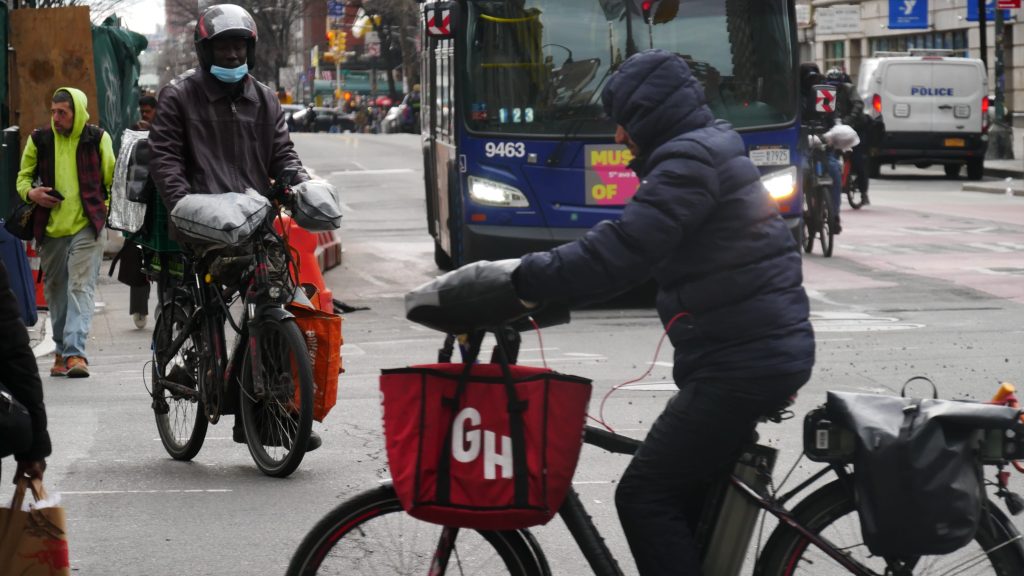
Relay’s legal exemption from the minimum wage law stemmed from its “business to business” model. Contrary to how things work with Uber Eats, DoorDash and Grubhub, customers don’t order food through the Relay app. Instead, restaurants pay for Relay to facilitate delivery and can either have their own website or app to facilitate orders, or list their offerings on the other popular apps but select the “self-delivery” option. Relay also already paid its workers a set hourly wage.
Workers for Relay often make deliveries for all of the major apps, because of the business to business model and the self-delivery option. The former employees Streetsblog spoke to didn’t know whether the other apps were subcontracting as well.
Grubhub told Streetsblog that the subcontracting was “not unique to Grubhub,” specifically calling out Uber and DoorDash: Uber Eats said it never subcontracted, while DoorDash ignored Streetsblog’s questions.
RELATED: WE SPENT A NIGHT WITH A RELAY RIDER
In response to the findings of this investigation, Grubhub told Streetsblog that it was “looking for ways to diversify its courier network amid NYC’s changing regulatory environment” and that the decision “helped Grubhub absorb spikes in volume and control for variable costs while we faced merchant fee caps, new courier pay requirements, and other challenges that made it difficult to operate sustainably in the City.”
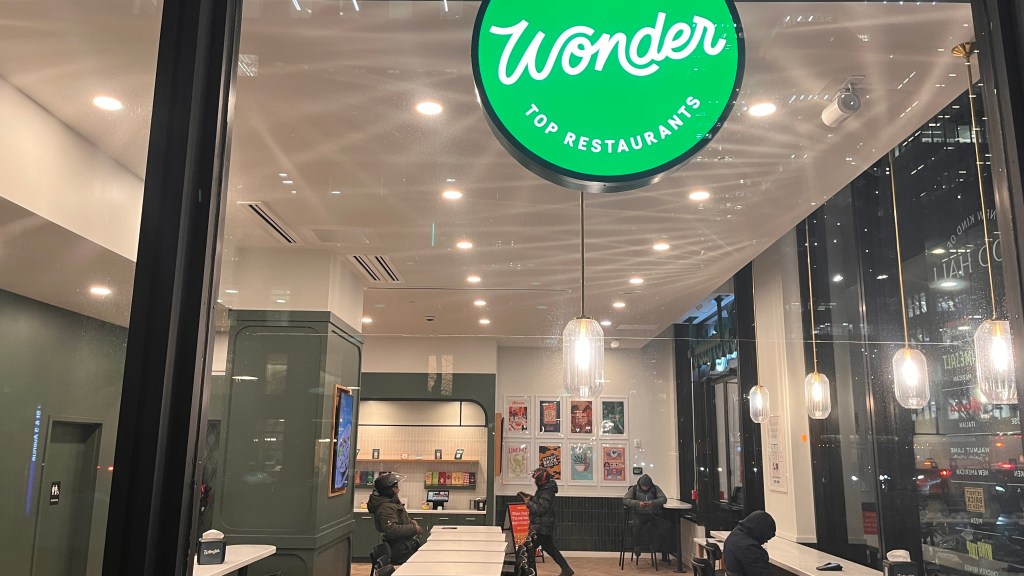
As Grubhub subcontracted out its orders to Relay, Wonder – a “super-app” food startup – purchased Relay. The startup started as a ghost kitchen and meal delivery service out of sprinter vans in the suburbs before pivoting to brick-and-mortar food halls across the country. Wonder needed delivery technology to facilitate that pivot, so it bought Relay. In November 2024, it bought Grubhub.
In June 2025, Wonder reached a settlement with the city’s Department of Consumer and Worker Protection. The City determined that Relay violated a city law allowing workers to set maximum delivery distances. As part of the settlement, Wonder agreed to drop Relay’s lawsuit against the minimum wage law and comply with it going forward, closing the loophole that Grubhub used to save money.
DCWP is still investigating Wonder for Relay’s alleged violations of the maximum distance requirements, however, officials said. The initial injunction granted to Relay opened the door for Grubhub’s evasion of the pay standard. The carve out ruling was partially based on the fact that Relay was not a customer facing app, and therefore couldn’t pass rising costs onto its customers.
But the subcontracting means that Relay was used as a tool for Grubhub’s customer-facing business. And when Wonder bought Relay and used it for orders from the Wonder app, it essentially became customer facing, as DCWP warned in a court filing in October of 2024. Still, Judge Moyne kept the injunction in place. When DCWP settled with Relay, it released Wonder, and its related companies, from any retroactive legal action over pre-settlement claims.
“The law must hold all companies to the same standard, without exceptions. Taking advantage of a loophole to pay workers a sub-minimum wage is wrong. It is also a predictable consequence of carving out a single company from coverage, which DCWP opposed at the time and successfully resolved by ending the litigation,” said DCWP Commissioner Sam Levine.
A consolidation Wonder-land
Wonder currently has around 24 locations in the five boroughs, according to its site. The company insists it doesn’t run “ghost kitchens,” but the food is prepped and par-cooked off site and assembled at the food halls. The company promises its customers free delivery in under 30 minutes. Its goal appears to be to subsume the entire restaurant industry – CEO Mark Lore said he aims to make the company the “Amazon of food and beverage.”
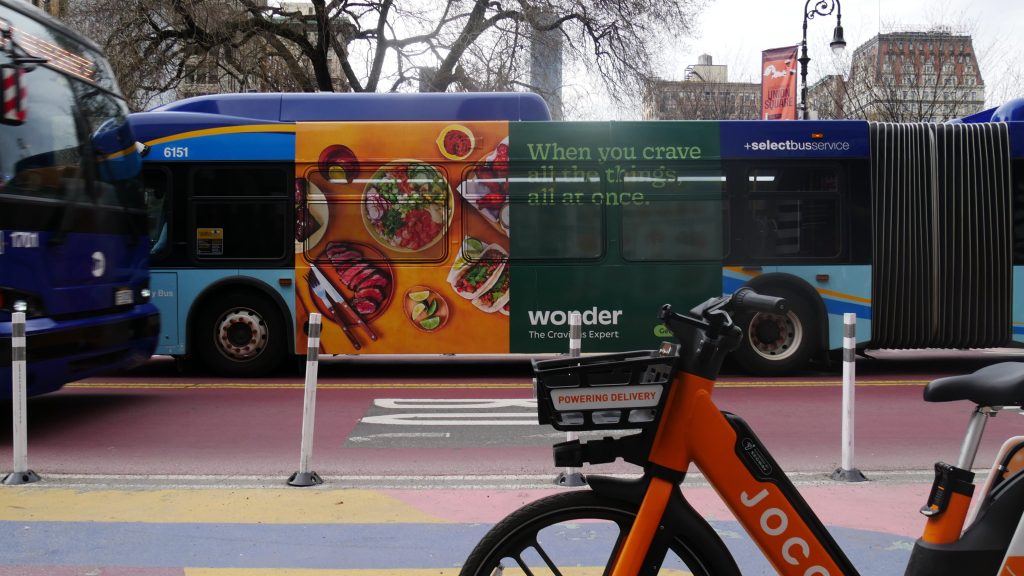
Wonder’s $650-million purchase of Grubhub in November 2024 offered a chance for the company to test out which software would work better for its future goals, former employees said. Grubhub did not stop subcontracting to Relay after Wonder acquired the two companies.
Then, on Feb. 17 of this year, Relay sent an email informing its workers that the company would close its New York City operation in April. The Relay workers were not offered positions on the Grubhub app. The company told Streetsblog that once Relay shuts down, all orders placed through Wonder’s app will be fulfilled by Grubhub, with overflow handled by DoorDash and Nash. Wonder will also continue to be listed as a restaurant on Grubhub, DoorDash, and UberEats.
Wonder is using the tried and true tech startup playbook: acquire other companies, and raise enough money in venture capital funding to be the cheapest option for consumers. Restaurants paid less to use Relay than they did to apps like Uber, DoorDash and Grubhub. Now, all the restaurants that relied on Relay will switch to one of the big three, which will increase their costs.
And Wonder’s consolidation could have other negative impacts on small businesses. The company’s purchase of Grubhub and Relay came with troves of data about the preferences of New York City delivery consumers, which could give the company the tools to copy small businesses and make the same products for cheaper.
“Wonder gets to know all the data of what’s sold,” Jeffrey Bank, the CEO of Alicart Restaurant Group, which owns popular New York establishments like Carmines, said at a New York Law School policy roundtable about the app industry last November. “So he’s looking at my data, at Carmines, and goes, ‘Ooh, wow. Everybody loves penne a la vodka. Maybe we should bring penne a la vodka into Wonder, and we could charge less.’”
Workers needed work, Relay gave it to them
Before the pay standard, companies allowed an unlimited number of workers to sign up for their apps, but they were not paid unless they were picking up a delivery. The pay standard fundamentally changed this dynamic by forcing the companies to pay workers for their idle time, not just their “trip time,” or the time spent biking between pickup and delivery. New York City had tens of thousands of delivery workers who were doing it full-time, not as the side-hustle the companies sold it as. As such, the industry needed to be “professionalized” in order for it to be fair, and for workers to ride safely, and that meant being realistic about how many workers it needed clocked-in at a given time, Parrott said.
“It’s a function of the fact that, in the eyes of the company, they don’t have any responsibility for the workers’ time. In the absence of the pay standard they are treating that as a free good,” he explained. “The companies are capitalizing on the desperation of workers. In a Wild West setting, that happens. You would think that New York City is removed from the Wild West and we should have businesses that are more responsible.”
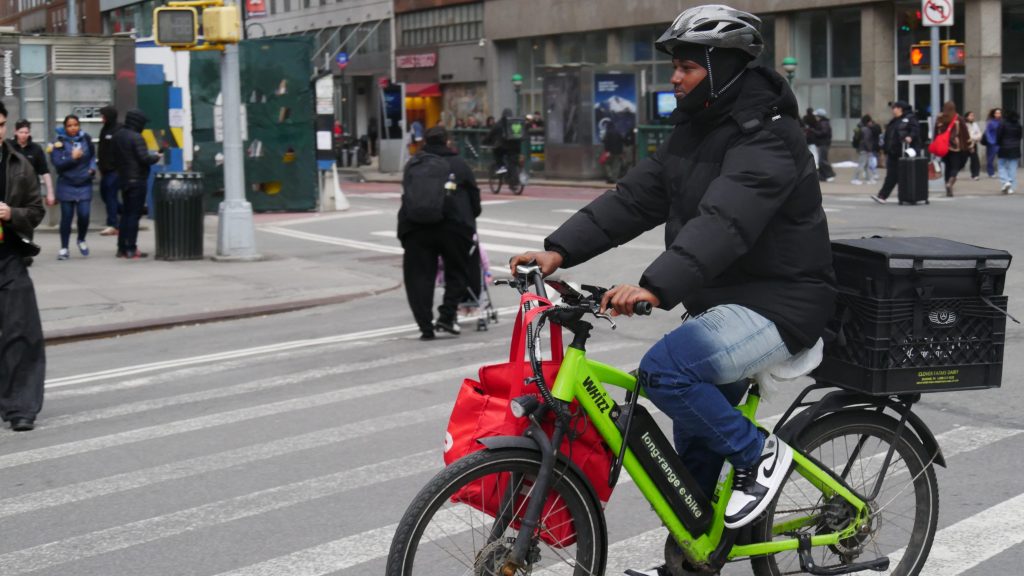
The minimum pay standard threw Grubhub delivery workers into a whirlwind of workplace bureaucracy. Grubhub, like most apps, grades workers based on performance, which workers say pushes them to speed and ride more recklessly, because if they are late to pick up or drop off a delivery, they see a negative effect, Ramírez said.
“When they gave minimum pay they were giving less time to go to the restaurant. This affected our work points a lot,” said Ramírez. “The points are very important so the app will give you more orders. If you accept orders 100 percent of the time and you deliver 100 percent, the app will give you a little more work. Now, if you have low points, they don’t give you a lot, but they give you fewer minutes to arrive at the store. Sometimes they gave me two or three minutes. Sometimes there is a lot of traffic on the way, but you have to go fast. When there are pedestrians crossing, you can’t wait a long time.”
One former Grubhub employee said the company has a rating system that essentially chooses the “best” or “most reliable” workers and gives them first pick. This wasn’t only based on speed, the former employee said, but on a number of factors.
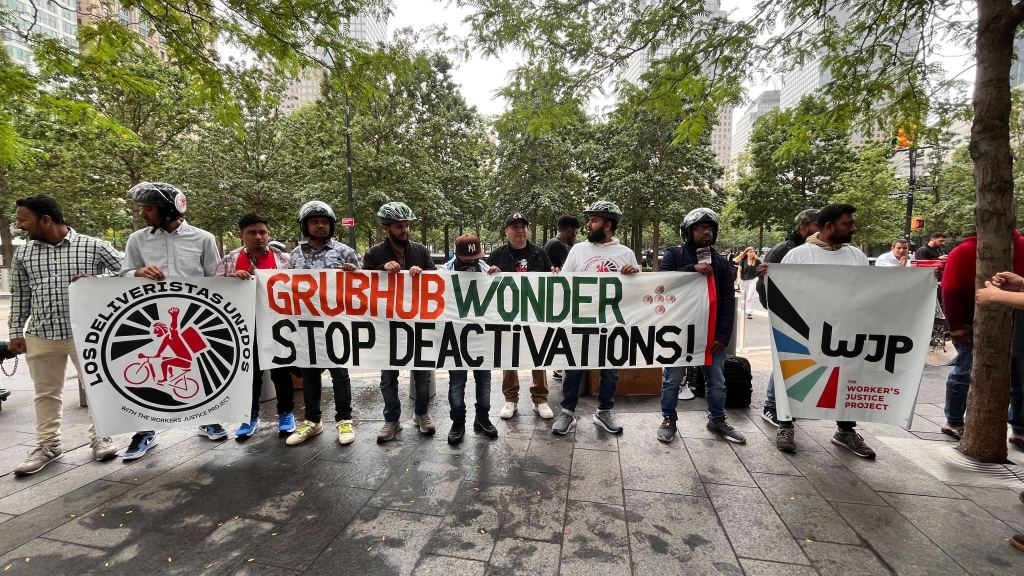
Soon after Wonder acquired Grubhub, while the company was still subcontracting a percentage of its orders to Relay, workers rallied in front of Wonder headquarters to protest the company firing more than 50 workers without cause. Los Deliveristas Unidos, a group run by the Worker’s Justice Project that organized delivery workers to fight for the pay standard, then worked with Wonder to resolve the deactivations.
While Grubhub workers struggled to get shifts and deal with deactivations and opaque grading systems, the company was offloading work to Relay, making the pool of deliveries available to Grubhub’s workforce even smaller. Internally there were concerns at Grubhub about the ethics of subcontracting the labor to Relay workers, especially about the potential lower tips, a former employee said.
“Their profit motive just takes precedence over their ability to see workers as human beings,” said Parrott. “It’s clear from the data, even with the pay standard the companies are still making money. They’re still making money, it’s just that they want to make even more.”
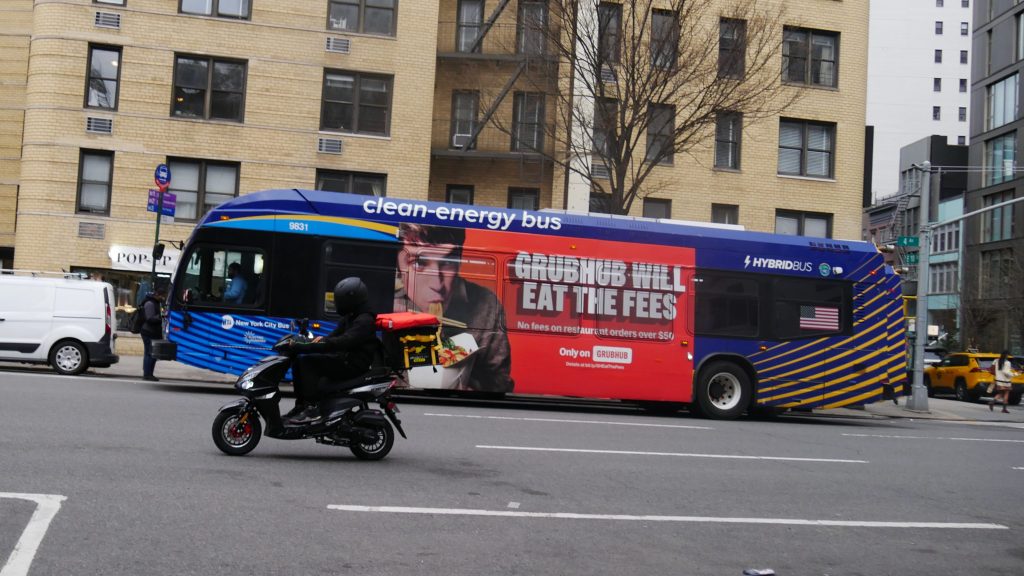
Grubhub has also postured itself as a company that cared more about its workers than the competition. Unlike DoorDash and UberEats, Grubhub did not move its tipping option to after checkout after the minimum wage law began.
“While others in the industry responded by targeting tipping, we sought reasonable and practical solutions that didn’t suppress courier pay. Today, our focus remains being the best partners we can be to couriers, restaurants, and the City,” a spokesperson told Streetsblog.
Yet what Streetsblog has revealed suggests that it instead diverted money from its workers by subcontracting its services out to a company that paid workers less, all the while deactivating and locking out its own workforce.
“It’s not fair, no matter how good they treat workers sometimes,” said Gustavo Ajche, the founder of Los Deliveristas Unidos, the organization that pushed to get the minimum pay standard law passed. “It usually is the one that treats workers better compared to DoorDash and Uber, Grubhub is the one that is good, but you see now they still find a way to skip the minimum pay. This is a problem with all the apps, they find a way to do this all the time.”

Read More:
Streetsblog has migrated to a new comment system. New commenters can register directly in the comments section of any article. Returning commenters: your previous comments and display name have been preserved, but you'll need to reclaim your account by clicking "Forgot your password?" on the sign-in form, entering your email, and following the verification link to set a new password — this is required because passwords could not be carried over during the migration. For questions, contact tips@streetsblog.org.