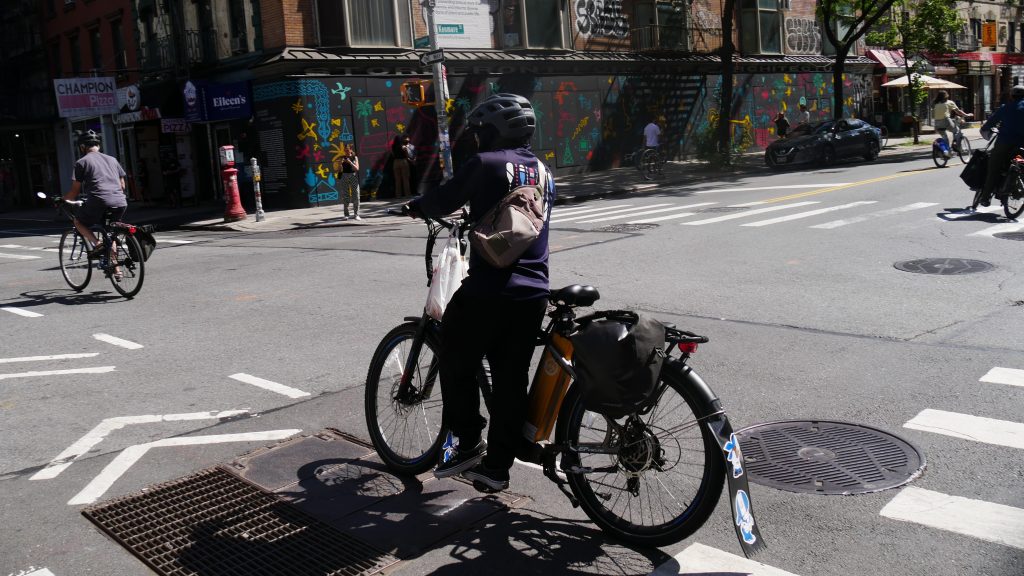
RIDE-ALONG: A Night On The Road With A Relay Delivery Worker
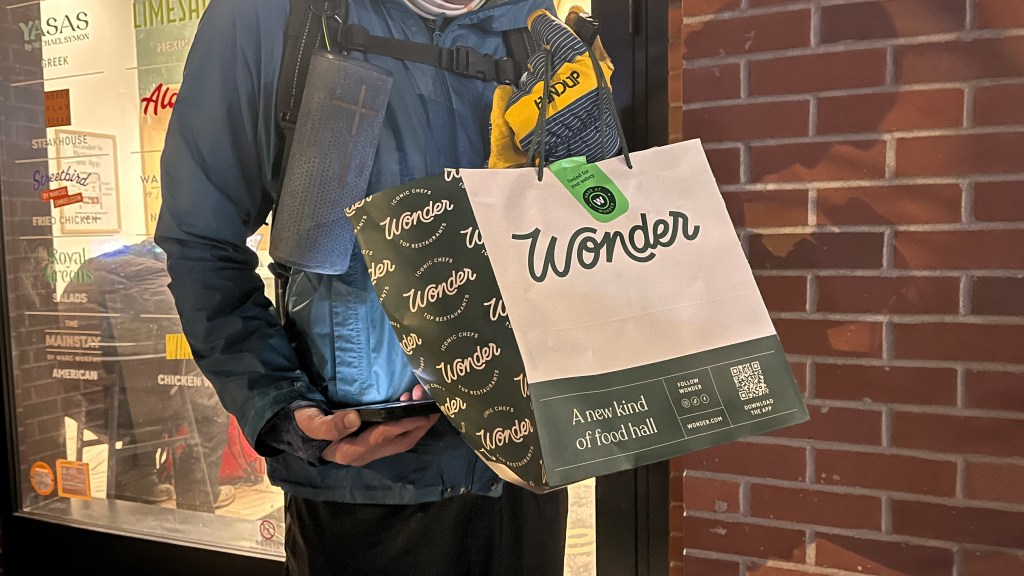
For Kae Cook, only getting access to late night shifts on the Relay app had its plus sides.
“None of it is really quality,” Cook said of the food from Wonder, a fast food delivery-first food hall chain that licenses the names of well known chefs to create restaurant brands. Wonder Inc, the parent company, bought Relay back in 2024 and uses Relay workers to make deliveries, which it offers for free. “When I am not getting orders, and just am getting screwed over by this app constantly, I am dumpstering while I am on the app. I’ll deliberately take shifts between 10 and 11 p.m.”
Cook found salmon fillets, branzino, and a 30 pack of chicken patty sandwiches dumpster diving at a Wonder during a Relay shift. “There is a lot of really good wasted hot food every single time I look.”
As part of a series investigating Wonder, the parent company of both Relay and Grubhub, Streetsblog recently met up with Cook for an hour-long shift for Relay, a relatively small business-to-business delivery platform that was used by Grubhub to evade the city’s minimum pay laws for delivery workers.
INVESTIGATION: Grubhub Used Relay To Evade Minimum Pay Law
Even though Relay plans to shut down its New York City operations on April 1, the Relay model is only getting started. Wonder raised at least $600 million in venture capital and bought companies left and right while opening brick-and-mortar “food halls” all over the city.
The Department of Consumer and Worker Protection is currently investigating Wonder for Relay’s failure to comply with the city’s maximum distance regulations, which are designed to let workers cap the length of delivery trips in order to cut down on long routes that encourage workers to bike more dangerously. Relay settled with the city last year and had to pay $200,000 to workers who were deactivated for declining long trips, in addition to a $20,000 civil penalty.
“Wonder runs Relay, so Wonder is accountable for everything that happened at Relay,” said Elizabeth Wagoner, of DCWP’s Office of Labor Policy & Standards. “For us, it’s not relevant … that Relay, doing business as Relay, is not operating anymore. [This is about] holding the company accountable.”
Customers don’t download and order food through Relay. Instead, restaurants and other delivery apps use Relay’s technology to facilitate deliveries in a business-to-business, also known as a B2B, model. Wonder, a growing food-hall chain that wants to be the “Amazon for food and beverage,” bought the company in 2024 and began using its workers for deliveries from its food halls as they popped up around the five boroughs.
On the streets with a Relay delivery worker
It was already dark when Cook, who uses they/them pronouns, arrived in Williamsburg for the 7 p.m. shift on Feb. 4.
Every evening, Cook can schedule shifts for the next day, but can only choose shifts in 30-minute increments. Favorable areas and times are booked quickly, leaving only late-night shifts. On our ride-along, Cook had two half-hour shifts from 7 to 8 p.m., then another two from 9 to 10 p.m. Almost immediately, the app sent them to London Tandoori, on Metropolitan Avenue, to pick up dinner for someone two miles away in Bedford-Stuyvesant.
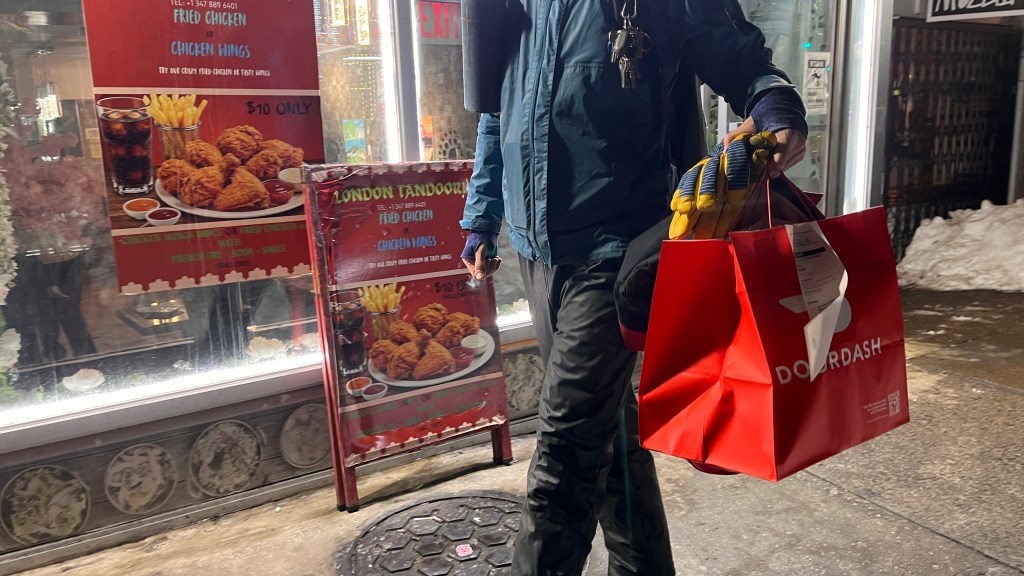
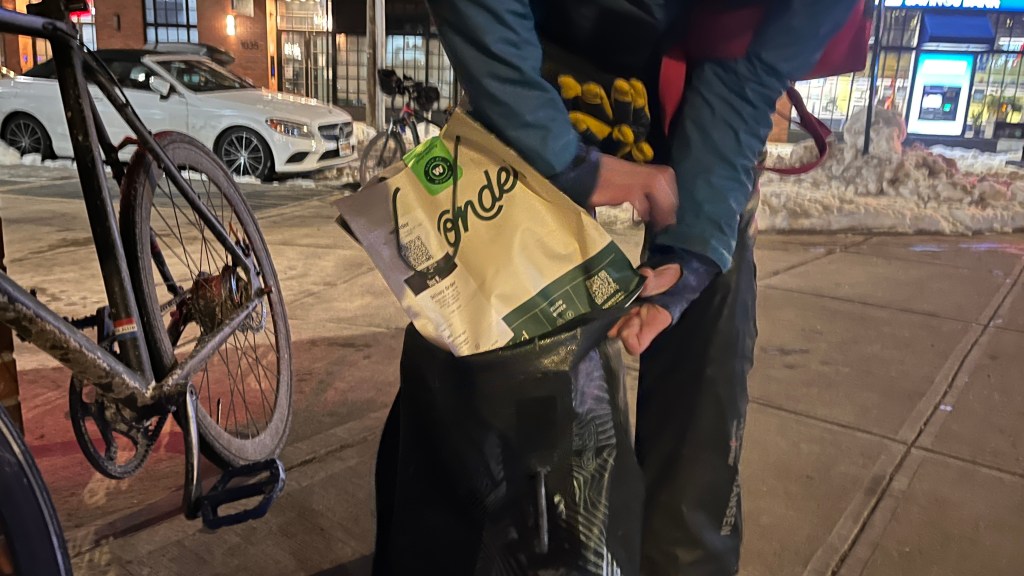
Cook emerged from the restaurant with a DoorDash-branded paper bag, but the order was actually placed through Grubhub, according to the Relay app. Cook stuffed the bag of chicken into their backpack, since their bike doesn’t have a rack or a basket.
“Reaching into my backpack without looking into it is a special skill,” they said.
We took Union Avenue to Bed-Stuy. Double-parked cars in the unprotected bike lane forced us to weave in and out of traffic. Cook told Streetsblog that they once set shorter maximum distances through the app, but found they didn’t get as many delivery opportunities as a result. Cook now sets their maximum distance to five miles.
“That’s one of the ways that it’s deliberately plotting against you — it penalizes you for not having a big range,” Cook explained. “It restricts your access to shifts, gives you a later access time to access the shifts in the day so there will be less things available if you set a shorter range.”
A rep for Relay said the company prioritizes giving orders to workers with pre-scheduled shifts, but acknowledged that a worker’s set maximum distance can affect whether or not the app selects them for an unscheduled shift during busier hours.
Cook must show up to a geofenced area to start a shift, but sometimes the app takes them outside of the zone, in which case they have to bike back into the zone to get another order. The rep said the app will have workers report back to their zone if the area is busy, but insisted “they can still accept orders outside the zone.”
But that has not been Cook’s experience.
“The app will show you [the] geofenced area in which you have to appear, but the deliveries don’t have to stay within that area,” Cook explained. “The deliveries can go wherever the fuck they want them to. Whether or not you’re back in that geofenced area is your problem. Once you leave the area, you aren’t guaranteed to get any more deliveries.”
Sidestepping minimum wage rules
Relay launched in 2014, long before UberEats and DoorDash dominated the industry. Co-founder Alex Blum framed the company’s origin story as a quest to eliminate “inefficiencies” that he noticed as a food delivery customer himself.
“When the delivery person showed up, I noticed he was only carrying my order,” Blum wrote in a 2015 blog post reflecting on Relay’s first eight months of business. “I asked if I was the only delivery he had to make in that trip, and if he now had to go back to the same restaurant he had come from. He confirmed both of my suspicions, and as I shut the door I remember feeling bad about the distance of both trips. As I ate, I started thinking how inefficient this was.”
That relentless focus on efficiency came at the expense of delivery workers. Before the arrival of delivery apps, many of those workers enjoyed full-time employment at restaurants, where they earned hourly minimum wage plus tips.
When the City Council passed its delivery worker minimum wage in 2021, all of the major apps sued to stop it. When DoorDash, Uber and GrubHub lost their request for an injunction in 2023, the judge granted one to Relay because it already offered workers a base pay and because it “contracts directly with individual restaurants.”
This allowed the company to continue with business as usual while the other major players at the time — UberEats, DoorDash, GrubHub, Seamless and smaller Chinese companies Fantuan and HungryPanda — had to follow the new pay rules.
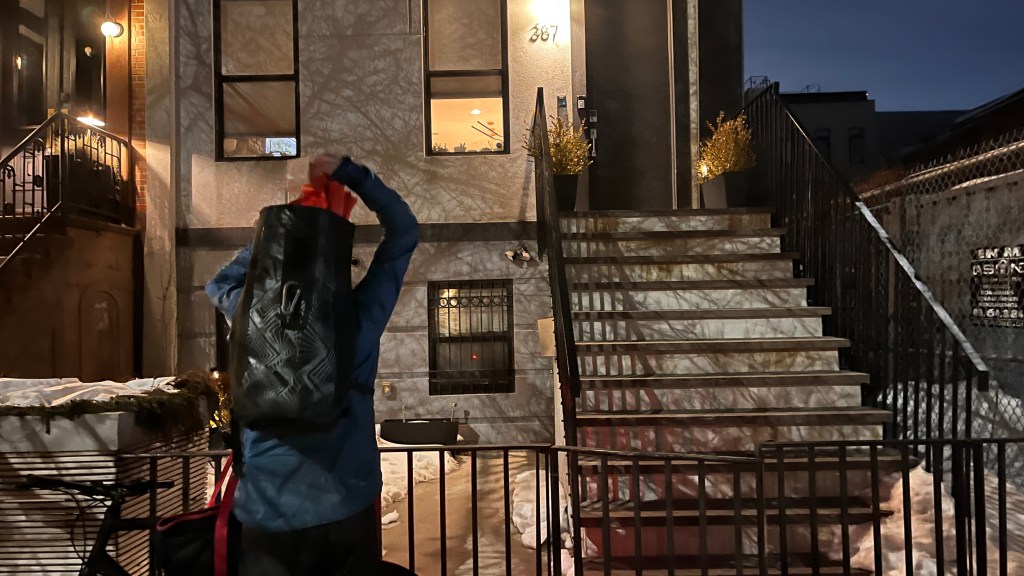
Wonder purchased Relay in April 2024. The company had previously acquired Seamless and would go on to buy GrubHub, Tastemade and Blue Apron. Wonder already used Relay to pivot from food halls to delivery; now it owned the technology behind it. Wonder licenses the names of popular chefs and creates food brands that appear as different restaurants on their app. Food is prepared off-site and assembled at Wonder locations fast-food style. The idea is to give customers the ability to order from different “restaurants” in a single transaction.
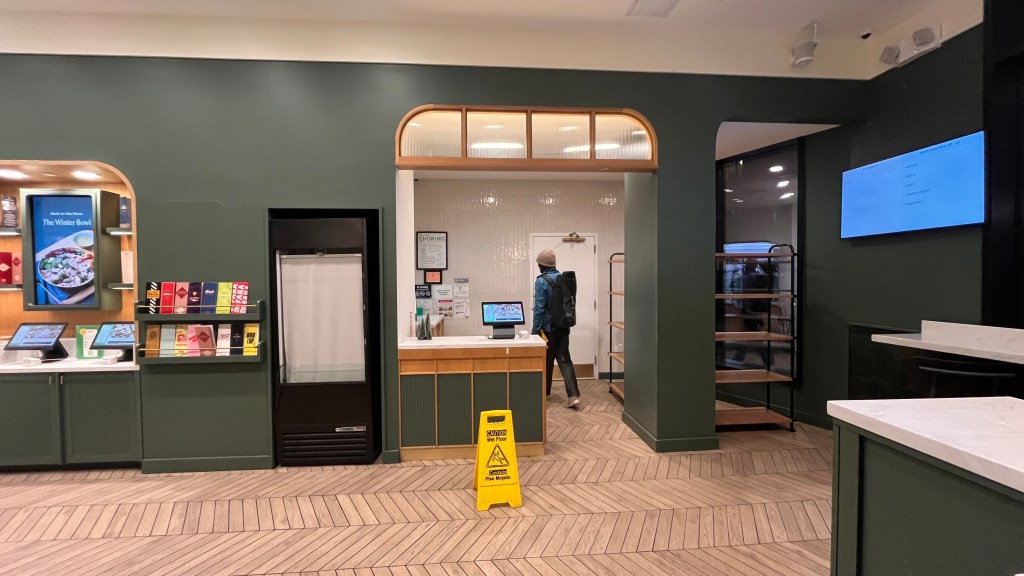
After Cook dropped off the first order, they quickly received another one — this time for an order placed at a Wonder food hall in Bed-Stuy.
“Wonder is just one of the many restaurants we deliver from,” Cook said. They quickly got their bearings, looked at the mapping directions to get to the Wonder location and put their phone in their pocket. Speed was top-of-mind. Cook told Streetsblog that they yield to pedestrians, but rarely wait for red lights, since they don’t want to be late to pick up or drop off food.
“If it’s safe for me to go, and I am not interfering with pedestrians, I’m going to go,” they said.
As we weaved through Bed-Stuy in the unprotected bike lane on Tompkins Avenue, we passed Bike Plant, a bike shop that has a “community repair fund” to help those who can’t afford to fix their two-wheelers.
“I would not have survived if it wasn’t for Bike Plant and their mutual aid policy, having a community repair fund,” Cook said. “I needed that so badly.”
Cook has to do a lot to prepare for all the biking, and to recover properly, like stretching, warming up, and biking to the delivery zone. All of this takes time that isn’t compensated. They also purchase their own gear, which wears down quickly.
“For the one hour of work, I am doing like four hours of work,” they said. “Do they understand the healthcare exposure that comes with being hit by a car driver multiple times a year? You have to replace your gear every single year because you wear it down. Your waterproof stuff? That won’t be waterproof next year.”
The delivery worker minimum pay standard is intended to account for these costs. But its effects have puzzled Cook, who often can’t tell if their paystubs reflect the minimum standard of $21.44 per hour. That’s because the pay standard is calculated is an exceptionally confusing way.
The city gives companies two options for compliance: The alternative method, which none of the companies use, requires the app company to pay the worker the minimum pay rate for “trip time,” or the time from the moment of pickup to the moment of delivery, divided by 0.6 to represent a utilization rate of 60 percent. The 0.6 figure was chosen because the average weekly utilization rate from January 2021 through June 30, 2022 for Uber Eats, Grubhub, and DoorDash, combined, was 60 percent. The utilization rate is calculated by dividing “trip time” by the total time a worker is connected to the app. An app can only choose the alternative method for a pay period if it has a utilization rate above 53 percent.
But the standard method, which Relay uses, requires that companies pay workers the minimum pay rate for trip time only, while ensuring that total payments to all workers meet or exceed the minimum pay rate multiplied by the sum of the workforce’s total trip and on-call time each week.
For example: If an app’s workers together spend 70,000 hours on trips and 30,000 hours on-call in a pay period, the app’s total payments to these workers together can’t be less than $2,144,000 for the period (100,000 total hours multiple by $21.44). This arrangement bewilders individual workers, and leads to strict scheduling and frequent lockouts.
Cook’s experience is vivid demonstration of this baffling system.
On Jan. 11, they worked from 4:42 p.m. to 6 p.m and completed one delivery. Their paystub showed an hourly rate of $13.47. The breakdown of pay showed $5.10 categorized as “relay base pay,” a “daily bonus” of $3.19, and another $2 “per delivery bonus,” and a $7 tip. Later that night they signed on again from 10:04 p.m. to 11 p.m. and made two deliveries. Their paystub showed an hourly rate of $12.48 — “base pay” was $5.51, “per delivery bonus” was $3.18, daily bonus $2.75, and no tip. To Cook, this seemed wrong.
But Cook’s weekly paystub seems to show compliance with the minimum pay standard: For the three shifts they worked during the week of Jan. 15, their total “trip time” was one hour and 45 minutes — but they were logged on and ready to accept trips for a total of three hours and 52 minutes.
Cook earned $53.53 before tips for that week. Because of the standard method, Cook can’t just do simple math to double-check Relay’s work. If Cook wanted to find out exactly how Relay calculated their pay, they would have to submit a complaint to DCWP. The department receives a monthly report from each app company that shows on-call time hours and total pay, and therefore can verify compliance with the aggregate requirement.
An industry player makes a big leap — and attracts regulatory ire
Wonder will absorb Relay after it shuts down on April 1. This kind of corporate consolidation worries Sam Levine, the commissioner of the Department of Consumer and Worker Protection.
“When you have fewer and fewer companies competing for labor, that is going to put more downward pressure on people’s pay, worse practices targeting workers — because you’re going to be in a situation where, if you’re deactivated, you have nowhere else to go,” he told Streetsblog in an interview about the industry, before Relay announced it would cease operations.
“If you feel you’re being mistreated, you have nowhere else to go,” he said. “And even though these are just temporary jobs from the company’s perspective, this is people’s whole livelihood.”
Wonder also owns Grubhub and its subsidiaries, but Relay’s email informing workers of its impending closure didn’t offer them the opportunity to switch to its sister apps — even though Relay workers often pick up orders from those very same apps.
In his 2015 blog post, Blum conceded that “there is not a lot of empathy in the life of a delivery guy,” and reminisced about “riding around through the snow at 10:30pm on a Sunday in mid December thinking ‘If I’m still doing this next month, I’m out.’”
More than ten years later, Cook was riding through Williamsburg in below freezing temperatures, with no app-provided gear to stay warm and nowhere to rest. They will now have to find new part-time work to make ends meet.

Streetsblog has migrated to a new comment system. New commenters can register directly in the comments section of any article. Returning commenters: your previous comments and display name have been preserved, but you'll need to reclaim your account by clicking "Forgot your password?" on the sign-in form, entering your email, and following the verification link to set a new password — this is required because passwords could not be carried over during the migration. For questions, contact tips@streetsblog.org.