Streetsblog provides high-quality journalism and analysis for free — which is something to be celebrated in an era of paywalls. Once a year, we ask for your tax-deductible donations to support our reporters and editors as they advance the movement to end car dependency in our communities.
If you already support our work, thank you! If not, can we ask for your help?This year’s fundraiser includes a special gift for our biggest supporters. Don’t miss out.
Together, we can create a more livable, walkable, bikeable, equitable and enjoyable city for all. Happy holidays from the Streetsblog team!
New Jersey Gov. Phil Murphy scaled back his planned $11-billion widening of the New Jersey Turnpike, but the lame duck executive’s so-called “compromise” will still induce thousands more cars and trucks onto Garden State roadways.
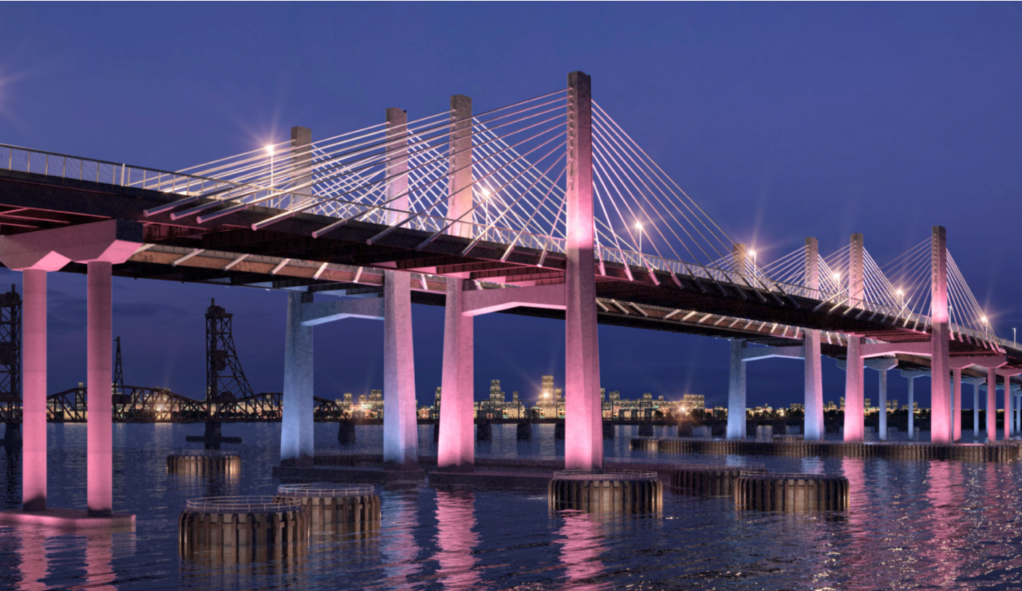
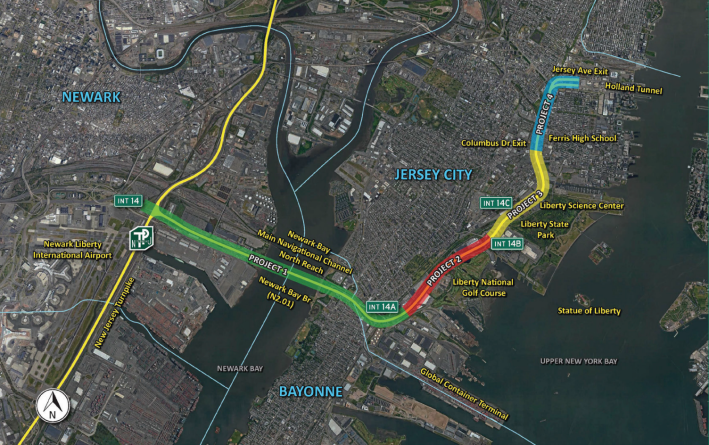
Murphy and the New Jersey Turnpike Authority announced late on Friday that the state will not add more lanes to the highway’s eastern spur closer to the Holland Tunnel to Manhattan — but officials will, next year, begin a 10-year, $6.2-billion construction project to double the size of the 1956 Newark Bay Bridge between Newark and Bayonne to a twin span with eight lanes.
Drivers will then merge back into the four lanes on the remaining half of the Newark Bay-Hudson County Extension through Jersey City to the four-lane Holland Tunnel.
Opponents blasted Murphy for keeping the worst parts of the boondoggle.
“If they double the size of that bridge, it’s going to make no difference in the end,” said Emmanuelle Morgen, a co-founder of Hudson County Complete Streets. “There’s not much change here, I can’t call this a compromise.”
And the groups EmpowerNJ, Turnpike Trap, Hudson County Complete Streets and Bike JC Coalitions issued a joint statement that said that doubling the capacity of the bridge “now makes even less sense.”
“Four lanes of east-bound bridge traffic will now perpetually merge into two lanes at Exit 14A causing monumental and continual traffic jams, leading to the very thing NJTA is supposedly working to reduce – traffic congestion.”
As part of the changes, the Turnpike Authority now plans to add new ramps from the bridge to port facilities in Bayonne and Jersey City.
The red, yellow and blue segments of the eight-mile Newark Bay-Hudson County Extension will not be widened after all. Map: NJTA
But that new road infrastructure threatens to offload more pollution and cut-through traffic on the cities’ poorer residents living near the highway, according to Morgen.
“Hudson County needs another cloverleaf like a hole in the head,” the advocate said.
Murphy claimed the project will still “relieve” congestion in a growing region and – bizarrely – “address the anticipated impacts of climate change.”
That flies in the face of the Turnpike Authority’s own projections, which forecast traffic growing by nearly one-third by 2050, as Streetsblog previously reported.
Turnpike officials estimated an increase of 32 percent, from 4,533 eastbound vehicles an hour in the peak morning rush measured in 2021 to 5,986 by 2050, according to a draft environmental impact statement [PDF] that covered the section of the bridge. Without the bridge widening, traffic would still grow to 4,909 vehicles, which is just an 8-percent bump, the study found.
Murphy’s backtrack will only shave off $500 million from the $10.7-billion price tag, less than 5 percent, and local lawmakers said it will simply move a bottleneck further up, while still spilling all the new traffic onto dense neighborhood streets.
“This doesn’t address the core issue of adding more lanes to the Turnpike,” said Katie Brennan, who recently won a state Assembly seat to represent Jersey City, in a social media post. “All this does is move the bottleneck up from the two-lane Holland Tunnel to the two-lane stretch of Turnpike in Jersey City.”
The Murphy administration has pushed the plans forward despite a reduction in congestion in the area since congestion pricing took effect for drivers heading to downtown Manhattan.
Governor-elect Mikie Sherrill has said the state must rebuild the aging Newark Bay Bridge, but on the campaign trail she said that “we can get to that point where we are comfortable that we are not increasing the carbon impact on the neighborhoods.”
Kevin Duggan joined Streetsblog in October, 2022, after covering transportation for amNY. Duggan has been reporting on New York since 2018, starting at Vince DiMiceli’s Brooklyn Paper, where he covered southern Brooklyn neighborhoods and, later, Brownstone Brooklyn. He is on Bluesky at @kevinduggan.bsky.social and his email address is kevin@streetsblog.org.
Streetsblog has migrated to a new comment system. New commenters can register directly in the comments section of any article. Returning commenters: your previous comments and display name have been preserved, but you'll need to reclaim your account by clicking "Forgot your password?" on the sign-in form, entering your email, and following the verification link to set a new password — this is required because passwords could not be carried over during the migration. For questions, contact tips@streetsblog.org.
President Trump sort of inadvertently made an argument for banning horse carriages from Central Park on Thursday when he critiicized the City Council's 40-7-2 vote to end the Central Park horse carriage industry with an ill-conceived analogy to cars.
The city's much-anticipated program to require speed-limiting devices inside the cars of repeatedly reckless drivers will launch next year, though questions remain.