Streetsblog provides high-quality journalism and analysis for free — which is something to be celebrated in an era of paywalls. Once a year, we ask for your tax-deductible donations to support our reporters and editors as they advance the movement to end car dependency in our communities.
If you already support our work, thank you! If not, can we ask for your help?This year’s fundraiser includes a special gift for our biggest supporters. Don’t miss out.
Together, we can create a more livable, walkable, bikeable, equitable and enjoyable city for all. Happy holidays from the Streetsblog team!
Every day, my children cross 31st Street in Astoria — one of the most dangerous streets in Queens — to attend our local public school. The street was scheduled for a safety redesign, but a judge ruled to nix the plan. Unless the city appeals the ruling, my kids are stuck with the unsafe status quo.
The redesign proposed by the Department of Transportation would have alleviated conditions that led to a galling 178 injuries between 2020-2024, making the street in the top 10 percent of most dangerous in the area. The plan provided for daylighting corners – a treatment that increases visibility in the crosswalk – as well as painted pedestrian islands (I would have preferred cement, but anything is better than what we have now). Travel lanes would have been narrowed, which is an effective way to lower speeds.
Right now, the street has two parking lanes and two travel lanes; the new design would have had two parking lanes, two travel lanes, and two bike lanes–nothing would have been lost, and we would have gained designated loading zones, too.
Currently, crossing 31st Street is harrowing. The street is unusually wide, and drivers use the space between the pillars of the elevated train and the sidewalk to double-park, idle, and even pass on the right – so in addition to crossing a busy two-way street, my family also has to worry about this ambiguous space. The redesign would have imposed order.
Drivers often fail to yield to my family in the crosswalk. Some of today’s larger cars have infamously large front blind spots, so their drivers may not see children, and many drivers are using their cell phones. Still others simply don’t care – failure to yield rarely results in a ticket, so they blow through the crosswalk with impunity. The redesign wouldn’t have made cars smaller or forced drivers to put down their phones, but it would have improved visibility, slowed down speeds, and eliminated the chaos between pillar and sidewalk.
The heated opposition to the redesign has centered on bike lanes, but that doesn’t tell the whole story. Hundreds of children cross 31st Street on foot every single day: our large public elementary school is directly across the street from another large public elementary and middle school. There are multiple daycares on or near 31st Street. Most local kids walk, otherwise there would be total gridlock. The needs of kids on foot and in strollers should be spotlighted in any discussion about 31st Street.
There’s a strong pedestrian safety case to be made for bike lanes. They slow down traffic, buffer sidewalks from moving cars, and with pedestrian islands, shorten the crossing distance. Our kids now or in the future might be cyclists themselves. Do I worry about bikes cutting us off in the crosswalk, and much more so about very heavy e-bikes and mopeds illegally using bike lanes and sidewalks? Of course I do. These behaviors need to stop, and should be enforced. But on the whole bike lanes make safety sense.
The plaintiffs that halted the redesign claim to care about safety, but their nitpicking has forced us to live with conditions that we know will injure people. The Council member who celebrated the judge’s decision represents a district nowhere near Astoria — an affront to locals because every single elected in our district supports the redesign. It’s time we all stepped aside and let traffic engineers do their jobs. The longer we wait, the longer we are needlessly put at risk of injury.
Every time I cross 31st Street, I think about the people who get to make decisions about the street. I wonder what streets their children cross to get to school. I am sick of hearing excuses. The city must appeal the judge’s decision and allow the proposed redesign to move forward — our kids can’t wait.
Emma Otheguy is the author of several books for children, including the picture books, "A Sled for Gabo" and "Martina Has Too Many Tías," and the middle-grade novels "Sofía Acosta Makes a Scene" and "Silver Meadows Summer." She lives in Astoria.
Streetsblog has migrated to a new comment system. New commenters can register directly in the comments section of any article. Returning commenters: your previous comments and display name have been preserved, but you'll need to reclaim your account by clicking "Forgot your password?" on the sign-in form, entering your email, and following the verification link to set a new password — this is required because passwords could not be carried over during the migration. For questions, contact tips@streetsblog.org.
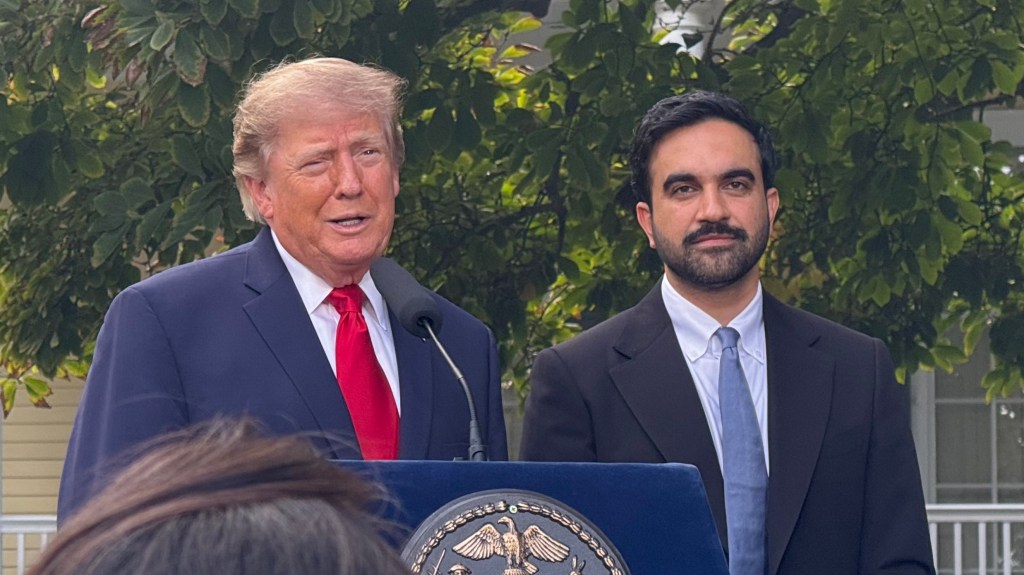
President Trump sort of inadvertently made an argument for banning horse carriages from Central Park on Thursday when he critiicized the City Council's 40-7-2 vote to end the Central Park horse carriage industry with an ill-conceived analogy to cars.
The city's much-anticipated program to require speed-limiting devices inside the cars of repeatedly reckless drivers will launch next year, though questions remain.