Streetsblog provides high-quality journalism and analysis for free — which is something to be celebrated in an era of paywalls. Once a year, we ask for your tax-deductible donations to support our reporters and editors as they advance the movement to end car dependency in our communities.
If you already support our work, thank you! If not, can we ask for your help?This year's fundraiser includes a special gift for our biggest supporters. Don't miss out.
Together, we can create a more livable, walkable, bikeable, equitable and enjoyable city for all. Happy holidays from the Streetsblog team!
Time is not on their side.
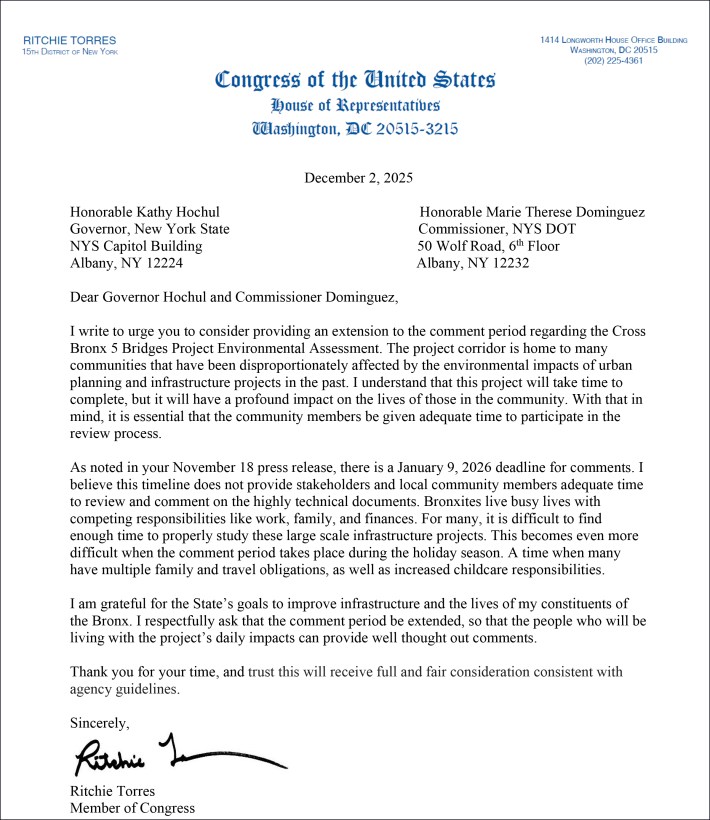
Rep. Ritchie Torres and advocates who got the state Department of Transportation to back off from a plan to build an expansion of the Cross Bronx Expressway are asking the state to give the public more time to respond to the draft environmental assessment for the plan that was quietly released after business hours on Nov. 18.
The public was given until just Jan. 9 to weigh in on the 6,000-page document — a 53-day period that includes multiple holidays.
The Torres letter.
"This timeline does not provide stakeholders and local community members adequate time to review and comment on the highly technical documents," Torres wrote to Gov. Hochul and state DOT Commissioner Marie Therese Dominguez on Tuesday. "For many, it is difficult to find enough time to properly study these large scale infrastructure projects. This becomes even more difficult when the comment period takes place during the holiday season. A time when many have multiple family and travel obligations, as well as increased childcare responsibilities."
Torres sent his missive one week after a coalition of advocates rallied the state to extend the public comment period to 90 days, citing similar reasons as Torres, namely that the holiday sprint is no time to expect people to pick through an environmental assessment and its appendices.
"We need time, and we're not going to have it," state Sen. Gustavo Rivera said last week. "I don't know about you, but I'm trying to figure out what I'm going to bring in my friend's Thanksgiving thing on Thursday. And I know Thursday I'm going to be filled up with turkey and drunk, so I'm not going to be reading any report. Neither are these folks."
The state DOT has eliminated the most harmful possibilities it once floated for the project, which will repair five elevated sections of the Cross Bronx Expressway that have reached the end of their useful life. The agency originally was going to knock the bridges down and build a diverter road next to the highway in order to keep moving traffic, which it then planned to convert to what it called a "community connector" that included a bike/pedestrian path and a bus lane. The state also appeared to be using this repair plan as a way to build an entire parallel road next to the Cross Bronx that would have functioned as a de-facto highway expansion.
Grassroots opposition derailed the diverter plan, and the state will now fix the bridges in piecemeal fashion without the diverter road.
However the repair plan still involves rebuilding the bridges with wider shoulders. The draft environmental assessment argued that the work needs to be done in order bring the bridges to what the state says are modern design standards, and to cut down on crashes on the elevated sections. The same coalition that fought the diverter road has objected to any widening of the highway's footprint, including wider shoulders. The state DOT has also suggested it could build a bike and pedestrian path connected to the rebuilt Cross Bronx bridges, but last week the anti-highway widening advocates objected to that plan as well.
"We have a genuine concern with anything that expands the footprint of the Cross Bronx," Bronx River Alliance Executive Director Siddartha Sanchez said last week. "That includes expansion for shoulders, expansion for a shared use path, particularly because they have an impact underneath the expressway. Also because we understand that is future capacity that could be permitted down the road to increase the volume of vehicles on the expressways and, by extension, the volume of air pollution in the community."
Feedback on the draft EA will be used to determine which one of the three alternatives the state selects to actually do the repair project, which is why advocates want as much time as possible to weigh in on the document.
The state DOT has said that the 53-day commentary period is longer than the traditional 30-day period, but the agency did not directly say whether the public comment period will be extended any further.
"The New York State Department of Transportation ... is committed to working with the community at every step in the process," said agency spokesperson Joseph Morrissey. "We have worked closely with elected leaders at every level of government, including Rep. Torres, to ensure that the needs and priorities of the community are reflected in this project."
Dave Colon is a reporter from Long Beach, a barrier island off of the coast of Long Island that you can bike to from the city. It’s a real nice ride. He’s previously been the editor of Brokelyn, a reporter at Gothamist, a freelance reporter and delivered freshly baked bread by bike.
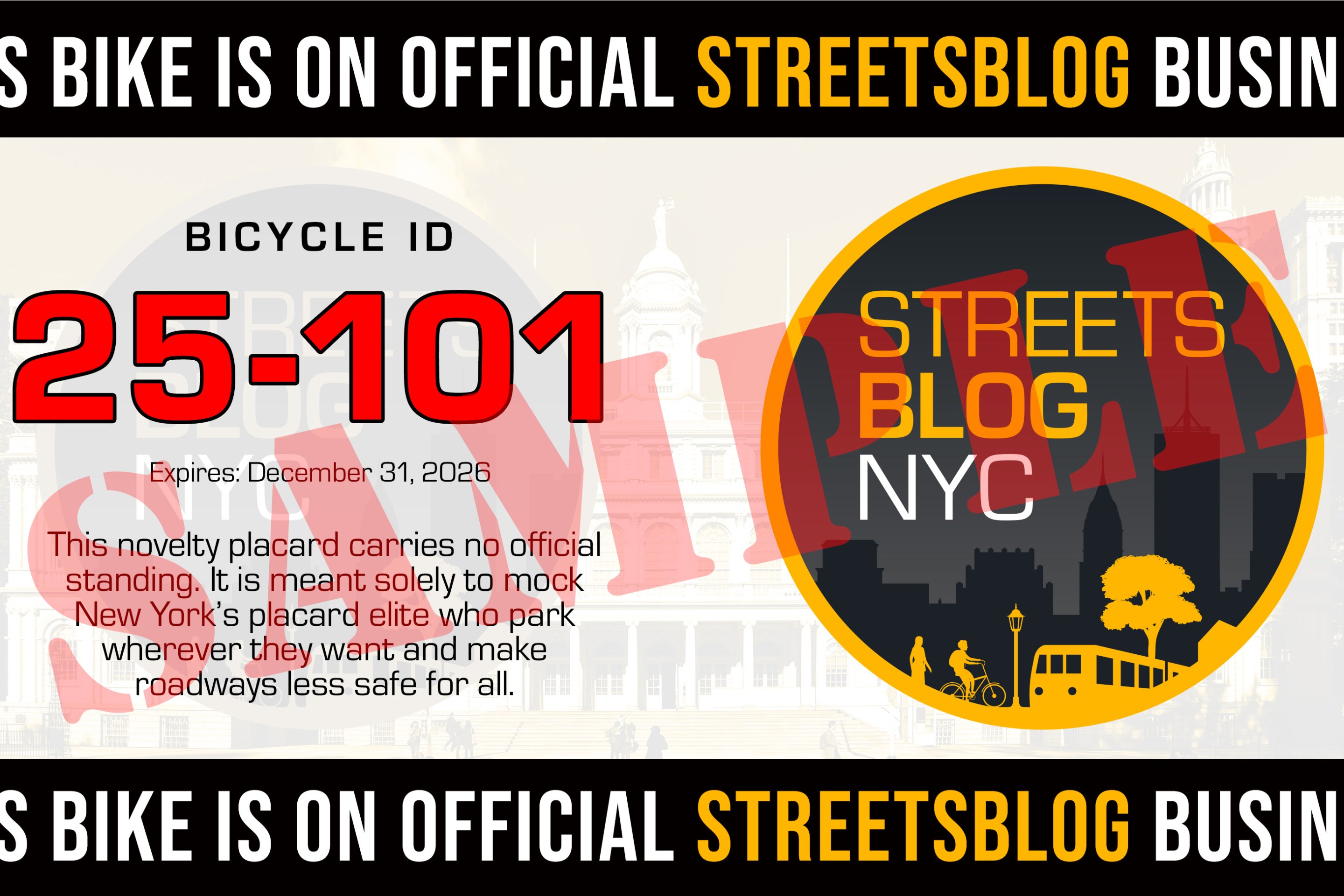
This year, your donation comes with the ultimate city perk: a completely official-looking, yet completely fake, Streetsblog parking placard! Donate today!
Watch as I consume a psychedelic drug known for revelatory visions (and, trigger warning, inducing vomiting) in hopes of getting federal drug agents out of the 10th Avenue bike lane.