DOT Reveals Draft Map For Staten Island Bike Share System in 2021

Staten Island’s latest bike share pilot is taking shape, as the Department of Transportation revealed a preliminary map for the next company to provide the service in 2021.
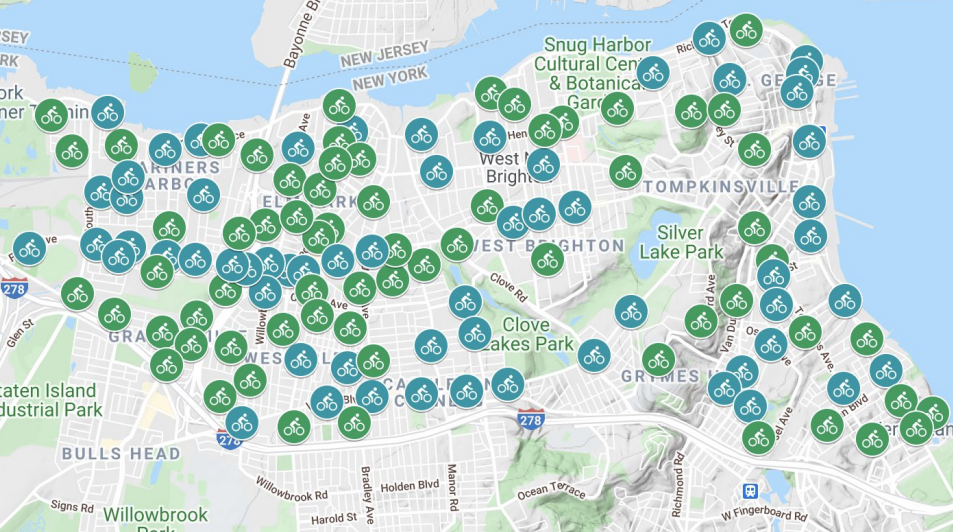
The DOT revealed the service map for Beryl, the British dockless bike share company picked to serve the island, in a presentation this month to Community Board 1. The company says it will bring 350 dockless bikes to the north shore of Staten Island, both pedal-assist and traditional rides by March. Beryl bikes are dockless, but users are charged an extra fee for parking bikes outside of designated spots known as bays, which are painted onto streets and sidewalks.
Per the DOT presentation, 128 Beryl bays will densely cover north and west Staten Island. Sixty-seven the bays will be painted on the street, and 61 will be on the sidewalk. The service area for the bikes is larger than the borough’s initial dockless bike share pilot, but it still pales in comparison to what was originally promised by the city: a 1,000-bike rollout across the entire island. The DOT will spend the fall painting the docks on the street and sidewalk, in preparation for the company’s debut next spring.
The presentation also revealed the pricing details: Riders will be able to use their smartphones to unlock the bikes for single rides at $1 per bike (plus .15 cents per minute) and $1.50 per e-bike (plus .25 cents per minute). Users who load up minutes in advance — $15 gets you 100 minutes and $60 gets you 600 — will only have to pay the $1.50 fee to unlock an e-bike. A $12 day pass entitles riders to an unlimited amount of rides in a 24-hour period.
Users who park their bikes outside of the designated bays will be hit with $3 extra charge, and those who park the bikes out of the service area entirely will have to pay an extra $25 fee.
Bery’s debut next year, which also doubles as the company’s debut in America, will also mean the return of bike share to The Rock for the first time since Jump and Lime exited in late 2019 — and now that the Bronx has gotten Citi Bike, Staten Island is the only bike-share-free borough. Beryl was originally supposed to debut on Staten Island in the spring, but the company said coronavirus-related travel restrictions made it impossible for company employees to come to America.

Read More:
Streetsblog has migrated to a new comment system. New commenters can register directly in the comments section of any article. Returning commenters: your previous comments and display name have been preserved, but you'll need to reclaim your account by clicking "Forgot your password?" on the sign-in form, entering your email, and following the verification link to set a new password — this is required because passwords could not be carried over during the migration. For questions, contact tips@streetsblog.org.