Do Alternate Side Parking Rules Increase Traffic Congestion?

Our regular babysitter Laura, an R train commuter, is out of town this week. Nicole, the woman providing us with back-up nanny service for our 1-year-old, travels to our house, in Park Slope, in a mini-van. This morning she noted, quite happily, that there was so little traffic on her way from Ocean Parkway that she was trying to figure out what holiday it must be.
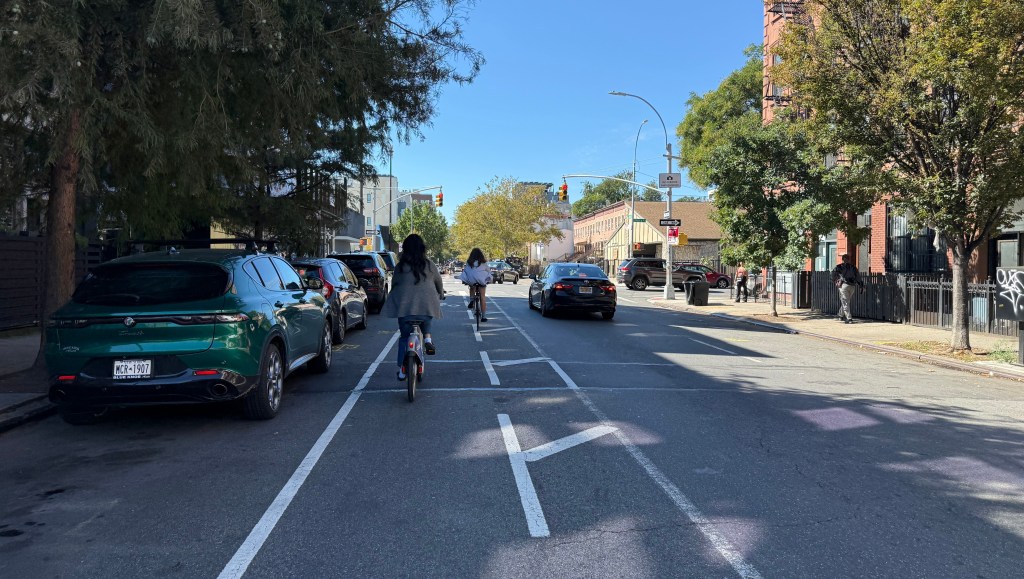
We live on Union Street between 4th and 5th Avenue, and as I biked our 3-year-old up to school at 8th Avenue and Garfield around 8:45 a.m., I also noticed what seemed to be a distinct lack of morning rush hour chaos in the neighborhood. Union Street was unusually mellow. Except for the usual delivery trucks, 5th Avenue seemed weirdly empty. Seventh Avenue looked pretty busy but traffic was really moving on 8th Avenue, which is sometimes very backed up in the morning. Only one car passed us as we biked up First Street.
As has been noted repeatedly and in oddly gleeful fashion by the New York Times, the Department of Transportation has suspended alternate side parking regulations in Park Slope for the summer. And while the press and Community Board types have mostly obsessed over how the new rules will impact residents’ parking availability, the more interesting and important question may be how the suspension is impacting traffic congestion and VMT (vehicle miles traveled) on local streets.
Certainly Nicole’s and my Wednesday morning observations aren’t enough to draw any conclusions. But how’s this for a hypothesis: A measurable amount of New York City’s traffic congestion, at least in some neighborhoods, is created by car owners moving their vehicles to comply with alternate side parking regulations. Eliminating or changing the regulations could help to reduce traffic congestion, vehicle miles traveled, pollution and carbon emissions on New York City’s streets.
Park Slope is the laboratory this summer. How might one go about testing the hypothesis?
Photo: Entobox/Flickr

Read More:
Streetsblog has migrated to a new comment system. New commenters can register directly in the comments section of any article. Returning commenters: your previous comments and display name have been preserved, but you'll need to reclaim your account by clicking "Forgot your password?" on the sign-in form, entering your email, and following the verification link to set a new password — this is required because passwords could not be carried over during the migration. For questions, contact tips@streetsblog.org.