What’s Going To Happen To The Land Around Penn Station?

What’s the plan?
Albany’s latent power over the land that surrounds Penn Station is colliding with Amtrak’s desire for tax revenues to fund President Trump’s reconstruction of the transit hub — and at least one state legislator wants to break the impasse with a big dose of build, baby, build.
In 2021, then-Gov. Andrew Cuomo empowered the Empire State Development Corporation to renovate and potentially expand Penn Station, and redevelop the area surrounding the station under a general project plan — a formal state land-use process that transfers zoning power from the city to the state. Amtrak now wants to seize that power for itself, to fund Trump’s dream of a gleaming train station.
Enter Assembly Member Tony Simone (D-Manhattan), who wants to use the existing GPP to convert Penn Station’s periphery into a new 24/7 neighborhood. Simone’s gambit is now running up against the risk that Amtrak seizes the land or undermines the GPP first.
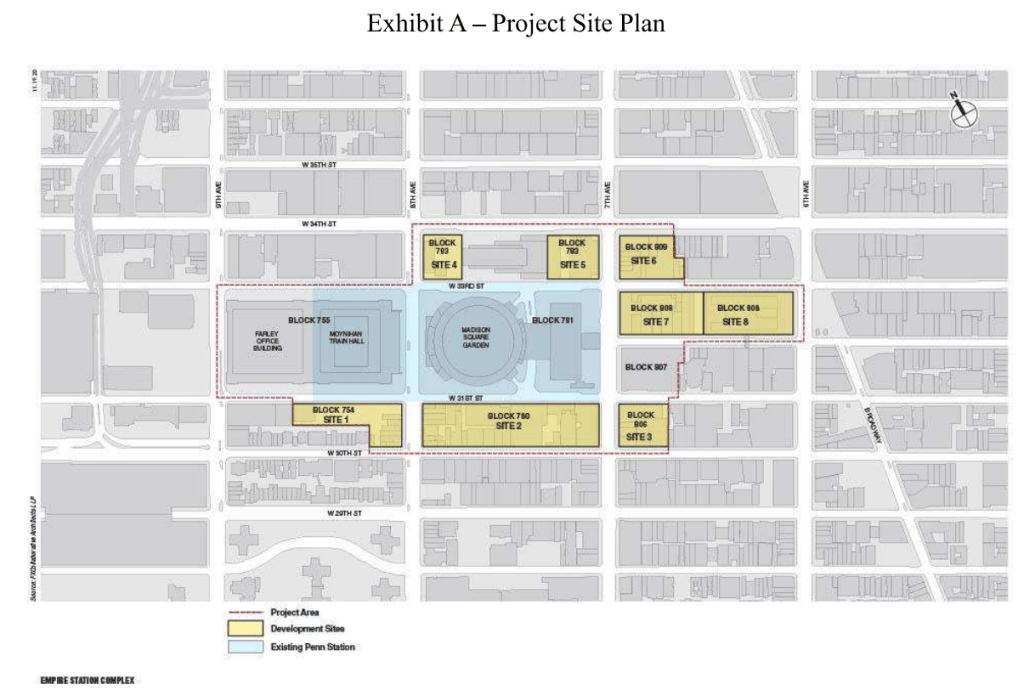
That GPP — which Cuomo originally stewarded before his scandals transferred the task to Gov. Hochul — proposed “a comprehensive mixed-use redevelopment initiative for a revitalized mixed-use area” on eight sites located between Sixth and Ninth Avenues and West 30th and West 34th Streets. Those projects would be “designed to support and generate essential revenue to help fund the reconstruction and potential expansion of Penn Station,” the plan stated.
Under Cuomo’s original proposal, the “mixed-use redevelopment” piece involved eight new office towers and the possibility of enlarging Penn Station’s footprint one block south of Madison Square Garden. That specific block, between 30th and 31st Streets and Seventh and Eighth Avenues, is known as Block 780 and has engendered intense local opposition that continues to this day. When Gov. Hochul tweaked the plan, she added language to include up to 1,850 residential units in buildings on three of the lots, but still left open the possibility of demolishing Block 780.
The opposition to the GPP centered on Block 780 because real estate behemoth Vornado, which owns a number of lots around the neighborhood, did not own Block 780. That meant the existing residents and businesses in the buildings on the sites did not see a huge upside in demolishing the places where they lived and worked.
But a soft market for office space in the aftermath of the pandemic undermined the entire theory of the plan, which revolved around the addition of tens of thousands of square feet of office space to the city. In 2023, Hochul “decoupled” the GPP from funding the Penn Station renovation and expansion.
But nobody seems to know what exactly that means or what “decoupling” the GPP from its original purpose entails. After Hochul severed the land-use scheme from funding Penn Station, the GPP now exists to preserve a handful of Midtown blocks in amber. On paper, the GPP still overrides local zoning — thereby allowing for the same development possibilities, for the same purpose, as it did when New York attached the plan to the Penn renovation. When Hochul announced the plan would no longer fund that work, her press release noted that “the GPP remains a tool that can be used in the future to support additional infrastructure development.”
The area covered by the GPP thus exists in a kind of limbo. Even if the Penn Station project it was intended to fund isn’t happening, the zoning override from the state still governs the land around the station.
Simone says
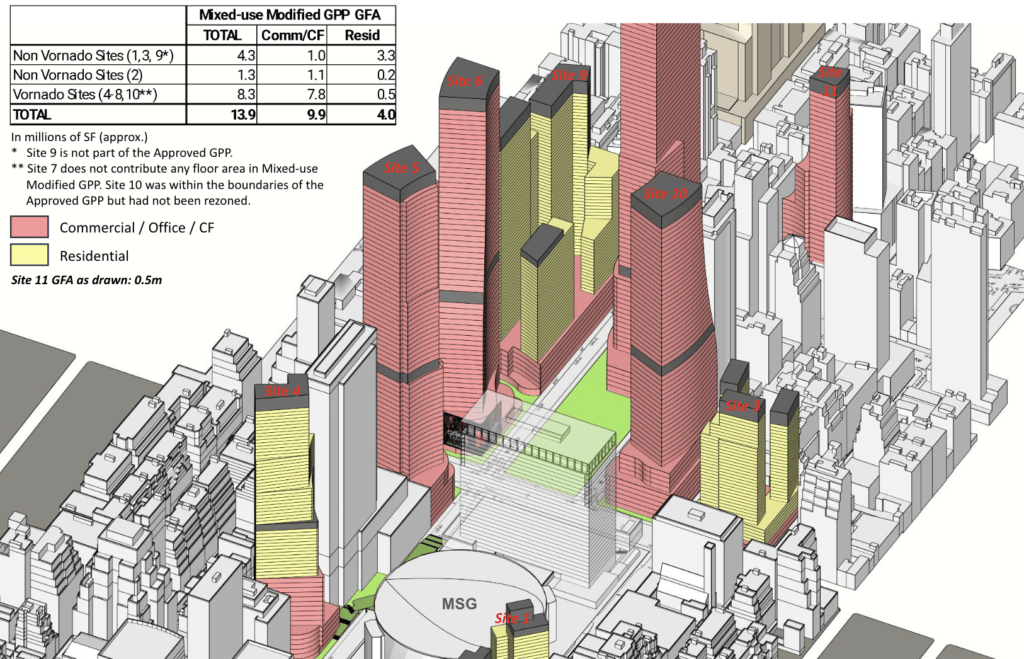
Simone swooped in last year with a proposal to modify the GPP to build 5,000 apartment units in multiple buildings on four sites, plus five office towers and a park on ten lots on the blocks surrounding Penn Station. The switcheroo also removed Block 780 from the redevelopment scheme.
The Midtown Assembly member believes the state should revive the GPP in a modified form, not throw it away.
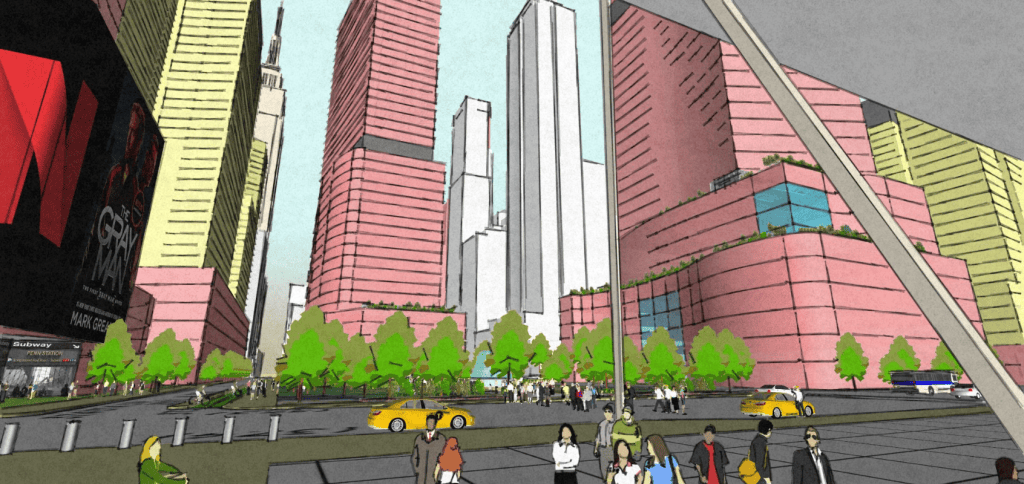
“I have a vision with other colleagues and local community boards and leaders of having a 24/7 mixed-income housing and work-play-live community,” said Simone. “We have an amazing opportunity to go to five thousand units of housing around Penn Station. We don’t need six or seven Empire State building-size office buildings. We should shift the model of having a housing-first vision in the neighborhood, and a beautiful park like Bryant Park that would be the anchor as you exit Penn Station.”
This may sound familiar. Two nearby neighborhood-scale developments, Hudson Yards and the newer Manhattan West, already feature office towers, apartment buildings and a bevy of recreational diversions. Manhattan West sits directly across Ninth Avenue from Moynihan Hall, and links to Hudson Yards via the Moynihan Connector on the High Line. Simone’s proposal would effectively create a nearly contiguous work-live-play neighborhood in Midtown West.
As Simone tells it, Hochul could begin turning the Penn Station area into a miniature version of the Financial District’s revitalized office-residential neighborhood with the stroke of a pen.
The housing component of Simone’s proposal is neither ambitious nor novel, but it still has a lot of moving pieces. In 2022, the GPP received approval from the Public Authorities Control Board, an obscure body that answers to both Hochul and Albany and must sign off on project financing proposals by certain state authorities. But when the PACB approved the GPP, it required ESD and the governor to seek its authorization for every tax break for every development inside the GPP.
These obstacles have affected Hochul’s enthusiasm for the plan. A member of her administration told Streetsblog that Simone’s desired modification of the GPP would require significant amounts of time and effort to navigate the state’s arduous environmental review process.
Furthermore, Vornado owns all or part of the eight lots inside the current GPP area. The real-estate behemoth positioned itself as the chief beneficiary of the Cuomo-Hochul Penn Station plan, but when that fell apart, the company simply hitched its wagon to the federal effort to renovate Penn Station and signed on as a partner with the consortium running the project.
According to the Penn Station project FAQ, Vornado’s only interest in the Penn project is as a retail space landlord inside the train station itself. But as the city’s Class A office market heats up, Vornado has a chance to benefit from the same exact real estate scheme Hochul separated from funding Penn Station — but only if Amtrak Special Advisor Andrew Byford can convince Congress to keep a value capture provision in the stalled surface transportation bill.
Tucked away in the House’s version of the federal bill is an amendment that would allow the federally managed railroad and any “partners” to override local zoning and tax laws to build up around Amtrak property and use property tax payments to support work on Amtrak projects.
At a Crain’s panel in September, Byford told a passel of machers that the controversial value capture provision “has merit.” His comment alarmed a group of Manhattan elected officials who had otherwise welcomed his involvement in the Penn renovation. Simone, State Senator Erik Bottcher, City Council Member Carl Wilson and Manhattan Borough President Brad Hoylman-Sigal all signed a press release entitled “Byford Bucks NYC Elected Officials, Signals Support for Taking Control of City, State Tax Dollars, Properties Around Penn Station.”
But the officials’ show of force did not deter the formerly beloved local transit honcho from continuing to publicly lobby for the Amtrak amendment, most recently in the Daily News, where he characterized his boss’s land grab as “a financing tool common to large projects in New York City.”
Byford’s continued push for the legislation, combined with his threat that President Trump will build a new Penn Station one way or the other, drew a bemused rebuke from MTA Chairman and CEO Janno Lieber last week.
“I always knew Andy was a little conservative on social issues but I never expected he would go full MAGA, and that’s what he’s done,” Lieber told reporters at an unrelated press conference at the Roosevelt Avenue-74 Street subway stop.
“It’s not gonna help to threaten us with behavior like we’ve seen from Washington recently,” he said. “To fund the project, they’re going to steal the property taxes from the center of Manhattan’s central business district that are normally used to fund cops and firemen and teachers, and they’re gonna take all that money and they’ll build Penn station and they’ll have all the glory … That’s nonsense.”
It’s unclear whether the surface transportation bill will survive a lame-duck Congress when lawmakers return to work after the midterm elections. It’s equally uncertain whether the value capture amendment will make it through a stalled Senate version of the bill or a final version that is presented to both legislative houses. If the bill or amendment go nowhere, Trump and Byford can put the GPP back in play.
Smash and grab
Trump and Byford would not be able to simply rip the GPP away from Hochul and New York. But if Amtrak can’t count on a federalized value capture to fund part of the Penn project, Byford will not have a ton of options to assemble the requisite funding for the $8 billion project.
Last November, The New York Times journalist Dana Rubinstein asked Byford whether he would ask New York to play ball with the GPP. “I think my best answer on that can be TBD,” he said at the time. “I’ve learned in life not to rule anything out, but not to necessarily rule anything in. We are working up ideas on what the business case could look like and the sources from which we can build that capital stack. I’m obviously mindful of the GPP. I’m aware of it.”
Almost one year later — no closer to a fully funded project — the journalist Michael Oreskes asked Byford if he would talk to the governor about using the GPP if the surface transportation bill doesn’t go his way. “Time will tell,” said Byford, who was talking with a group of reporters after the Crain’s panel in September.
“Using” the GPP is not as easy as flipping a switch, but as long as the document’s land use and its stated aims are on the books, the federal government could lean on New York State enough to essentially restore the GPP’s financial support of Penn’s renovation. It’s a Hail Mary plan for a bad cause — and it may not even work, since the PACB would retain its power to approve, or disapprove, each payment-in-lieu-of-taxes agreement or tax break for each development site.
Trump has not been shy about illegally withholding funds from states he considers his enemies and his Justice Department has demonstrated a gleeful willingness to launch sham investigations to satisfy the president’s innumerable grievances and grudges.
But Hochul is unlikely to follow the path of former Mayor Eric Adams, who extensively cooperated with the Trump administration after the president ordered the Department of Justice to drop pending criminal corruption charges against him.
Simone dismissed the idea that Hochul would fold if Trump attempted to strong arm her into giving up the land use powers. “I don’t think this governor, who’s been strong against the president, would hand the GPP to him,” he said. “I’m not personally worried about that.”
But Byford is the one who recently wrote, in public: “Ultimately, the new Penn Station will be built — the president is going to see to it.” If the president maintains his commitment to the Penn project, and he remains interested in paying a big favor to donor and pal Steven Roth, then who exactly is going to stop him? The Supreme Court treats him like a king; it is entirely imaginable that they would force New York State to surrender its land-use powers to pay for Trump’s vanity project.
Get rid of it
Given the development freeze around Penn Station, and the lingering chance that the federal government seizes the GPP for its own purposes, some experts want the governor should to trash the entire plan.
“The danger of the GPP remaining on the books is that the Trump administration could try to squeeze Hochul to get the same benefits for Vornado if they fail in Washington,” said Reinvent Albany Senior Policy Advisor Rachael Fauss.
Vornado’s involvement also complicates Simone’s plan, because the real-estate behemoth still owns the five sites from the original GPP. Simone’s proposal also adds a sixth Vornado site, known as Site 10, which is on the western end of the block between West 31st and West 32nd Streets and Sixth and Seventh Avenues.
Simone’s modified GPP takes Block 780 out of play and adds two new sites to the plan. The first is what he calls Site 9, on the east side of the block between West 33rd and West 34th streets and Sixth and Seventh Avenues. The second is what he calls Site 11, which is the trapezoidal block bounded by West 31st and West 32nd Streets, Sixth Avenue and Broadway. Both would require additional negotiations with property owners in the area.
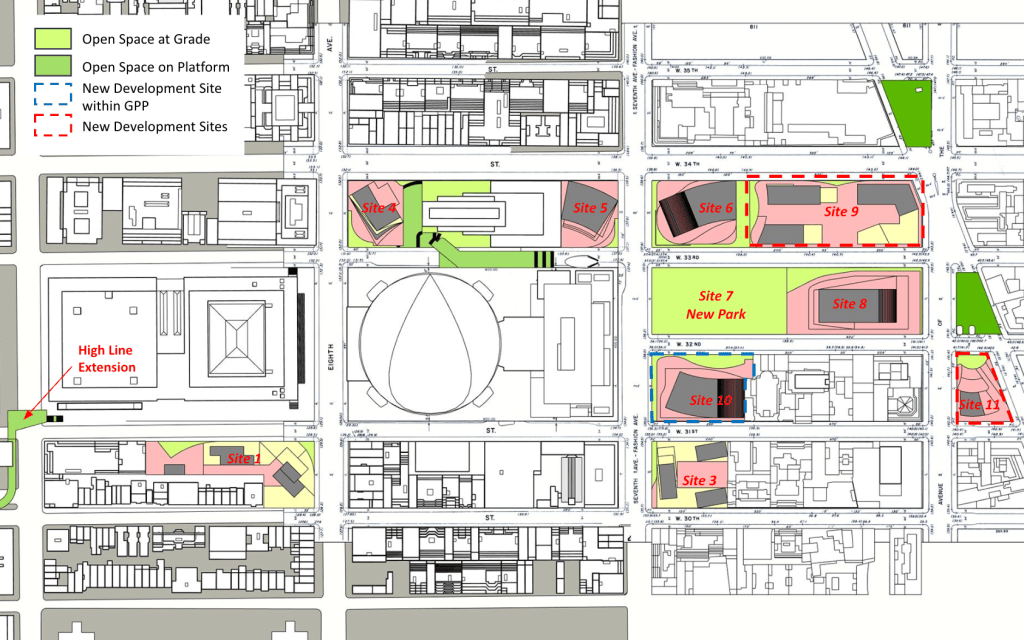
In reopening the GPP to change the projects it would allow, Hochul and ESD would need to discuss financing with Vornado and other affected landowners. Simone himself has pitched a financing plan for the GPP in which Vornado would give Sites 4 and 7 to New York State and receive permission to build an office on Site 8. New York, in turn, would build a residential development and a park on Sites 4 and 7. According to Simone’s math, the state would gain $1.5 billion of property in exchange for $1.5 billion in reduced property taxes and other monetary benefits for Vornado.
Even if this math penciled, Hochul and ESD would still need to work out financing for the other sites not covered by Simone’s plan. Fauss said she was skeptical this strategy would benefit the city, and pointed to the mixed results of various state-level economic development schemes in the past.
“[Reinvent Albany] doesn’t trust ESD to be the right party here,” she said. “The usual scheme is you can do more height, you can do more whatever in exchange for giving us payments in lieu of taxes. We’ll give you the incentive, but then you’ll pay us. They’re overriding zoning, so why isn’t city planning doing this instead? Because it’s city land.”
Fauss credited Simone for trying to make something out of the GPP that was less of an overt power grab or giveaway, but she also argued for the city to have control over the future of several extremely valuable parcels of land.
“Tony Simone may have good intentions of trying to salvage this,” she said. “The original problem of it was [that] it was an Andrew Cuomo state-power grab. You’d have to trust that the state isn’t going to try to extract something. Would you rather have the Hochul administration negotiate with Vornado, or would you rather have the Mamdani administration negotiate with Vornado?”
Whether the city would be at all interested in tackling the question of what to do with the entire Penn Station area is also an open question.
A representative for Mayor Mamdani did not respond to a request for comment.

Read More:
Streetsblog has migrated to a new comment system. New commenters can register directly in the comments section of any article. Returning commenters: your previous comments and display name have been preserved, but you'll need to reclaim your account by clicking "Forgot your password?" on the sign-in form, entering your email, and following the verification link to set a new password — this is required because passwords could not be carried over during the migration. For questions, contact tips@streetsblog.org.