The Explainer: Why The Penn Station Project Is Getting All Messed Up, Again
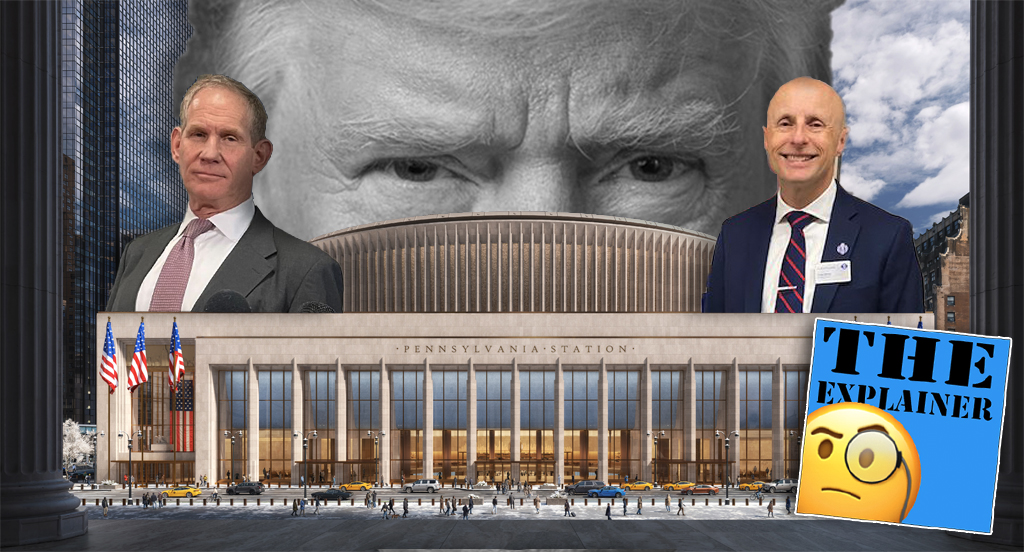

The Penn Station mess is arriving right on time.
The latest effort to renovate the transit hub is being dogged by turf wars, questions over funding and obscure secret documents, which will sound familiar to anyone who watched the last two efforts to renovate the station fall apart under their weight as real estate scams masquerading as transit improvements.
It was supposed to be different this time, even as it started with a tempter tantrum by a reality-TV-star-turned-Transportation-Secretary, but now it looks once again like a real-estate scam masquerading as a transit improvement done at the behest of Donald Trump.
We know how hard it is to keep all these trains of thought on the right track, but that’s why we have The Explainer to stoke the engine, starting with your most basic questions:
So, um, what was last week’s pissing match about?
You may have thought the exchange of anguished letters were the province of 19th-century epistolary literature, but Amtrak special adviser Andrew Byford and MTA Chairman and CEO Janno Lieber proved you wrong last week.
Byford began the fusillade with a letter asking Lieber to sign a “memorandum of agreement” for the ongoing Penn Station renovation, but before he sent it to Lieber, he sent it to several reporters for the purposes of having said reporters write stories that essentially came down to, “Wow why is Janno Lieber being so unreasonable?”
This ticked off Lieber, who sent Byford a letter of his own informing him that the MTA essentially did not trust the Briton, and that instead of signing an agreement, the agency would rely on the various rights it has under its existing very long, pre-paid lease to operate out of Penn.
The subtle burbling tension around the Penn project finally exploded into obvious and boiling tension. Just in time!
But this kind of tension is baked into the Penn Station project, right?
In one way or another, yes. People have moaned about restoring the grandeur of the old Penn Station since even before it was fully knocked down, and many elected officials have vowed to make things right. The most recent attempt started, as so many things, with a big Andrew Cuomo power play.
In 2020, the then-governor set his sights on a big Penn Station expansion he called Penn South. That plan proposed knocking down a city block across the street from Penn Station, where the state would build a new train hall atop eight new tracks — a necessary capacity expansion in advance of the ongoing Gateway tunnel, as well as Penn Access, which will allow Bronx commuters to get to Penn Station in addition to Grand Central.
Cuomo also wanted to rip up the insides of Penn Station to make it less cramped, and buy and demolish the then-Hulu Theater from Madison Square Garden to create a grand entrance on Eighth Avenue (sound familiar?).
That doesn’t sound that bad. So what went wrong?
First, Cuomo said it would cost $8 billion for Penn South, but later reporting pegged the cost at $15 billion. Whoopsie!
Worse, the entire “Empire Station Complex” as Cuomo dubbed his plan was really closer to $22 billion when you tallied up the Penn renovation, the expansion, public realm improvements and transit improvements, according to Reinvent Albany.
The governor proposed having Amtrak cover half the cost, with New York and New Jersey chipping in 25 percent each. A big chunk of New York’s piece of the funding puzzle was supposed to come from a land-use action called a General Project Plan, which would allow mega-developer Vornado to put 10 office towers around Penn Station and then spin off the resulting property tax revenues to fund some of the renovation.
Key note: Instead of regular property taxes, Vornado was going to send New York State something called Payments in Lieu of Taxes, a specialized form of property taxes that are used to back a specific project, and that come with a discount for the developer paying them — allowing Vornado to pay a lower tax bill and (and here’s where the “lieu” comes in) avoid sending money directly to New York City’s general fund.
That doesn’t sound fair!
Oh, come on, what would New York City do with all that property tax revenue anyway? I mean, other than fund the government, that is.
So what happened?
Fortunately, before the boondoggle could be sprung, the pandemic cut the legs out from the city’s office market and Cuomo resigned for (take your pick): nursing home-related COVID deaths, a corrupt book deal, being a sex pest, being a bully, everyone becoming sick of his shit.
But when Cuomo went away, the idea of Fixing Penn Station didn’t. Gov. Hochul’s 2022 plan dropped the Penn South block demolition (fortunately, she also dispensed with the grand Eighth Avenue entrance). Instead, she pushed a single-level Penn Station with a mid-block glass atrium in place of an unused taxiway at Madison Sqaure Garden. The plan didn’t explicitly pay off MSG owner James Dolan for his property in the way that Cuomo would by purchasing the Hulu Theater, but it did propose buying the mercurial billionaire’s cooperation with a series of infrastructure upgrades for MSG like an underground loading dock.
Similar to Cuomo’s plan, New York hoped for a 50/25/25 split among Amtrak, New York and New Jersey, and a big piece of New York’s share was supposed to be paid for by PILOTs from Vornado, which now had to build nine office towers and one residential building instead of 10 office towers, still done under the auspices of the GPP.
All of this would cost $7 billion, which is a lot cheaper, yet people still didn’t like it or the way it was supposed to be funded.
What didn’t people like?
Really, you should just read this story. The cosmetic touches were nice, but people said this was a lot of money to pay for a face lift. In any event, by 2023, Hochul “decoupled” the General Project Plan from paying for Penn Station, and international conglomerate ASTM was pitching a competing Penn Station plan that revived the idea paying MSG for the Hulu Theater to build a big Eighth Avenue entrance.
The people in charge of this stuff really seem to like a grand train entrance, eh?
Yeah.
But Hochul’s Penn Station plan had no funding strategy even as the MTA forged ahead with a chosen designer. Meanwhile, ASTM was hawking a gorgeous plan that relied on funding a lot of the project upfront, including a $500-million chunk to buy the theater at MSG, but then charging customers of Amtrak, the MTA and NJ Transit $250 million a year in fees for 50 years to recoup their costs and also make money. (Do the math: That’s $12.5 billion.)
ASTM initially said its plan cost $6 billion but then it turned out it would cost $8 billion because the suggested price didn’t account for inflation. Meanwhile, the MTA started and finished a project to renovate the 33rd Street and Seventh Avenue entrance to Penn Station by raising the ceiling more than twice as high as it had been and putting a big halo on the escalator and people fucking loved it.
If the biggest problem with Penn Station is the aesthetics, why don’t Amtrak and NJ Transit simply make a minor renovation like the MTA did and call it a day?
The simplest answer here may be that Donald Trump doesn’t like “minor” anything (well, at least when it comes to construction projects). And you may recall that the president failed to kill congestion pricing, and that made him very angry. In the midst of that pique, Transportation Secretary Sean Duffy decided that the federal government would take over the Penn Station project. Grabbing this boondoggle with both hands was supposed to be some kind of punishment to New York, which is still a strange thing to consider, given that Hochul was only too glad to cede control of the unfunded project, as long as she didn’t have to pay her state’s share.

Duffy put former New York City Transit President Andrew Byford in charge of the effort to find a developer to bring Penn Station up (or down, depending on your perspective) to Trump’s aesthetic standards.
Byford’s search for a developer ended in June this year and brought us all the way back to 2023, as Amtrak chose Halmar (which is owned by ASTM) and its plan for a grand Eighth Avenue entrance that pays off James Dolan. Vornado is there as part of the team, too
Why is Vornado always in the center of this?
Vornado remains part of the Penn renovation team because the General Project Plan still exists, even if it’s currently mothballed. Company CEO Steve Roth is a friend of Donald Trump, but at his tax bracket friendship crosses ideological lines: he’s also bought friendships with Cuomo and Hochul, which has allowed him to continue being a friend with ideas for the area around Penn Station no matter who’s in charge.
And if the GPP isn’t revived, there’s another possible path for Roth to get his way: there’s an Amtrak-backed amendment to the national surface transportation bill that would allow the railroad to override local zoning codes for the purposes of funneling property tax money towards its projects. How convenient that Vornado and Roth own so much property around Penn Station! (The amendment is pending as the larger bill works its way through the sausage machine in Washington.)
The Penn project FAQ suggests Vornado is just a 15th man at the end of the bench, mostly there to make sure the forthcoming Pollo Campero has a big enough space in the future retail strip, but to anyone with eyes there are obviously still chances for the connected developer to cash in big time.
There’s been a lot of money talk, but how much is the new Penn plan supposed to cost — and who’s supposed to foot the bill?
That question has been hovering over the Penn renovation for over a year. Before the master developer was selected, Byford said he couldn’t tell us how much it would cost because he didn’t have a design. But he did say in no uncertain terms that the federal government would not pay the full cost of the project.
Last December, I asked Byford why the federal government couldn’t just pay for this itself. Byford said that because “different financial models” had failed in the past, the financing for the project had to involve a public-private partnership model that brought in financing from the private sector. Of course, that also allows the private partner to recoup its costs on the backs of transit users.
Byford isn’t wrong that previous financing models fell apart. But those models relied on a cost-sharing plan where two states had to find at a minimum $1.75 billion each, which is hard because they can’t print money. The federal government spent $7 trillion in Fiscal Year 2025.
The limitless financial power of the federal government dwarfs the money moves piddling states like New York and New Jersey could make. The price tag of $8 billion represents roughly 0.4 percent of the federal government’s $1.9 trillion in discretionary budget. Nonetheless, Byford is going around suggesting that the federal government can’t find $8 billion from the couch cushions to pay for a project taken over by Amtrak at the behest of a gold-foil- and renaming-building-loving president.
“I think anyone who suggests that the public sector will fund 100 percent of this project is probably deluding themselves,” Byford said last year.
So Byford wants us to pay?
One bit of news that was revealed in Byford and Lieber’s epistolary battle was that an initial version of the agreement Amtrak wanted the MTA to sign had a “requirement for financial contribution,” meaning the MTA would have had to pony up some cash for the project if it signed.
Byford’s letter, however, claimed that Amtrak had removed that requirement, but the fact that it was there at all is not encouraging and suggests that at least part of this fight has to do with whether or not Amtrak is trying to impose a cost sharing agreement on the MTA for a project that agency leadership never wanted to do in the first place.
Why are two professional technocrats with decades of experience in government at each other’s throats? Is this just about men and their egos?
I mean, it wouldn’t be the first time important questions of public policy were refracted through a dick-measuring contest.
But the worst thing you can say about Lieber is that he is wounded by the fact that he had an opportunity to finally be the Guy to Fix Penn Station, which people have been moaning about for decades. Then it was taken away from him by haircut (Duffy) who kept calling the subway a “shithole” and handed to former rival at the MTA who built a whole cult of personality around how smart and charming he is (Byford, whom many still call “train daddy”).
Now Lieber is facing the prospect of seeing the widely celebrated work he did on the one spruced-up piece of Penn Station torn up at some point. Lieber’s short fuse and clear annoyance over Penn Station-related questions at a press conference on Wednesday was more guff stuff than usual for the gruff MTA boss.
But he’s not wrong when he champions Long Island Rail Road riders.
“I’m declining to be the first person in New York real estate history to say I want to enter into a real estate deal with Donald Trump with no lease and no protections,” Lieber told the MTA Board on Wednesday by way of explaining why the agency wouldn’t sign the agreement with Amtrak.
OK, Janno has a point. But come on, it’s Andy Byford — Train Daddy!
We call him “Andrew” around here these days. Nicknames are for friends, and this version of Byford is not at all like the guy New York City fell in love with almost 10 years ago.
Byford’s press tour last year started with a cheerful declaration that “my trump card is the Trump card,” an odd thing to say about a man who was and is actively waging war on New York.
The transit professional who won plaudits for telling tough truths to Andrew Cuomo just limply shrugged off questions about how Trump’s attempts to kill the Gateway project would impact his own job of fixing Penn Station. The detail-oriented leader who whipped subway operations into shape has been shrugging off questions about funding or using weasel words to get around thorny questions on the subject. Byford spent months saying that it was inaccurate to suggest railroad customers would wind up paying for the Penn Station upgrades, but always attached that promise to the specific idea of ticket surcharges.
Once Halmar won its bid, company Vice President Peter Cipriano flatly stated that “availability payments” from the tenant railroads were absolutely on the table, at which point Byford said what he meant was that the money siphoned out of the railroad operating budgets merely wouldn’t be “unaffordable.”
Byford also hasn’t been forthcoming still about why exactly he needs the MTA to sign the same memorandum of agreement NJ Transit has signed. Always a skillful player in the press, there is clearly a reason that Byford gave a letter addressed to Lieber urging him to sign the memorandum to a select group of reporters before he even gave it to the MTA’s boss.
This is a tried-and-true tactic from advocacy organizations that are applying public pressure while working towards a specific goal, but this time it was directed from one government agency at another. There is clearly something Byford and Amtrak gets if the MTA signs the memorandum of agreement, but once Lieber rejected the offer in his own letter, Byford said it actually didn’t matter if the MTA signed on. It doesn’t make a lot of sense.
Speaking of making sense, help me understand why President Trump was at Game 3
What, you think that the president didn’t want to see whether Karl-Anthony Towns would thump Victor Wembanyama for a third straight game? Are you suggesting that perhaps with hundreds of millions, or even billions, of dollars at stake, James Dolan didn’t see a good opportunity to have a chat with Trump and Duffy about the future of the Infosys Theater? Well …
Let’s start with the basics: no one has put forward an independent assessment of the true value of the Infosys Theater, a 5,600-seat stub that hosts darts championships and Chrono Trigger In Concert. Three years ago, Dolan was supposed to get $500 million for the theater. Given who we are dealing with, is it impossible to imagine that Dolan, while he was hosting Sleepy Trump and Duffy in his box, was also telling them he couldn’t possibly let go of this treasured asset for less than $1 billion?
Maybe it was all on the level, but shortly after the luxury box confab, the White House included a mysterious $1-billion request for the Penn Station project in a federal Defense Department spending bill. Suddenly, it wasn’t so difficult to imagine what Trump, Duffy and Dolan were talking about.
Byford won’t say how much Amtrak will pay for the Infosys Theater, saying (oh the irony) that he doesn’t want to negotiate in public. (On the plus side, Byford is pushing to buy the theater, not simply to make things pretty on Eighth Avenue, but also to allow Halmar to remove some support columns that extend to the train platforms to free up room for passenger circulation and bring in some through-running.)
In light of the existing Moynihan Station, why does Penn Station need a “grand Eighth Avenue entrance”?
Also, with Moynihan and Grand Central Terminal, why does New York need a third grand train hall in Midtown?
Wow, you have a lot of questions. In both cases, the answer is, yeah, what the hell? But the better question that not enough people are asking is, “At the end of this whole process, will we have a better Penn Station?”
At the end of this whole process, will we have a better Penn Station?
If you define “better” the way President Trump does — “Will it look good and have my name on it?” — yes. But if you define “better” the way urbanists do — will it expand capacity to reflect expected population growth and the sustainable transportation needs of a booming region — the answer is simply no.
Byford’s said that this renovation could make room for some through-running when all is said and done, and included a study of the idea in the overall Penn project. But there are tricky governance and labor issues hanging over the idea of running NJ Transit trains into LIRR territory and vice-versa, which no one has really talked about. You could argue that it’s better to just get the physical constraints out of the way while you have the chance and figure out the rest later, but we won’t actually know the results of the service study until October 2027, which is also right around when the project is supposed to break ground.
Meanwhile, the questions around the funding and real estate pieces of the project are once again indicating that this entire thing is a real estate scam masquerading as a transit project. This is the third, or fourth, attempt to renovate Penn Station this decade and somehow they all wind up sounding the same: Vornado and Dolan get large bags of money, the price for the projects constantly change and you get either an atrium or a column-filled entrance across the street from Moynihan Station.
It will cost billions of dollars to accomplish this and your train won’t come any more frequently, but you will have a nicer place to walk through with the $8 small coffee you bought in a local chain next to a brightly lit corridor.

Read More:
Streetsblog has migrated to a new comment system. New commenters can register directly in the comments section of any article. Returning commenters: your previous comments and display name have been preserved, but you'll need to reclaim your account by clicking "Forgot your password?" on the sign-in form, entering your email, and following the verification link to set a new password — this is required because passwords could not be carried over during the migration. For questions, contact tips@streetsblog.org.