Amtrak’s Penn Station Dog And Pony Show Avoided the Only Question That Matters

No money, mo’ problems.
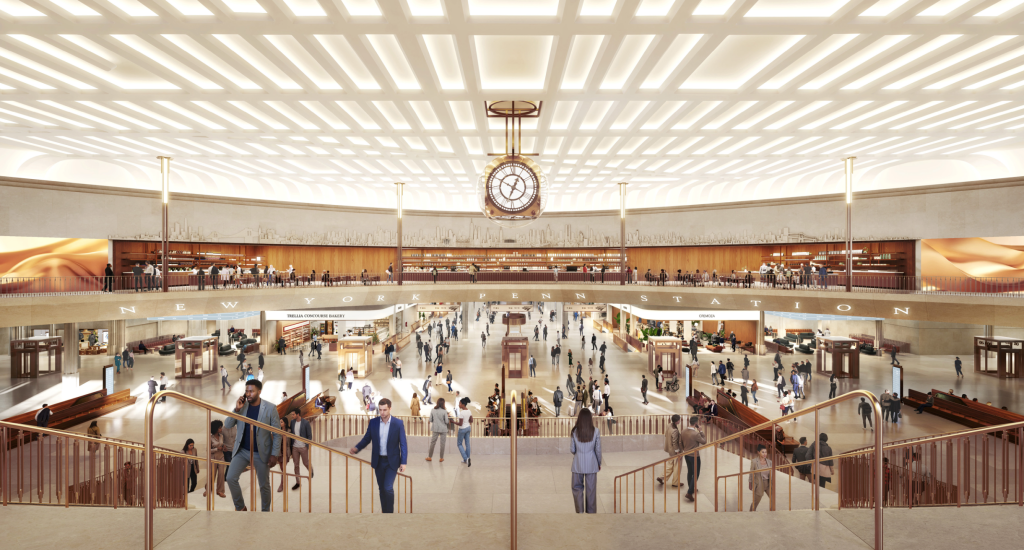
Amtrak honchos officially showed off renderings for President Trump and Secretary of Transportation Sean Duffy’s renovation of Penn Station on Monday, but left unsaid amid the unveiling of pretty pictures was the only aspect of the Penn Station redevelopment that matters: How much will it cost, and who’s paying?
One possible answer: Tenant railroads Amtrak, the MTA and New Jersey Transit. According to the development company vice president Peter Cipriano (who was a senior adviser to the U.S. DOT during President Trump’s first term), those tenants might have to pony up “availability payments” to cover a share of the project costs.
“Presumably there will be some level of availability payment at the end of the road on this project, like Amtrak has on 30th Street Station in Philadelphia,” the Halmar executive told reporters.
This type of payment scheme — which the railroads will almost certainly pass on to their riders — was the linchpin of the Halmar/ASTM plan that Cipriano’s team pitched the MTA in 2023. That plan would have involved Halmar and its parent company ASTM funding the renovation upfront, then collecting $250 million per year over 50 years from the three tenant railroads.
But neither Cipriano nor Andy Byford, Amtrak’s special adviser for Penn Station, would put a pricetag or timeline on the “availability payments.”
Byford, who has openly bragged about using President Trump to strong-arm New York into accepting the project, insisted he would not allow an “unaffordable” funding scheme.
“I made it very clear in the RFP to the bidders: do not come with a proposal that saddles the railroads, of which Amtrak is obviously one, with unaffordable availability payments, because you won’t get through, you will not win,” said Byford. “My strategy is to minimize the gap between the overall cost and what we can raise through capital, like loans and grants, and what remains to be paid for via availability payments.”
One type of “availability payment” that Byford insisted is not in play is a surcharge on train tickets for trips originating from Penn Station. But riders will wind up paying in one way or the other if Amtrak plans to charge the railroads they ride, and the MTA is already raising objections to the proposal.
“Gov. Hochul has been clear from the day President Trump took over this project: if he wants it, then he’ll have to pay for it,” said MTA spokesperson Mitch Schwartz. “Secretary Duffy didn’t have any problem with that arrangement when he told Congress that his administration was ready to ‘give’ Penn Station $8 billion — the full cost of the project. Now, they’re admitting their real plan is to charge New York taxpayers billions. Their position may have changed. Ours hasn’t: we’re not interested in that deal.”
Amtrak held Monday’s press briefing in order to reveal renderings of the project, some of which were previously published in Gothamist. Cipriano, Byford and architect Vishaan Chakrabarti did not seem eager to discuss the project’s funding despite a barrage of criticism and concerns from Manhattan pols including Rep. Jerry Nadler.
Byford eventually copped to a vague total cost of between $7 billion and $8 billion — the reported price for the previous Halmar plan in 2023. Part of that cost included paying Madison Square Garden owner James Dolan $500 million to buy the Infosys Theater (formerly the Hulu Theater, formerly the Felt Forum) and knock it down to make way for a station entrance on the Eighth Avenue side of the station.
Other wild cards remain in the offing: A recently passed amendment to the proposed federal Build America 250 Act would give Amtrak the power to seize local property tax funding to pay for station rehab projects.
The amendment is not yet law, but if it passes critics warn it will enable a federal land grab that could allow real estate titan Vornado to redevelop the area and send its billions in property taxes that otherwise would have gone to New York City to pay for what is essentially a facelift for Penn Station.
For his part, Cipriano suggested that proposed scheme was no different than what New York state had previously proposed for the project (something local critics also opposed).
“If Amtrak got that authority, Andy would probably go through a process that looks somewhat similar to the one that [New York State] undertakes now. He would go to the city and say, ‘This is what we want to do. Can we work together?’ Should this thing get built, I think it’s fair to speculate that the surrounding property values will go up,” he said. “People call that ‘value uplift.’ What we’re talking about is Amtrak, by virtue of having delivered this, especially if the state’s not participating in costs, Amtrak should get a piece of that value which it created. That’s all. It’s fair. It’s done throughout the world,:
Cipriano alluded to, but did not directly mention, the previous Penn Station redevelopment plan floated by former Gov. Andrew Cuomo and briefly pursued by Gov. Hochul to do a similar value capture scheme in which New York seized zoning power around Penn Station through the creation of a land-use action called a General Project Plan.
Through the GPP, the state planned to give Vornado the power to develop multiple office buildings around Penn, and pay payments in lieu of taxes to cover the costs of the Penn Station renovation.
But the Cuomo-Hochul plan had built-in guardrail — including a chance for the state’s Public Authorities Control Board to review plans for each parcel of land. Critics of the GPP and the House amendment passed last week threw cold water on Cipriano’s benign spin.
“The so-called ‘Transit Oriented Development’ amendment … is an unprecedented power grab from the Trump administration and Vornado to steal New York City tax revenues for what appears to be an unnecessarily expensive facelift for Penn Station,” said Reinvent Albany Senior Policy Advisor Rachael Fauss. “It overrides all local authority over taxation and zoning in the area around Penn Station. Even if Amtrak did agree to consult with local officials, there is no requirement they do so and they could stop at any time if they don’t like what they hear.”

Read More:
Streetsblog has migrated to a new comment system. New commenters can register directly in the comments section of any article. Returning commenters: your previous comments and display name have been preserved, but you'll need to reclaim your account by clicking "Forgot your password?" on the sign-in form, entering your email, and following the verification link to set a new password — this is required because passwords could not be carried over during the migration. For questions, contact tips@streetsblog.org.