The Great Mirage: Amtrak’s Big Penn Station Reveal Sidesteps Who Will Pay For Renovations
How many unanswered questions remain about the Penn Station redevelopment even after Amtrak announced a developer last week? Well, all of them, actually.
Yes, Halmar International has been selected for the costly Trump-ified revamp of the station — but Amtrak officials have offered little insight into how they plan to fund the renovation of the nation’s largest transit hub, let alone any clues as to why Harlmar was selected.
Even Amtrak President Roger Harris had nothing to say at the railroad board’s monthly meeting on Thursday.
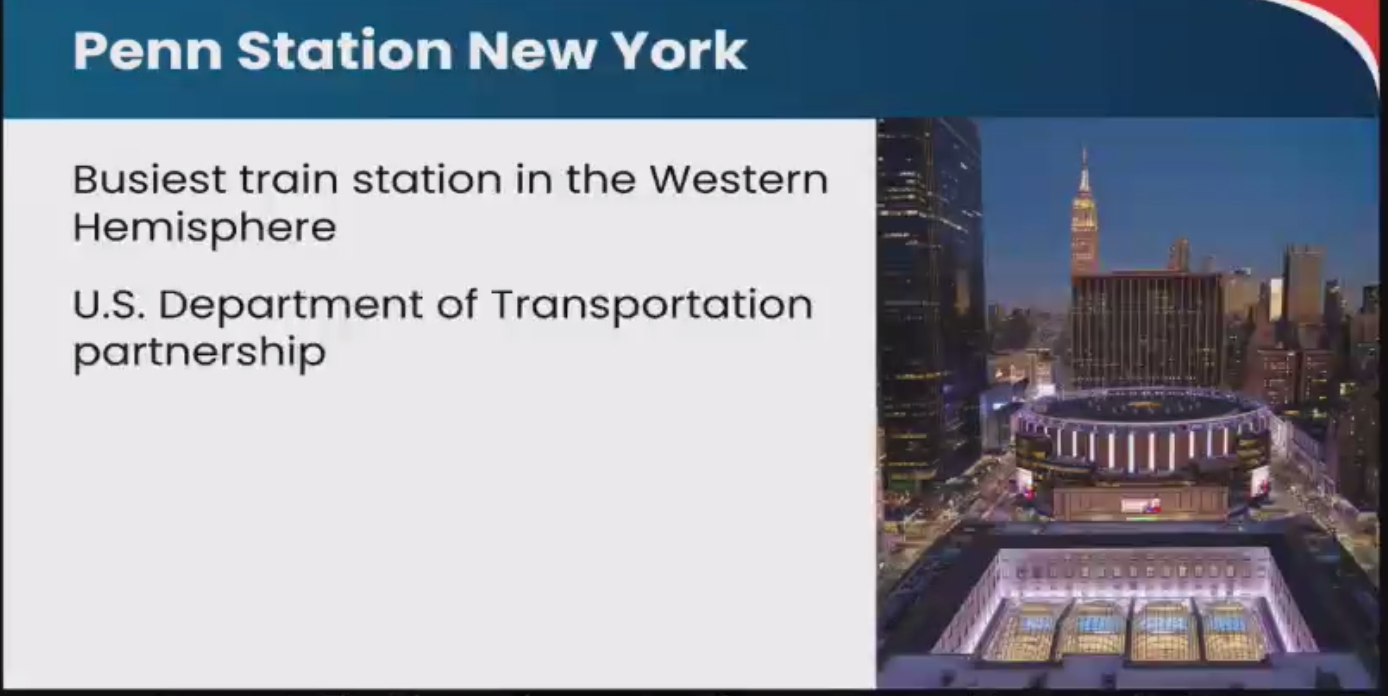
“We will shortly be announcing the results of our developer there,” was the extent of Harris’s comments on what is setting up to be one of the noble — or ignoble — projects in New York history. Harris also provided this useless slide:
Instead, Amtrak has only said that the Halmar-led project will add a “grand entrance” on Eighth Avenue, a new concourse, way-finding improvements and retail while slapping a new exterior on Madison Square Garden to give it “a classical look,” in the words of Amtrak or make it look like a “pseudo-nouveau riche homeowner in Nassau County,” in the words of one social media poster. Duffy and company have also promised the addition of “limited” through-running at the hub.
Despite a small media frenzy surrounding the announcement and its minor details, Amtrak has shared little else, and certainly no major details — leaving a laundry list of questions, such as:
1. What will this cost and who will pay for it?
The cost and funding question has loomed over the project since the moment federal Transportation Secretary (and road trip reality show star) Sean Duffy took it over last year, and continues to loom over it now.
In 2023, ASTM told the public its plan would cost $6 billion, but reporters later pegged its cost at something closer to $8 billion. The Italian conglomerate claimed that by paying for the construction itself, the project would be a win for taxpayers.
In reality, the company planned for Amtrak, New Jersey Transit and the MTA to pay the company $250 million a year for 50 years to run the station complex — a total price tag of $12.5 billion.
Andy Byford, the former beloved head of MTA New York City Transit-turned-gleeful cheerleader for the Duffy-Trump team, has also not provided any funding estimate. He has said that the feds won’t pay for the entire project, and that it would involve a private sector developer fronting some of the money.
“There will be a hefty public sector funding element, but that will be topped up by some upfront funding from a master developer who will thereby have skin in the game to get it done and get it done properly and get it done on budget,” Byford told the Permanent Citizens Advisory Committee to the MTA at a briefing in December.
That “public sector funding element” isn’t limited to federal government and Amtrak. Byford has suggested New York will have to have “skin” in the game as well. In January, he said that Amtrak had talked to New York City about paying for some of the project.
Byford faces an uphill battle on that front, however. Gov. Hochul has flat-out said that New York taxpayers are not going to chip in.
“To be successful, this project must accomplish two things: dramatically improve the experience for every rider who passes through Penn Station, from the A train to the Acela, while protecting the record performance of the LIRR and ensuring the costs are not borne by New York commuters or taxpayers,” Hochul said last week. “I will accept nothing less.”
Byford has ruled out having the MTA, NJ Transit and Amtrak or their riders pay for the station upgrades in the form of ticket surcharges or annual payments to Halmar.
At a Senate hearing last Tuesday, Duffy told Sen. Kirsten Gilliband that U.S. DOT was “going to give $8 billion to rebuild Penn Station,” which suggested that the feds would cover the entire cost of the project, contradicting Byford’s previous statements. A spokesperson for U.S. DOT told Streetsblog the secretary was referencing the previously reported total cost of the project — not how much the feds plan to chip in.
In April, the Federal Railroad Administration announced $4.7 billion in grants for intercity rail projects along the Northeast Corridor, including an unspecific amount of money for improvements to Penn Station and Washington D.C.’s Union Station.
The funding question relates to another outstanding query …
2. What was Amtrak’s criteria for selecting a developer?
Amtrak and Byford refused to make public their criteria for selecting a developer for the project, to the ire of New York officials and good government groups.
In October, the federally owned railroad issued a request for letters of interest from companies to show they could manage and execute the project without closing down the station. That document shed some light on the fact that the selected developer would be responsible for designing, building, maintaining, operating and financing the project.
This arrangement, known as a DBOM-F, set off alarm bells among watchdogs who worried that the scheme could leave New Yorkers and transit riders holding the bag for the cost of the project in the form of decades of maintenance payments from the three railroads that use Penn Station, ultimately paid by riders.
New Yorkers could also end up paying for the renovation by siphoning of city or state taxes from the area in the form of “payments of lieu of taxes,” as the state once planned to do under Gov. Hochul and her predecessor, Andrew Cuomo.
That scheme would have funded renovations by allowing the real estate giant Vornado to build office towers to pay back the state’s Penn Station loans instead of paying city property taxes. This is also known as “stealing New York City tax money,” and so people were not enamored with the idea. Vornado CEO/Trump pal Steve Roth is a partner on the Halmar effort, raising the obvious question of, “What’s in it for Vornado?”
The answer could be that since the state has never actually unwound the powers it has over land use around Penn Station, developed under an arrangement known as a General Project Plan, those zoning powers could still be handed to Vornado and Halmar as part of a scheme to pay off some of the train station project.
After Amtrak picked three companies to share design and financing ideas, the railroad refused to tell the public what it asked of the applicants in terms of financing or design elements or land-use issues around the train station — raising eyebrows among transparency advocates concerned local taxpayers could get a raw deal.
“The public should be able to see for itself what Amtrak asked developers to submit in terms of design, any real estate development, and how exactly this will be paid for — including through public and private funding,” said Reinvent Albany Senior Policy Advisor Rachael Fauss. “We still don’t know if New Yorkers might be on the hook to pay for any piece of the project. Amtrak should release the full RFP that was sent to bidders, not a ‘summary’ of the process and scope of their request.”
3. What will the new Penn Station actually look like?
Neither Amtrak nor Halmar released any images to go along with their announcement. The proposal from Penn Transformation Partners, the official branding for the chosen developer, may resurrect a plan that Halmar owner ASTM pitched in 2023:
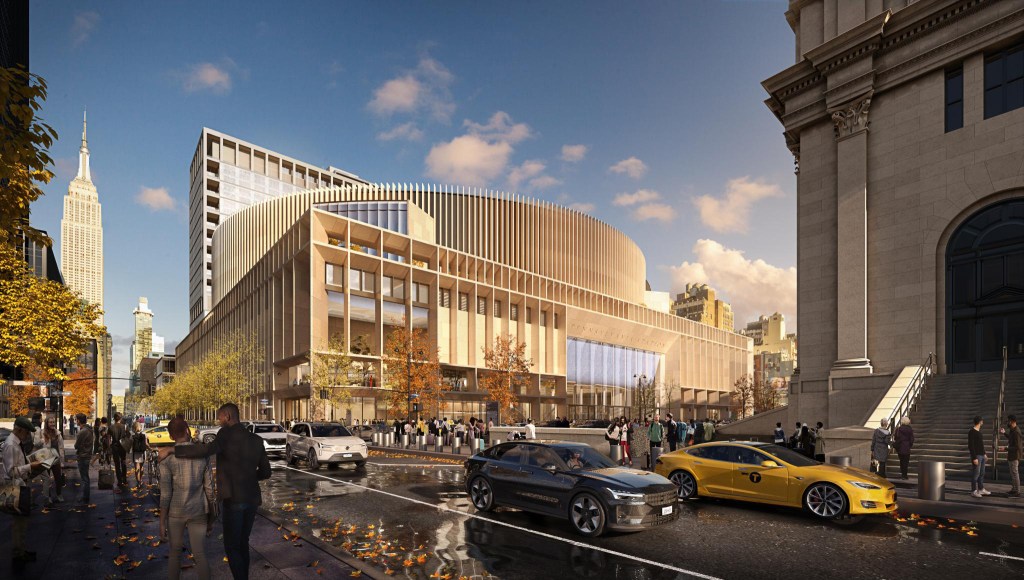
ASTM’s proposal involved giving Madison Square Garden owner James Dolan $500 million to knock down the Hulu Theater in order to build a grand Eighth Avenue entrance to Penn Station along with a single-level concourse above its train platforms.
But neither Halmar nor Amtrak has shared any public details of its 2026 proposal. As far as the public is concerned, the project allegedly set to start construction next year is a mirage.
ASTM did have renderings of its proposal from 2023, seen above, back when it was trying to win hearts and minds over to the concept of giving half a billion dollars to the much-hated Dolan.
4. How much through-running are we talking here?
Penn Station serves one federal railroad (Amtrak), two local commuter railroads, and, eventually, a third (Metro-North). With good planning and a design called through-running, the hub could theoretically serve one-seat rides among New Jersey, upstate New York, Long Island and Connecticut.
Amtrak’s press release said there would be “limited” through-running, but it’s unclear the extent to which LIRR, Metro-North and NJ Transit will expand into each other’s territories, instead of terminating at Penn Station as they do today.
Providing riders one-seat rides between Long Island and New Jersey — or the Hudson Valley and New Jersey, or Connecticut and New Jersey — could unlock new economic and housing opportunities and even cut the number of cars on the road in all three states.
But Amtrak, the MTA and NJ Transit have long resisted the idea, arguing that there’s no room on the existing platform level to allow passengers to get on and off the trains safely and quickly enough for through running to be achieved.
That changed when Byford joined the Penn project and promised the Federal Railroad Administration would study the rail operations at the rail hub with an eye towards bringing through-running to the region.
That study is supposed to come out this spring, but it has not, even as the April showers are quickly yielding to the dog days of summer.

Read More:
Streetsblog has migrated to a new comment system. New commenters can register directly in the comments section of any article. Returning commenters: your previous comments and display name have been preserved, but you'll need to reclaim your account by clicking "Forgot your password?" on the sign-in form, entering your email, and following the verification link to set a new password — this is required because passwords could not be carried over during the migration. For questions, contact tips@streetsblog.org.