Eyes In The Park: DOT’s Redesign Of Central Park’s Drives Fell Way Short Of Promises
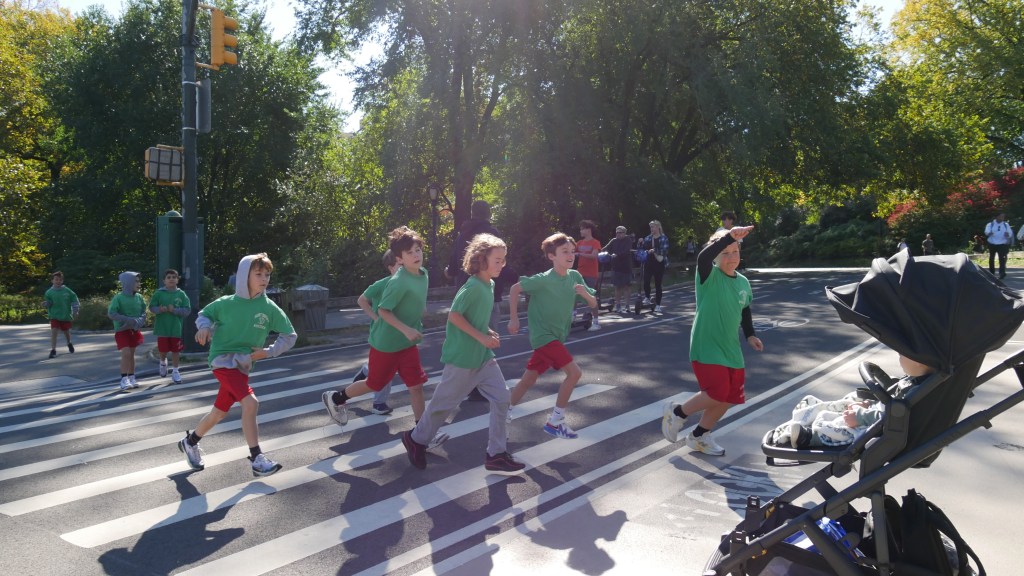
The city’s failure to fully implement a comprehensive redesign of the drives in Central Park as proposed in 2024 has left users of the park struggling with a formerly car-choked path booming with a wide variety of recreational uses.
This year, three New Yorkers were killed while trying to enjoy the Drive, a roughly six-mile loop that, since the banishment of cars in 2018, now hosts a wider variety of recreational and commercial activities.
One cyclist was killed when an off-leash dog ran onto the drive. One pedestrian was killed by a pedal cyclist. And a tourist was killed when he fell out of a carriage pulled by a horse that bolted.
Such fatalities, while extremely rare, have put a new spotlight on Central Park, with cyclists mostly being used as scapegoats when, in fact, bold action like the kind proposed two years ago by the Central Park Conservancy would have created a new narrative in an old park. The city still has a chance to make Central Park less chaotic after banning cars, but has so far only implemented half-measures.
“There’s just so many things that [city officials] said that they were thinking of doing that they haven’t done,” said Daniel Varghese, who runs the newsletter Leg Day about recreational cycling in the city.
How did we get here?
The Department of Transportation banned cars from the parks in 2018 and within two years, the city was gripped by a life-changing pandemic. Though seemingly unrelated, these events sent shockwaves across Central Park.
The removal of cars, of course, led to a significant increase in people using the park in general and the Drives specifically, now that car drivers no longer created such unwelcoming noise, pollution and intimidation.
The pandemic led to increases in recreational cycling and walking as well as home delivery of food and other products. Delivery workers made long deliveries across multiple neighborhoods in hopes of making a living. These far-flung deliveries encouraged delivery cyclists to use the park drives as a cut-through — and also to avoid local streets that were, increasingly, themselves choked with truck traffic making additional deliveries.
Something had to give.
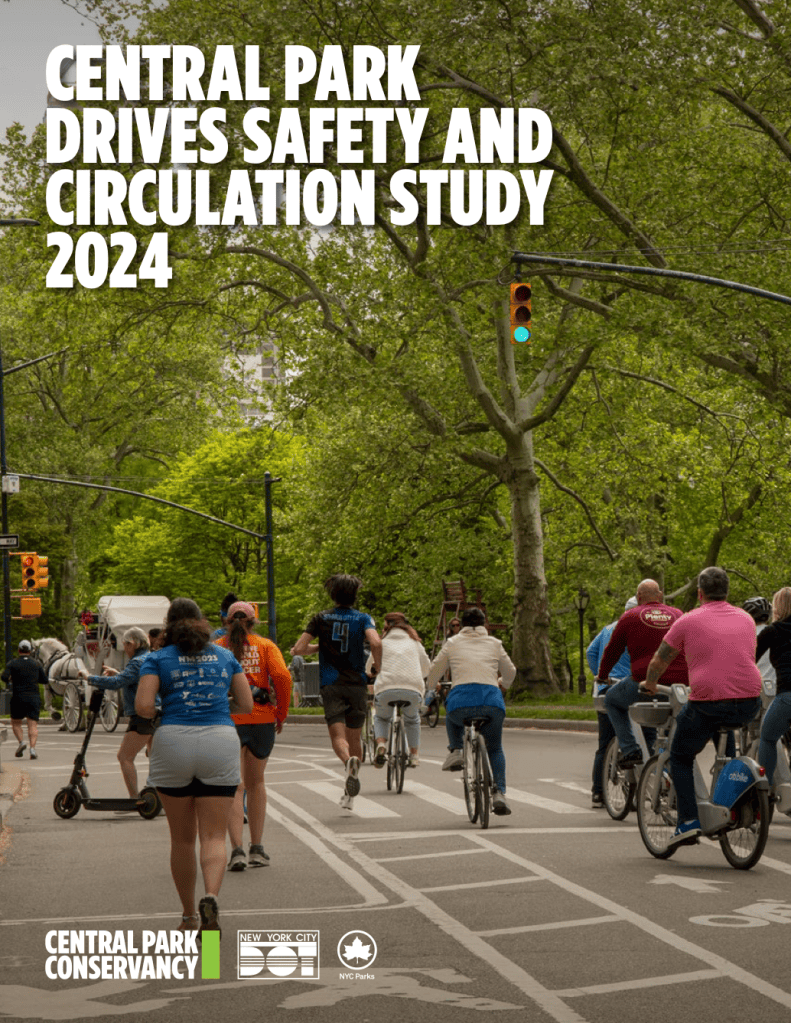
So in 2024, the departments of Transportation and Parks, plus the Central Park Conservancy released a comprehensive study and redesign proposals conducted by the consulting firm TYLin (where current DOT Commissioner Mike Flynn worked). The study outlined a set of near-, middle-, and long-term recommendations that would reorganize and simply the park Drives.
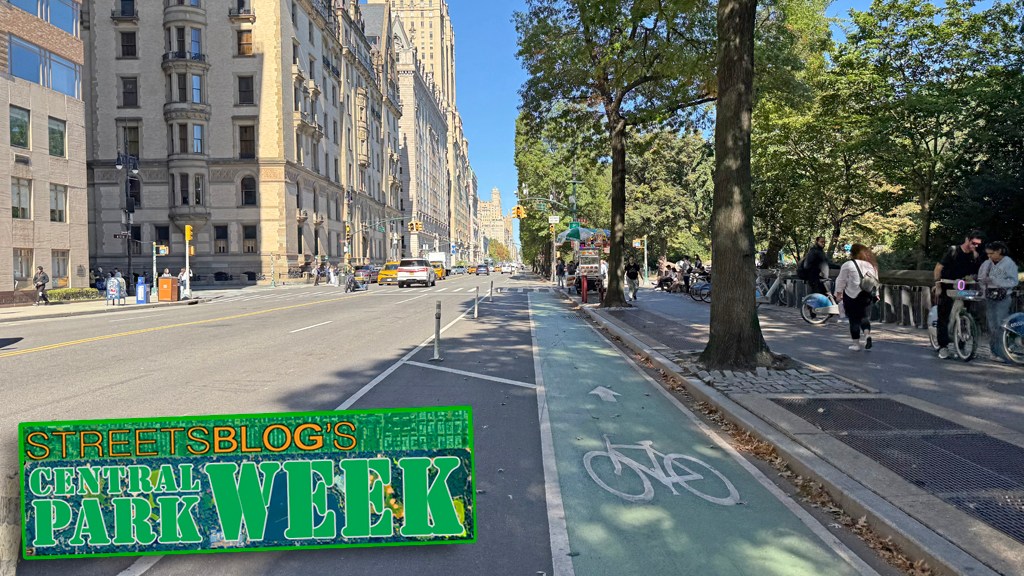
The “near-term” goals included ways to designate space for the park’s many users: differently hued pavement treatments to indicate which modes of travel should go where; textured pavement on the pedestrian path to discourage cyclists from using it to pass; a physical barrier between the cycling lane and the walking and running lane; and raised crosswalks to encourage faster modes to slow down at pedestrian crossings.
But these changes were not implemented by the city’s transportation and park officials, who at the time were DOT Commissioner Ydanis Rodriguez and Parks Commissioner Sue Donoghue, both appointed by then-Mayor Eric Adams.
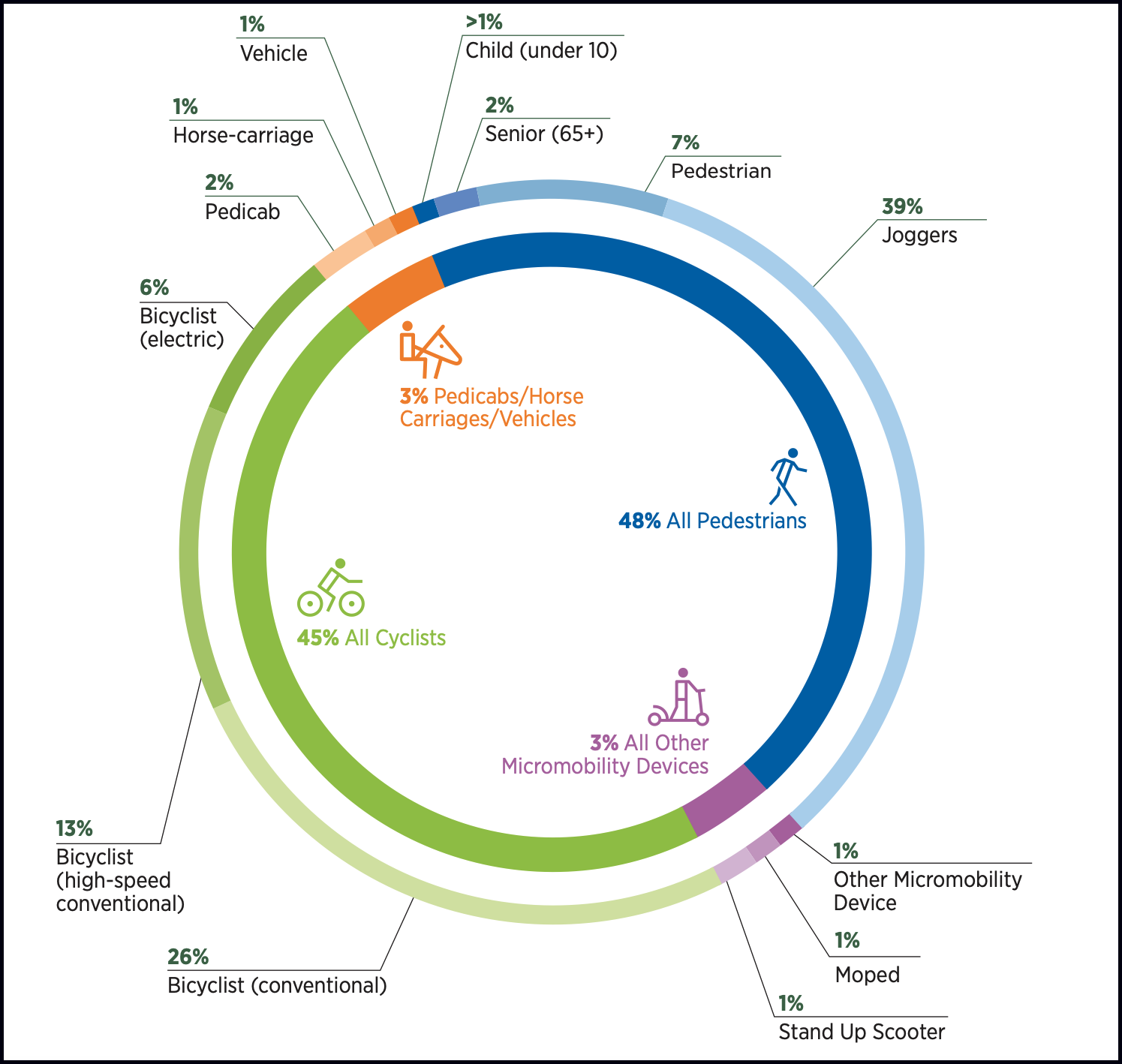
Instead of an extensive reimagining, DOT updated the drive markings with unclear symbols, and some, but not all, of the Drives’ traffic lights were set to blinking yellow — and indication to cyclists to yield. But next to the lights are signs that tell pedestrians, “Stop Here” — a confusing mixed message.
Streetsblog spent the day in the park on Thursday and that confusion is palpable.
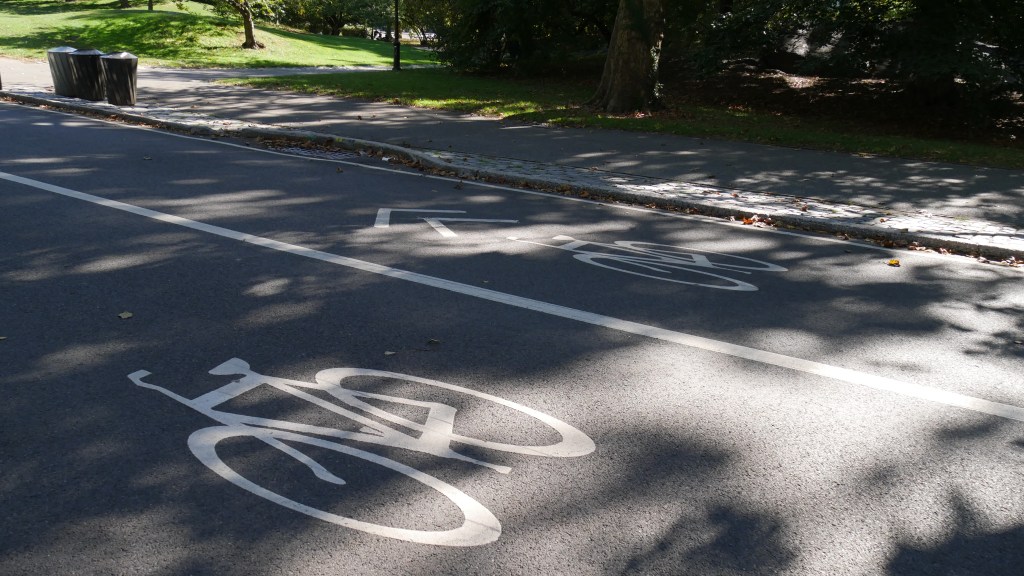
The new intersections are understood differently by different users. There are still traffic lights, the pedestrian signals are covered by a temporary looking burlap sack, and there are signs telling cyclists to “stop” for pedestrians. Some trying to cross the street are waiting for everyone approaching the intersection to come to a complete stop to wait for them to cross. But the blinking yellow traffic light indicates to cyclists that they should yield, not necessarily come to a complete stop.
This gets confusing, much like at a road intersection where drivers and pedestrians eye each other until figuring out who is going to yield — an inherently unsafe negotiation.
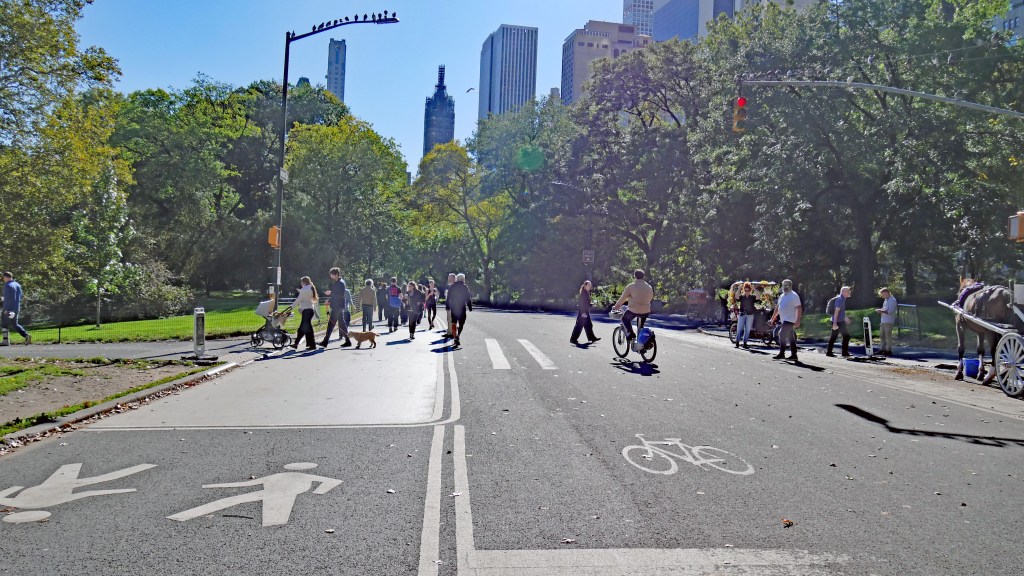
Steve Vaccaro, a bike-advocate lawyer who has ridden laps in Central Park since he was a teenager and is a board member of the New York Cycle Club, said he often experiences miscommunications with pedestrians. If he motions for them to use their right of way and slows down, a waiting crosser won’t always start walking until he completely stops.
“Does [the pedestrian] really need me to put a foot down [on the ground] before he’s going to take the right of way?” Vaccaro asked rhetorically. “When I’m already motioning with my hand, saying, ‘After you?’ I’ve said that to at least five pedestrians in the park in the last week. And then, from the pedestrian’s perspective, they’re like, ‘If I get it wrong, I’m dead.’”
And then there’s the passing. Because the Drive was previously organized around private car traffic, pedestrians and cyclists were squeezed into the inner ring, while drivers enjoyed two full lanes on the outside, or the left side.
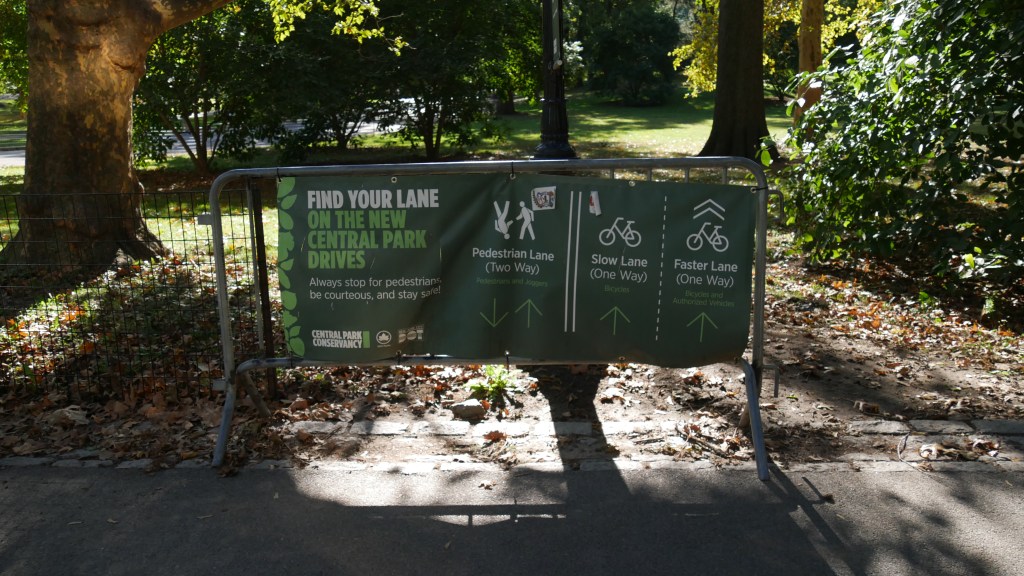
The DOT’s redesign kept that general organization intact. The slowest users — runners and walkers – have a designated lane on the right. Next to that is a slow bike lane, followed by a fast bike lane that is shared with the other vehicles that occasionally use the park.
But the markings aren’t clear and there is just one spot in the park, the tourist-heavy Columbus Circle entrance, that Streetsblog observed that explains the setup.
“We need to have a consensus as to what the rules are, so that it’s predictable where danger is going to come from,” said Vaccaro. “We need to make sure that the pedestrians are aware that danger is coming from cyclists proceeding in the lawful direction of travel in the areas marked as bicycle lanes, and that they need to anticipate and respect the cyclists who have the right of way moving through that space.”
The setup means cyclists are meant to pass each other on the right, an atypical arrangement that adds to the confusion. Additionally, some cyclists have been accused of poor behavior while doing recreational or training laps.
“People do not have great cycling etiquette. … Like hand signals and just looking over your shoulder and things like that,” said Nick Cabot Rodriquez, who has been riding the loop as a member of the New York University Cycling team before cars were banned. “When you combine that with the passing lane being on the opposite side, … I think that can be problematic.”
He added that Central Park is a victim of its popularity now that car drivers have been banished.
“people taking [exercise and training] very seriously right next to other people for who it’s their first time in Central Park,” he said.
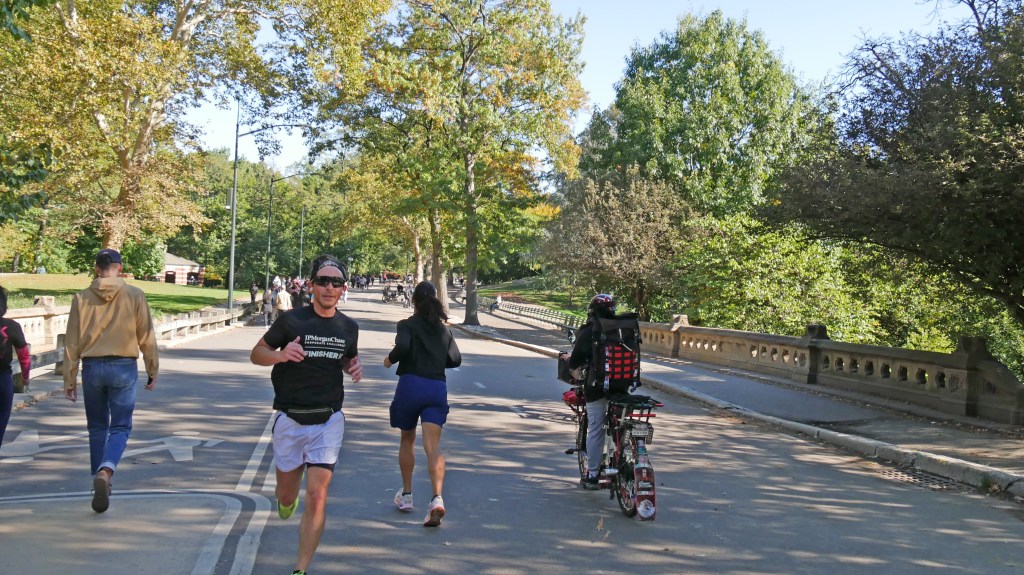
The DOT said it incorporated the recommendations where feasible. But raised crosswalks or barriers between lanes were deemed infeasible because dozens of bike races are conducted in the park, and vertical delineators would need to be removed for events, the agency said. The DOT added that it will continue to make adjustments to Drive intersections on an as-needed basis (at one crossing, the DOT has added “rumble strips” which alert cyclists with a noise and slight vibration).
DOT also said that it implemented its classic green-for-bike and beige-for-pedestrian features in high-traffic areas. But Streetsblog walked the entire loop one day last week and found that there is only one green-painted spot, and the beige paint is only used on a few pedestrian islands.
Agency spokesperson Will Livingston defended the DOT’s efforts.
“DOT’s recently completed redesign expands pedestrian and cycling space while better separating those walking from faster users,” he said in a statement. “DOT is working in close collaboration with the Central Park Conservancy and NYC Parks to continually monitor use of the drives and make adjustments to enhance safety for everyone enjoying this iconic park.”
Interestingly, the 2024 recommendations did not include any specific speed limit for cyclists in the park, nor did the Central Park Conservancy call for one. But the Adams administration moved to institute one anyway (signs are up in the park, but the policy remains frozen as litigation continues).
This year, however, after the killing of a pedestrian by a cyclist in September, the Conservancy issued a statement demanding the 15-mile-per-hour speed limit.
Vaccaro, whose group is suing the city over a proposed speed limit, believes the city is intentionally drawing the focus on cyclists to distract from its failure to implement more safety features.
“By mismanaging the loop to the point where cyclists and pedestrians and dog walkers are so angry at each other and even killing each other, then they can come in and they say, ‘There’s a crisis and we have the answer: Let’s remove the element of danger: the cyclists,’” he said.
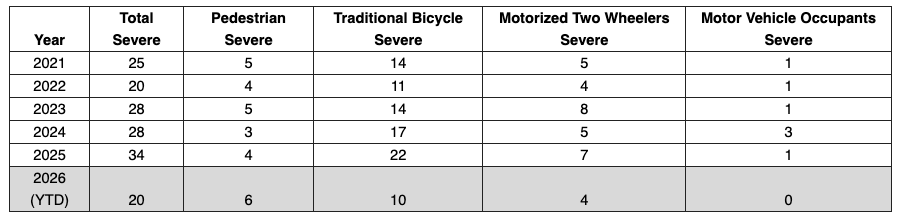
According to the DOT’s recorded stats, severe injuries did increase last year on the Drive. In 2025 there were a total of 34 severe injuries, up from 28 the year prior. So far this year, the first full year with the implemented changes, there have been 20 severe injuries on the Drive.
Exercise or exorcise?
The victory over private cars dramatically increased the use of the park drive for recreation. That’s a good thing — Central Park may be the world’s gleaming image of an urban tourist attraction, but it’s also many New Yorkers’ backyard.
And like so many times in this space-starved city, many people are saying, “Not in my backyard” — this time about bikes.
To Vaccaro, who was also part of the campaign to ban private cars, cyclists are now being punished for what they fought for, which benefits everyone. The 15-mile-per-hour speed limit is a de facto ban on serious road cycling because cyclists in training routinely hit speeds of over 20 miles per hour.
“We won, and now we’re being kicked out because we’re being told that we create too much danger on the loop,” he said.
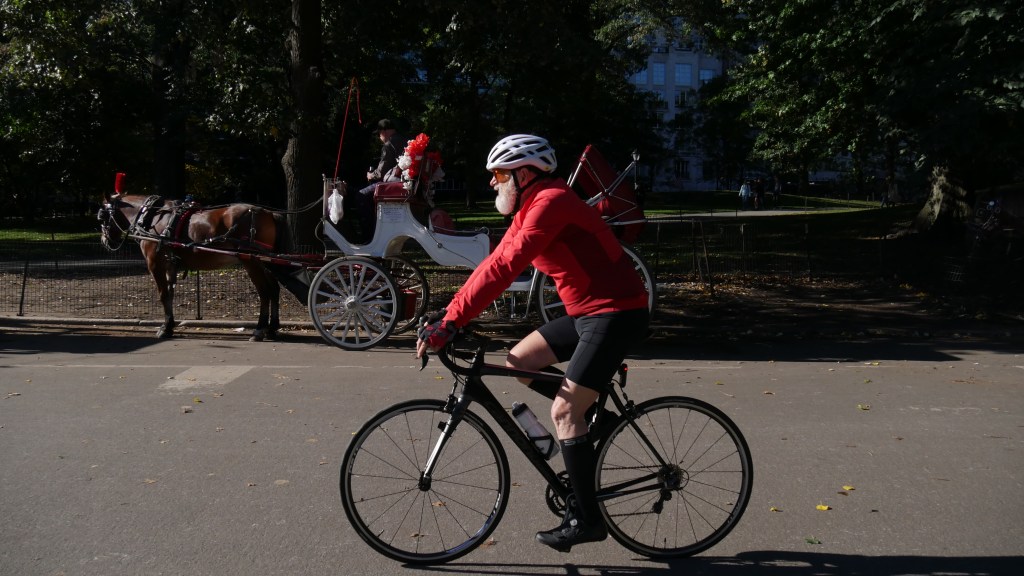
Most serious cyclists save their workout laps for the early morning, when the park is less crowded. And some even opt to train elsewhere because the park has so many visitors.
“Unless I’m riding in the early morning or late at night, Central Park is not somewhere where I feel like you can stretch your legs as a cyclist,” said Rodriguez. “I don’t necessarily know if that’s even what it is made for. The tough thing is cyclists are really bummed, but we are asking for a lot. Cyclists are basically asking for a place where they can go as fast as they can and have no obstructions, which is a pretty big ask in a city of eight million people.”
Vaccaro wants the city and the Conservancy to set aside specific hours, from 5 a.m. to 7 a.m., for cyclists to train in order to preserve serious riding while setting aside the park for virtually the rest of the day for slower road users and pedestrians.
“That’s what we’ve been pushing, and they refuse to engage,” he said.
Maintaining the Central Park Drive as a place for serious cycling is important, cyclists say, because of the dearth of places in the city to train. It’s worth noting that at least Olympian — Paris gold medalist Kristen Faulkner — started her cycling journey in the park.
“I hear a lot of people say, ‘Why don’t you do it somewhere else?’ There isn’t really anywhere else. It’s also just amazing that this is so well located. Because of the convenience, it created a cycling culture here that is really exciting, which the city should be proud of,” said Varghese, of Leg Day. “We literally have a person who started riding bikes in Central Park and then won the Olympics.”

Read More:
Streetsblog has migrated to a new comment system. New commenters can register directly in the comments section of any article. Returning commenters: your previous comments and display name have been preserved, but you'll need to reclaim your account by clicking "Forgot your password?" on the sign-in form, entering your email, and following the verification link to set a new password — this is required because passwords could not be carried over during the migration. For questions, contact tips@streetsblog.org.