Central Park Changes Have Eased Crossings for Pedestrians, New Data Shows
Wild West? Um, less.
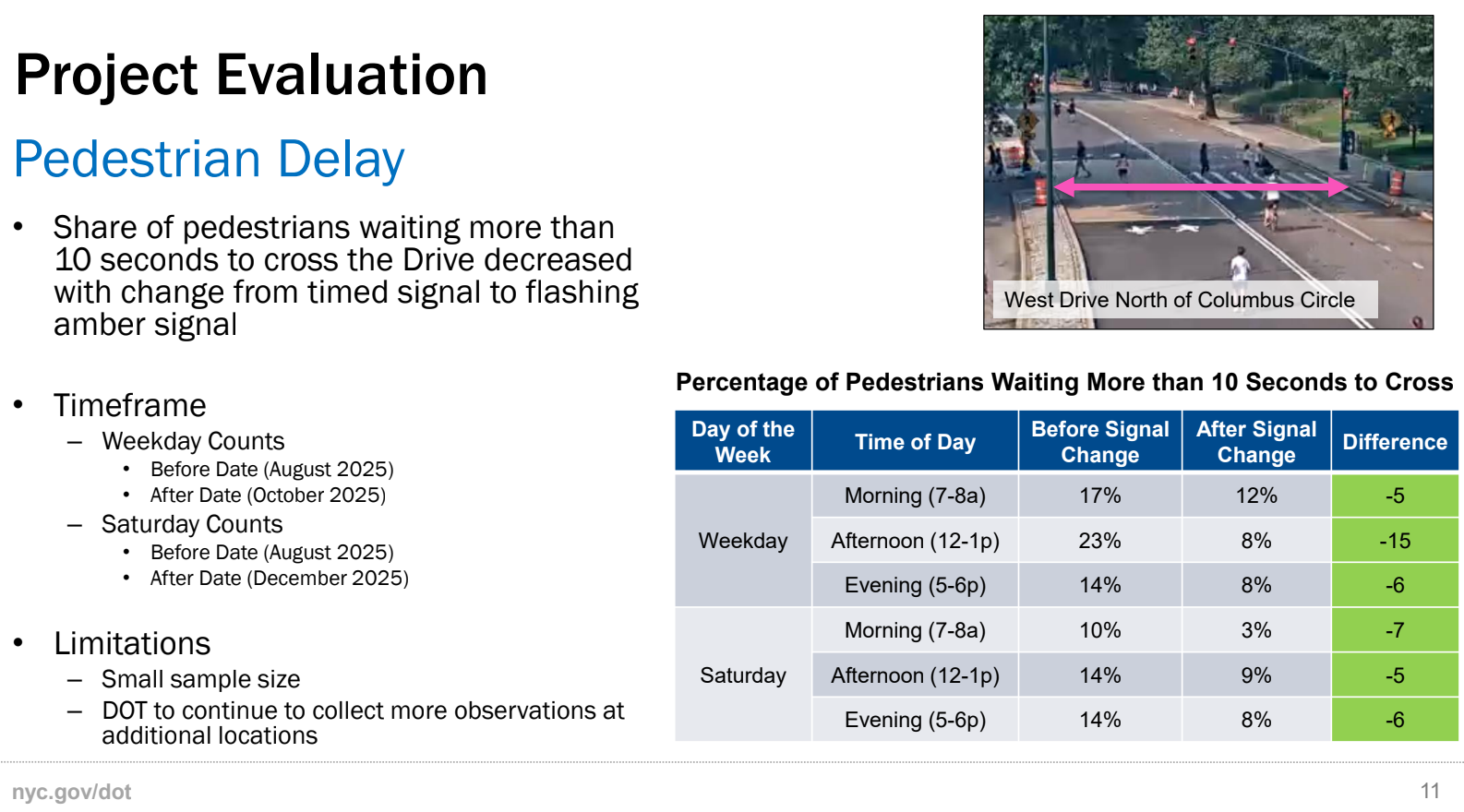
Pedestrians are waiting less time to cross Central Park’s bustling six-mile loop after the city shortened crossing distances and replaced stop lights with flashing yellow “yield” signals — further evidence of the success of the Department of Transportation’s gradual undoing of the car-first design of the parks roadways.
The percentage of pedestrians waiting more than 10 seconds to cross the drive dropped at all times observed by DOT on a weekday and a Saturday after the redesign, officials told the Manhattan Community Board 7 Parks and Transportation committees last Monday.
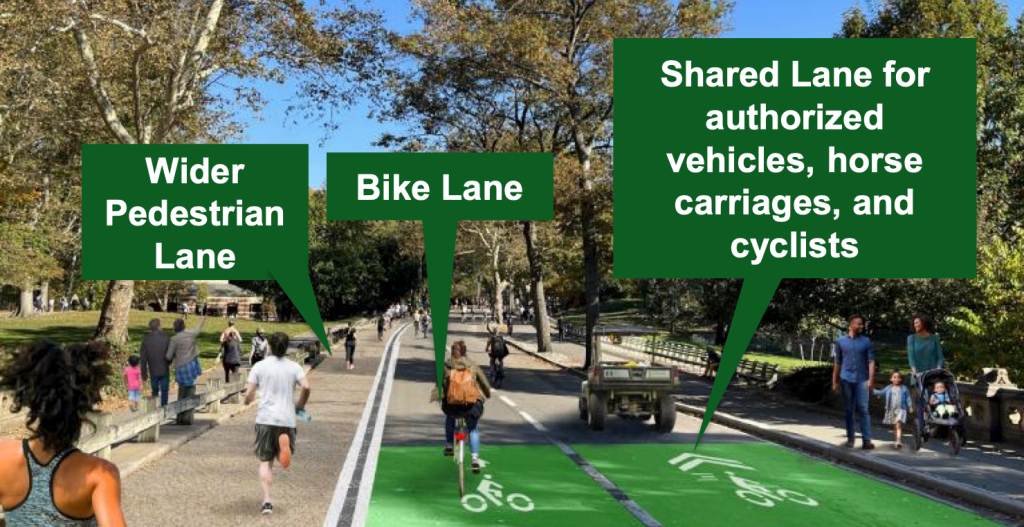
DOT presented evidence that cyclist speeds did not increase after the redesign, which expanded the designated pedestrian space on Central Park Drive — which remains busy with cyclists, runners and horse-drawn carriages. At signalized crosswalks, the city installed pedestrian islands to more clearly block out space for walkers. The city also changed the park’s traffic lights to blinking yellow signals and painting warnings for both cyclists and pedestrians, in line with changes recommended by a 2024 Central Park Conservancy study.
“The flashing yellow means if there is a pedestrian present and wanting to cross, the cyclist must stop — that is the intention with the flashing yellow,” DOT official Esteban Doyle told the committee members.
The initial data shows that the redesign has made crossing the park drives more intuitive, CB7 member and longtime car-free Central Park advocate Ken Coughlin told Streetsblog.
“It makes intuitive sense that it would be happening because a certain number of people would have been waiting when it was just red, yellow, green,” Coughlin said. “They would have been waiting for the walk signal. And they could have been waiting quite a while. Now they can cross when they feel that it’s prudent to do so.”
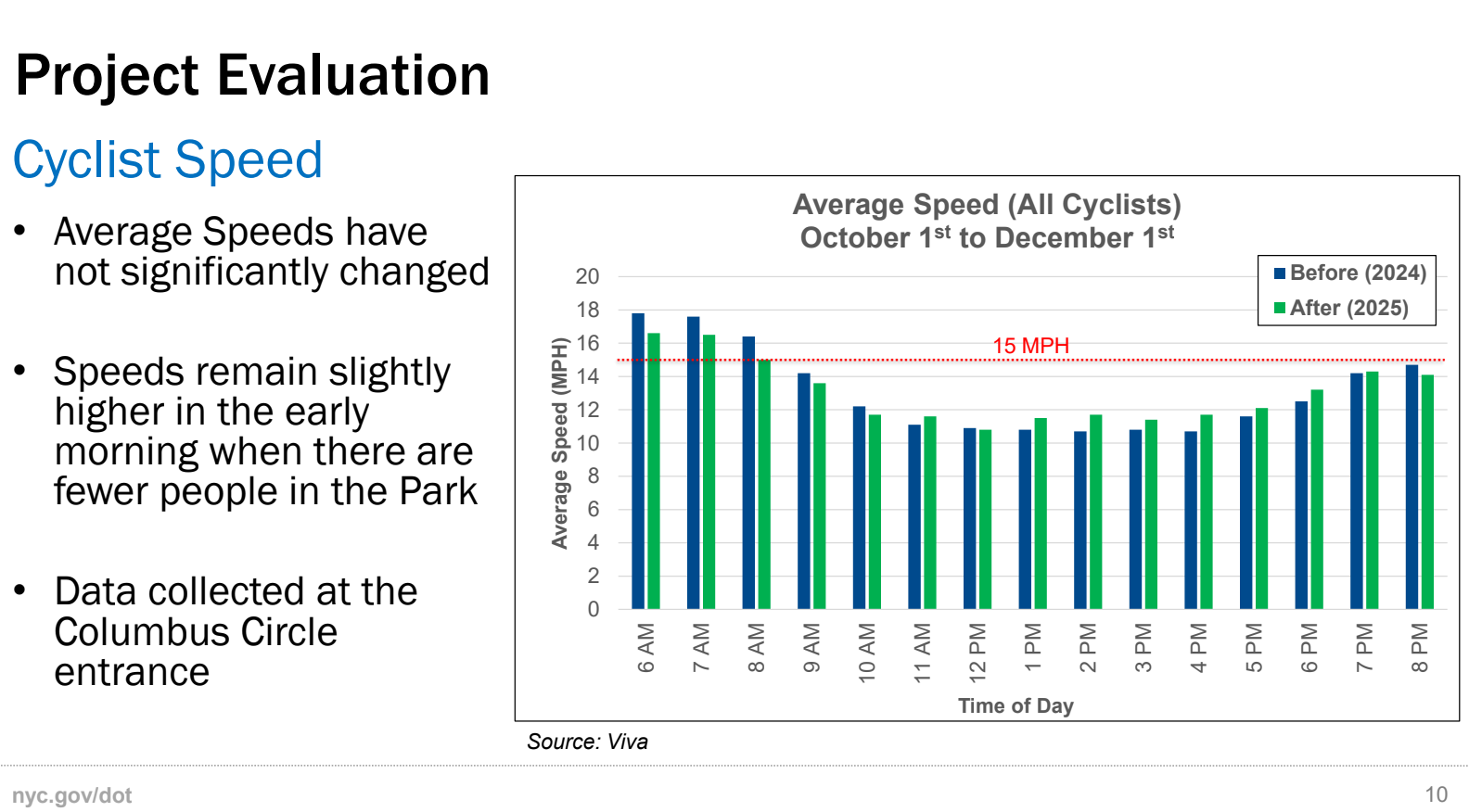
Cyclist speeds remained relatively steady after the redesign was installed, DOT found. Speeds were highest in the early morning, when cyclists typically exercise on faster road bikes. After 8 a.m., when pedestrians make up a larger portion of park-goers, speeds taper off to at or below 15 mph, DOT observed.
Reported pedestrian injuries have also remained flat — 22 in 2021, 13 in 2022, 22 in 2023, 21 in 2024 and 22 in 2025, according to NYPD figures.
DOT banned private cars from Central Park back in 2018, after a half-century of advocacy and piecemeal efforts to reduce motor vehicles’ footprint on the world famous urban green space. But officials waited until last year to redesign the drives to reflect the park’s new car-free status. Officials installed the new design south of 96th Street on the west side and south of 90th Street on the east side, and plan to finish the job this year.
“Since cars were permanently banned on Central Park’s drives in 2018, it’s been a long time coming that the city rethinks the park drives to center around people — not vehicles,” said DOT spokesman Vin Barone. “DOT’s ongoing redesign expands pedestrian and cycling space while better separating those walking from faster users, with more work to come to enhance safety for everyone enjoying this iconic park.”
Starting next month, a 15-mph speed limit — advanced by former Mayor Eric Adams — takes effect on Central Park Drive for all users. The current speed limit is 20 mph.
But NYPD Central Park Precinct Commanding Officer Deputy Inspector Timothy Magliente cast doubt on the speed limit’s enforceability at Monday’s meeting.
“Speed enforcement is not easy with bicycles. The frame of a bicycle is very narrow which makes the LIDAR gun impossible to shoot,” he said. (NYPD did not reply to Streetsblog’s multiple requests for confirmation of Magliente’s claim.)
Even after a meeting filled with opposing views on how best to use the car-free space, Coughlin said he is hopeful that the new design will be accepted and work for everyone. After all, he remembers when car drivers used to zip through the park at 40 mph. Coughlin spent decades advocating to ban cars from the drive, for the benefit of walkers, runners, and bikers.
A Streetfilms video resurfaced on Reddit last week showing a typical day on the drive in 2002 — where runners had to dodge taxis, not e-bikes:
“My blood pressure started to go up watching it,” said Coughlin with a laugh of the resurfaced video. “I told Clarence, ‘You should have given a trigger warning.'”

Read More:
Streetsblog has migrated to a new comment system. New commenters can register directly in the comments section of any article. Returning commenters: your previous comments and display name have been preserved, but you'll need to reclaim your account by clicking "Forgot your password?" on the sign-in form, entering your email, and following the verification link to set a new password — this is required because passwords could not be carried over during the migration. For questions, contact tips@streetsblog.org.