West Siders: Better Bike Lanes, Not Bans, Will Make Central Park Safer
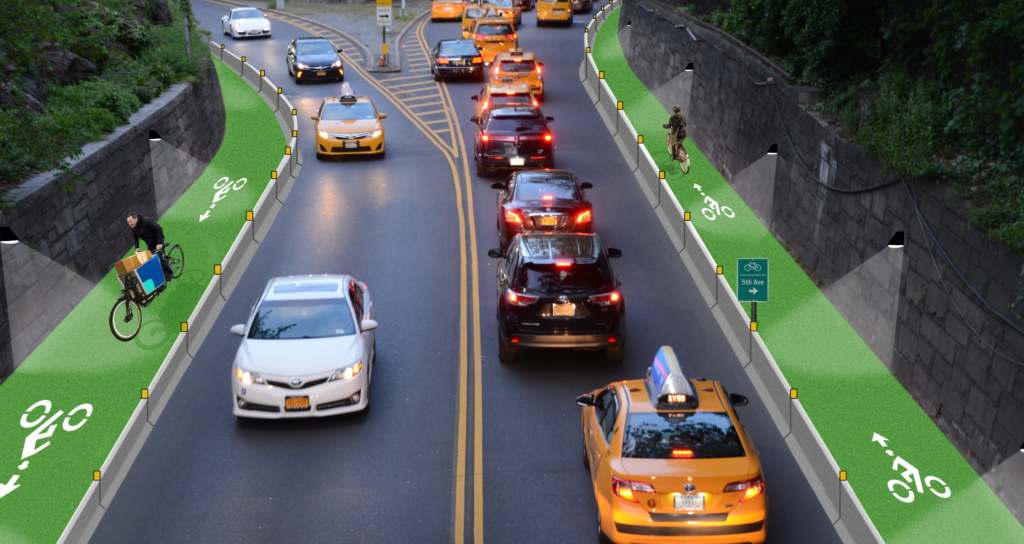
Cyclists and e-bike riders would be a lot less likely to use Central Park for routine trips around town if the city built protected bike lanes around the park and on its transverse roads, two-wheelers told a local civic panel on Monday.
“I commute through the park, cutting through at 72nd Street because that’s the only place that I can do so,” W. 72nd Street resident Laura Sachs said during a joint parks-transportation committee meeting of Manhattan Community Board 7. “Using the four transverses that were designed by Olmsted, particularly the one in 86th Street, lends itself to give an opportunity to utilize the design and the multi-layers of the park to improve pedestrian safety and diminish the conflict between vehicles, bicycles [and] pedestrians.”
There are over 60 miles of pedestrian-only paths in Central Park but just six where bikes, e-bikes, scooters, pedicabs and horse carriages have to share space: the Central Park Drive, which was the topic of an hours-long discussion at an Upper West Side community board meeting.
The park’s perimeter has just one bike lane — a northbound-only lane up Central Park West. As a result, cyclists and advocates noted, people biking for reasons other than recreation have no other safe option for many of their trips.
“Part of the reason there are so many cyclists is Central Park is the safest bike route in the city,” said Upper West Sider Austin Celestin. “On the east side, there is no bike lane until Third Avenue. Having alternative routes and having the transverses would give everyone a place to safely operate.”
A 2024 Central Park Conservancy study by consulting company recommended DOT build protected bike infrastructure on the 86th Street transverse to facilitate crosstown travel. Mayor Mamdani’s new DOT commissioner, Mike Flynn, formerly worked at TYlin as a city solutions sector manager.
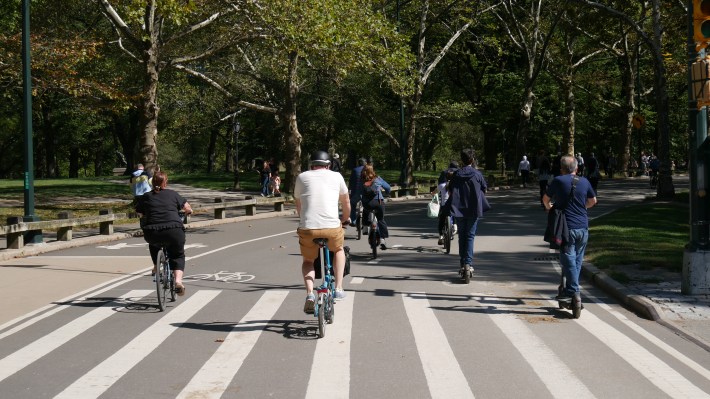
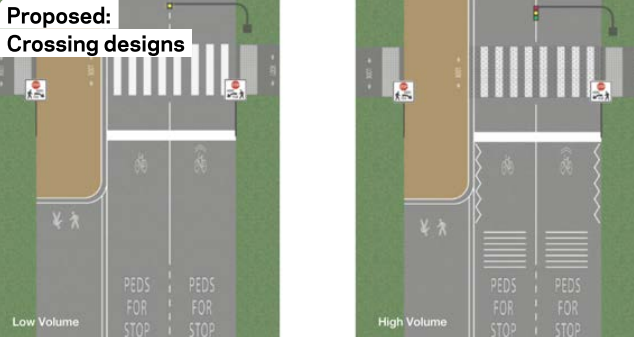
The Department of Transportation recently completed Phase I of a two-phased planned redesign of the drive, south of 96th Street on the west side and 90th Street on the east side, also recommended in the study. The changes — which expanded pedestrian while changing many of the traffic lights to blinking yellow “yield” signals — are part of a plan recommended by the Central Park Conservancy, a non-profit that maintains the park, after a study of the drive was conducted in 2024.
A DOT spokesperson told Streetsblog that the city is considering the two-year-old study’s recommendations. For now, DOT is focused on implementing Phase II of the drive redesign uptown.
The new configuration finally accounts for the fact that cars have not been allowed since 2018.
CB7 held Monday’s meeting ostensibly to discuss those redesigns, as well as whether to ask Parks to ban e-bikes from the park. The committees did not vote on either matter, instead hearing two hours of a testimony from the public and a short presentation from DOT. Public speakers variously identified themselves as cyclists, pedestrians or both. Some said the prevalence of e-bikes had turned them off from Central Park entirely. Others said e-bikes kept the park accessible for older New Yorkers who can’t ride “acoustic” bikes. Still others blamed “sport cyclists” for causing the most danger.
“I represent the community of people in their 70s and 80s who cycle and run in Central Park,” Hindy Schachter, whose husband was killed in the park by a teen cyclist in 2014, said design is the way forward and thinks DOT is on the right path. “Please make a park that works for everyone. Make a park that works for slow riders, and for my many friends that have switched to e-bikes. Don’t ban them; spend your time organizing designs that will work for everyone.”
Schachter and others welcomed the new design as a step in the right direction.
“It’s not perfect, but it’s better. I didn’t feel like the old traffic lights were appropriate. I am loving these changes so far, let’s keep going,” said Erica DiPiero, who lives on W. 78th Street and rides in the park with her 10-year-old child as well as on Citi Bike e-bikes on her own.
Who makes the park less safe?
The new design designates separate lanes for faster and slower bicycles — and e-bike fans and enemies alike seemed content at Monday’s meeting to direct their ire at some recreational cyclist for not respecting others on the road.
Alex Bell, the board’s chair who has an e-bike he uses to transport his two kids around the city, often through the park, shared a story of meeting up with board-member Barbara Adler, who proposed the resolution to ban e-bikes.
The two met on a Sunday morning ahead of the meeting to observe the drive.
“We walked very slowly, sometimes painfully slowly, back and forth,” said Bell. “Two people did stop completely and they were both delivery guys. I will say, there were two or three clear examples of a bicyclist that could be way safer than they were.”
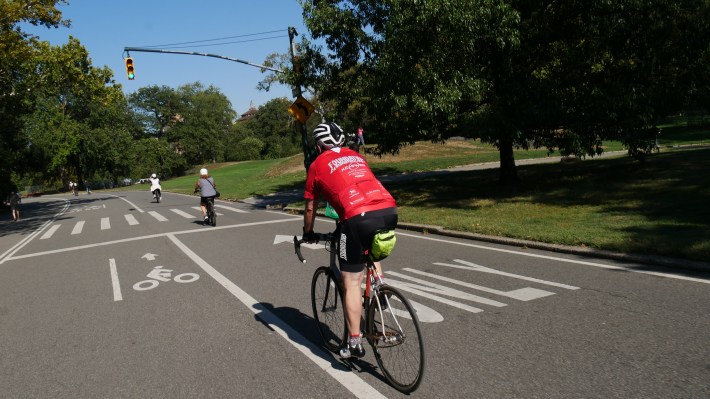
The three cyclists who made Bell and Adler feel unsafe were men in Spandex who seemed to be riding laps for exercise, Bell said. They were not on e-bikes and didn’t slow down, passing in front of the two pedestrians.
“The e-bike thing is hard for me because it’s not what I see. I see a problem with lots of bikers, but it doesn’t to me break down by type,” he said.
The two discussed the blinking yellow lights that replaced the car-era traffic lights, with Bell concluding that the change is difficult for pedestrians who now have to take on more of a “cognitive load” when crossing the street.
But to Ken Coughlin, a Transportation Committee member who bikes and supports the new design, the new crossings even the playing field.
“We have a recreational space and people trying to cross a recreational space,” said Coughlin, who led the fight to get cars banned from the park. “Everybody is having to be on alert which is making everybody safer. That’s part of the reason why we are hearing some cries of pain, it’s because of that ‘cognitive load’ which is actually good. It just may take some time.”

Read More:
Streetsblog has migrated to a new comment system. New commenters can register directly in the comments section of any article. Returning commenters: your previous comments and display name have been preserved, but you'll need to reclaim your account by clicking "Forgot your password?" on the sign-in form, entering your email, and following the verification link to set a new password — this is required because passwords could not be carried over during the migration. For questions, contact tips@streetsblog.org.