Cycle of Rage: Mamdani Administration Playing Games With Road Violence Stats
In God we trust — everyone else bring data.
Mayor Mike Bloomberg purportedly issued this dictum to his agency heads as an admonishment to make sure to provide the boss with up-to-date information so that he could make decisions based at least partly on hard evidence rather than anecdote or faith.
The Mamdani administration could learn a lesson.
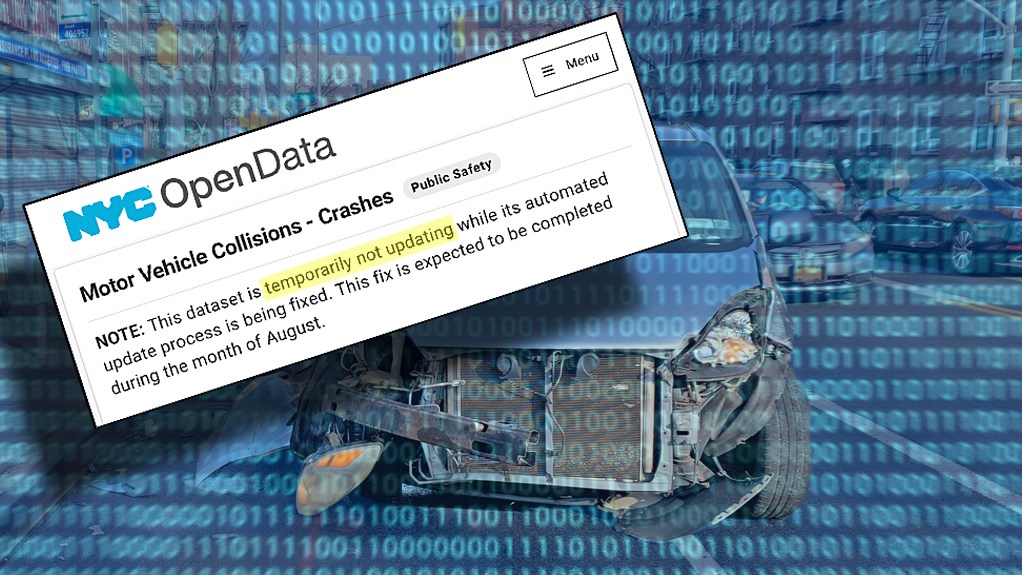
It’s been more than a month since the administration promised Streetsblog that it had fixed the then-three-month void in publicly available traffic crash data — yet not only has the database not been properly updatedl but no administration officials will respond to Streetsblog’s calls as to why.
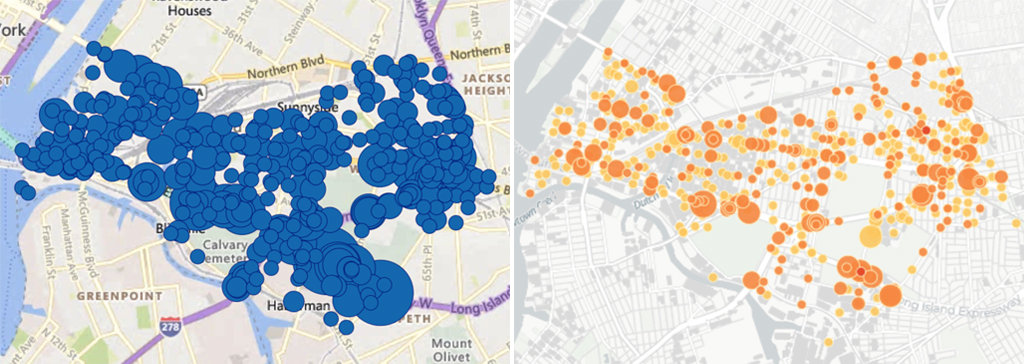
And lest you click to a different page and mutter, “Who cares?” consider that the NYC Open Data database of crashes is the gold standard for analyzing where and when all reported crashes have occurred in the city, how many people were injured and what factors contributed to the crash. It’s not just an essential tool for anyone interested in figuring out patterns of crashes, but also provides the underlying data for such interactive maps as Crashmapper and Crashcount, both of which now have disclaimers revealing that their maps are no longer up-to-date. (Better data exists on the NYPD’s website, but it is neither searchable nor archived, so it is only barely better than useless.)
This isn’t just a problem for journalists — it’s a disaster for public policy (and for the legacy of Bloomberg’s dictum).
Last week, Comptroller Mark Levine compiled statistics about the number of crashes that have occurred in neighborhoods that have asked the Department of Transportation to slow down car drivers using its power under the so-called Sammy’s Law to set speed limits at 20 instead of 25 miles per hour. More than one-quarter of New Yorkers live in those neighborhoods.
The problem? Levine’s statistics don’t fully reflect the danger on our streets because the data is more than four months out of date. In some neighborhoods, that means hundreds of crashes and even a few fatalities are not reflected in the data.
Let’s use one neighborhood as an example. Levine noted that Queens Community Board 2, which covers Long Island City, Sunnyside and Woodside, passed a resolution on Feb. 5 of this year to demand that DOT lower the speed limit — one of 17 boards to do so.
Levine’s statistics reveal that the neighborhood has experienced 559 crashes and two fatalities in the 131 days between Feb. 5 and June 15.
But NYPD data — which is not searchable like the New York City Open Data portal that Mayor Bloomberg established years ago — shows that there have been 1,420 crashes and nine fatalities in that community district between Jan. 1 and Oct. 11 (that’s 284 days).
That’s five reported crashes per day!
So if you take out the 35 days between Jan. 1 through Feb. 5 before the resolution passed, there have been roughly 1,245 crashes between the date of the resolution and Oct. 11, the last date for which there are NYPD statistics available.
There have also been nine fatalities, rather than two as Levine mentioned (these seven deaths indeed occurred between June 11, when the data went dark, and Oct. 11).
You can see that Levine’s numbers are far less scandalous — which makes them not only less interesting to newspaper editors, but also to anyone in city government whose job it is to prioritize what to fix first.
And that’s just the statistical shortcoming of one of the 17 community boards that passed the 20-is-plenty resolution. The dates that each board passed its resolution range from Feb. 11, 2025 through Oct. 6, 2026. With fully updated Open Data, it would be very easy to determine all the crashes that have happened in each district since the board passed its resolution; without Open Data, it’s impossible to get accurate numbers.
And remember, when I reported on the outage more than a month ago, the city Office of Technology and Innovation told me a fix was imminent.
Agency spokesperson, Gloria Chin, said on Aug. 28, “The work to improve access to the data is complete and undergoing a final review.” [Columnist’s snarky note: Aug. 28 was 48 days from yesterday. In a typical 48-day period in New York City, there are 11,219 reported crashes, so don’t tell me that accurate crash data isn’t important.
I reached out to OTI multiple times this week, but have heard nothing back.
I don’t get it. But here’s a note to all the reporters out there who are being contacted by Mark Levine about Sammy’s Law: He’s right — there have been hundreds of crashes since those 17 neighborhoods passed their resolutions.
Now add a zero.
That’s how bad it is out there.

Read More:
Streetsblog has migrated to a new comment system. New commenters can register directly in the comments section of any article. Returning commenters: your previous comments and display name have been preserved, but you'll need to reclaim your account by clicking "Forgot your password?" on the sign-in form, entering your email, and following the verification link to set a new password — this is required because passwords could not be carried over during the migration. For questions, contact tips@streetsblog.org.