Empty Quarter: City’s Crash Database Hasn’t Been Updated In Three Months

It’s worse than you think.
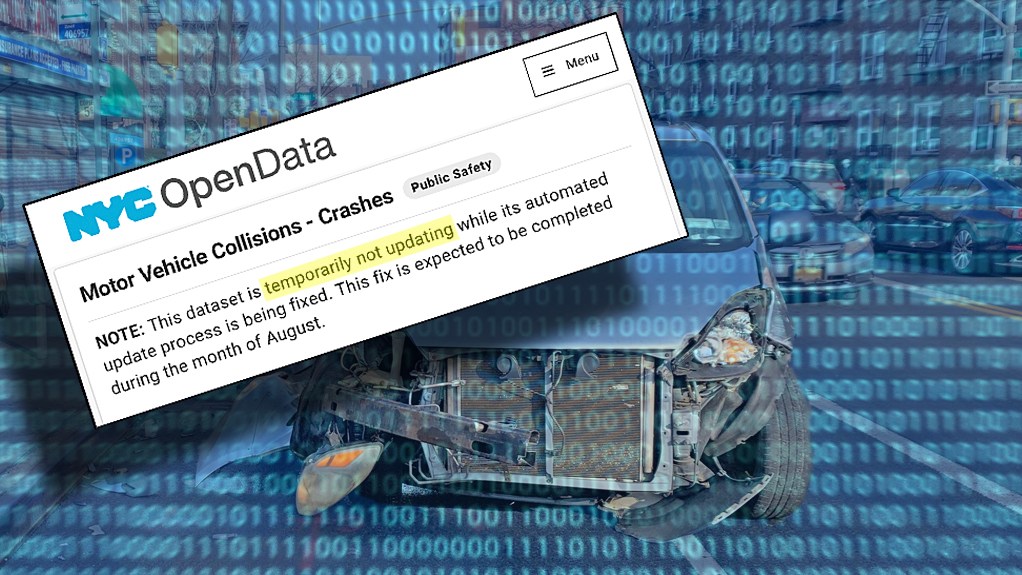
The city’s public data on motor vehicle crashes — the portal that provides the underpinning for public-facing, easy-to-use, map-based websites such as Crashmapper and Crashcount — hasn’t updated since June 11, meaning that thousands of crashes are not showing up on those independent websites.
The result is that members of the public who use such sites may have a false sense that roadways are safer than they actually are, because those automatically updated pages are not refreshing.
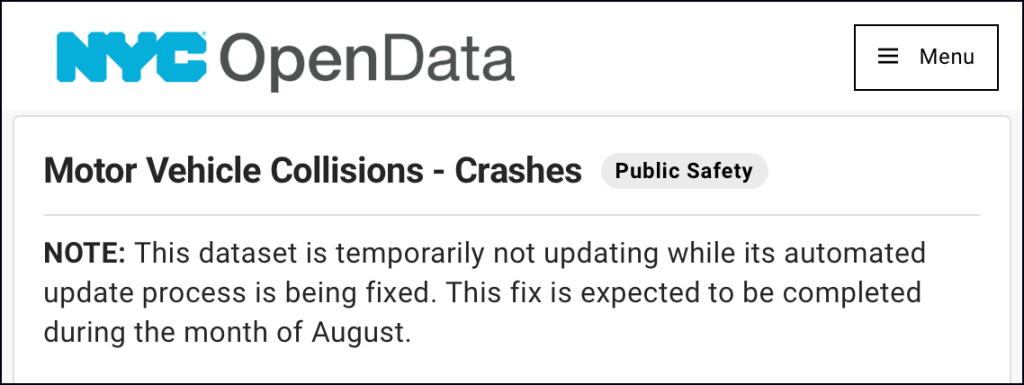
It is unclear why the NYC Open Data page is broken.
“This dataset is temporarily not updating while its automated update process is being fixed,” a “note” at the top of the page states. “This fix is expected to be completed during the month of August.”
As of Sept. 8, it has not been fixed, nor has there been any explanation for the data smog.
“I’m really frustrated,” said Michael Freedman, who created Crashcount to track “the relentless toll of traffic violence in New York City,” as the site’s mission statement states. “The data isn’t coming in. As a result, we are no longer able to provide independent analysis of the police crash data, so the public can’t determine if the data confirms what the Department of Transportation is saying or not.”
In order to understand the need for reliable and regularly updated data, one need only look at the crash statistics for the year.
Through June 11 — the last date the city updated the the public database — there were 36,195 crashes, or an average of 223.4 reported crashes every day.
But a casual user of Open Data might not realize that the database has not been updated — and might think that those 36,195 crashes through June 11 were actually through Aug. 30, which would lead to the conclusion that there are 149.6 reported crashes per day, which is one-third fewer than the 54,832 reported crashes through Aug. 30.
Freedman offered a specific example: Court Street has objectively become safer since the city completed the protected bike lane on that roadway. According to the DOT’s less-functional “Vision Zero View,” which is based on raw NYPD data, there have been six injuries on the roadway through July 31, compared to 15 over the same period before the bike lane went in.
But Crashcount and Crashmapper users would see only four injuries on the roadway, because two of them happened after June 11. (One Reddit poster made the comparison using Crashmapper in May, but an update would prove inaccurate.)
And neither user-friendly map shows any of the nine people who were killed by hit-and-run drivers citywide in August.
One of the original designers of Crashmapper is frustrated that the data is not being updated.
“Crash data is one of those things we have argued — repeatedly — to be automated properly and to be accurate,” said Noel Hidalgo, now executive director of BetaNYC, who worked with CHEKPEDS, the seminal pedestrian advocacy group, on Crashmapper. “Open data is supposed to ensure faithful representation of crashes to the public to ensure that the public knows about the safety of the streets. But in this case, the data is purely up to the NYPD, which must create systems that maintain that data flow. NYPD has constantly needed advocacy to improve its practices.”
A spokesperson for the NYPD, who declined to provide a name, declined to explain why the open data portal has gone so long without an update, referring our questions to the city Office of Technology and Innovation, which maintains the database.
The OTI spokesperson, Gloria Chin, declined to answer specific questions, saying only, “The work to improve access to the data is complete and undergoing a final review.” (That comment was sent to Streetsblog on Aug. 28.)
A spokesperson for DOT pointed out that concerned residents still have access to the NYPD’s traffic crash website, but many users of Crashmapper and Crashcount have been frustrated because that police web page does not allow users to plot specific streets or areas over time, but is merely a rolling, unarchived data feed.
“We understand the importance of accessible data to keep the public informed,” said the DOT spokesperson, Vin Barone. “The city’s granular data uploads have been temporarily paused as we work with OTI to update the uploading process with improved data presentation, and appreciate the public’s patience during this period.”
One activist, who has a long history of challenging NYPD narratives about crashes but requested anonymity because of negative interactions with the police, blamed the NYPD for the broken data.
“NYPD has zero interest in making its data useful to the general public unless it tells a political story that is oriented to their operations,” the activist said. “CompStat is a political narrative.”

Read More:
Streetsblog has migrated to a new comment system. New commenters can register directly in the comments section of any article. Returning commenters: your previous comments and display name have been preserved, but you'll need to reclaim your account by clicking "Forgot your password?" on the sign-in form, entering your email, and following the verification link to set a new password — this is required because passwords could not be carried over during the migration. For questions, contact tips@streetsblog.org.