In Bid To Speed Buses, Mamdani Hopes To Go Where No Mayor Has Gone Before
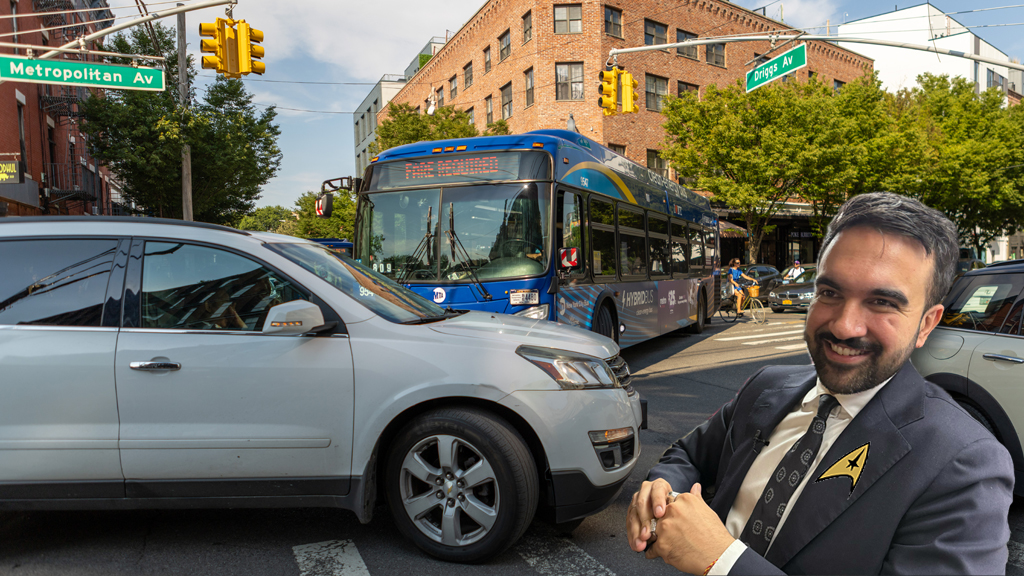
Mayor Mamdani’s big plan to speed up buses relies on him not repeating the mistakes of his predecessors who talked an eerily similarly big game … and failed dramatically, spectacularly and most of all, politically.
The latest $850-million plan to speed our slowest-in-the-entire-nation buses is built on bold promises, including speed upgrades on 50 priority corridors carrying 25 of the slowest bus routes in the city; the creation of a real-deal bus rapid transit system; better management of bus maintenance and dispatching; and all-door bus boarding by 2027.
At the core of the hopes and dreams: wrangling the bifurcated system that puts the state-run MTA in charge of the buses and their routes while the city Department of Transportation manages the traffic- and scofflaw-filled streets on which those buses travel.
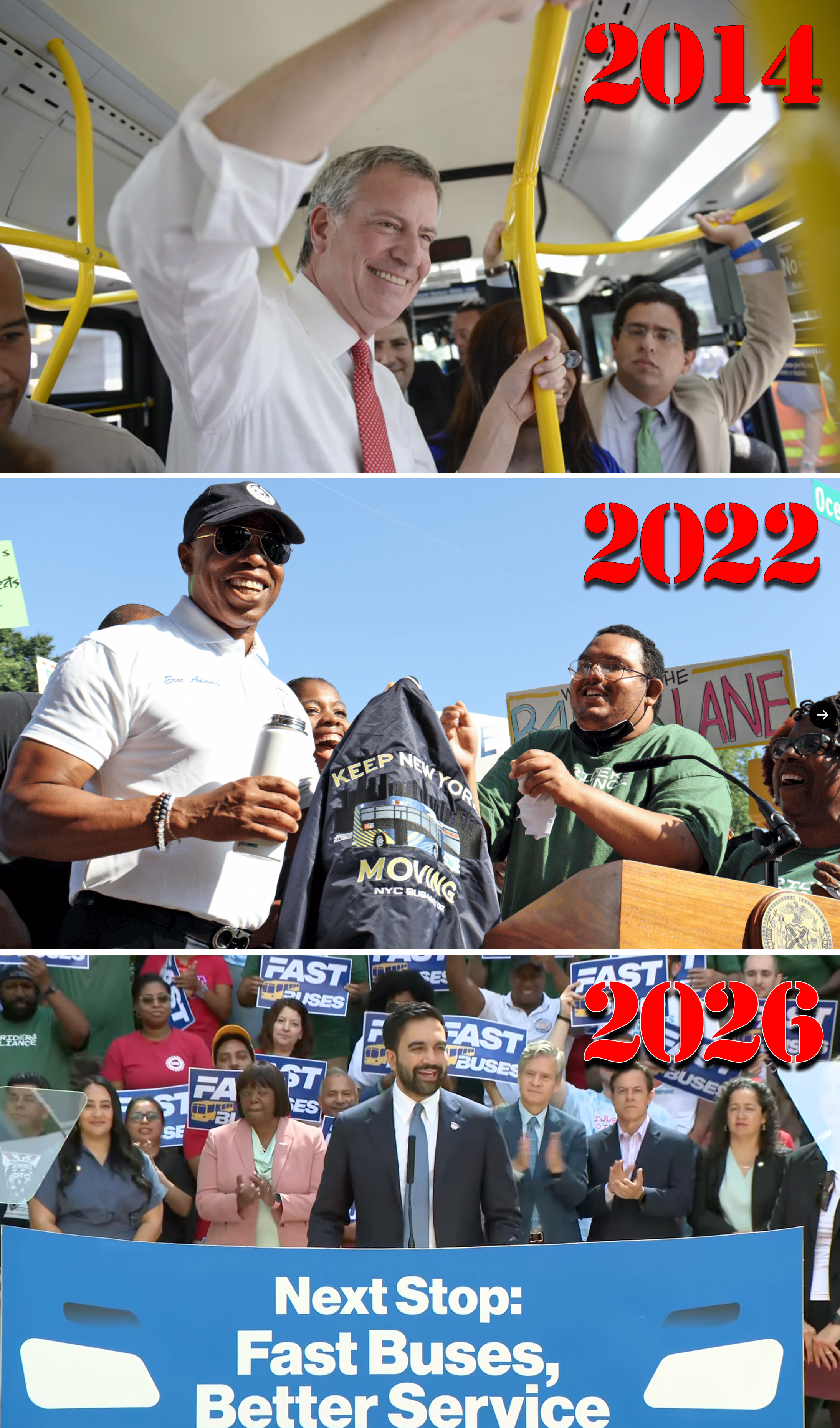
Would-be “Bus Mayors” have come and gone — looking at you, Mayors Eric Shamadams and Bill de Busisslow — and there’s a new city executive seizing the mantel as the person who will finally usher in a kumbaya era between the MTA and DOT. Previously, when promises of collaboration have failed, the back-and-forth between the city and state makes for great news copy, but frustration for bus riders.
Let’s offer the new mayor a primer on what he’s getting into!
A history of less than great
There’s no magic wand for great buses. Promises are easy, but where the rubber hits the road, it takes a huge commitment from multiple parties, firstly a mayor who takes on entrenched interests, such as car drivers who raise hell if “their” lanes or “their” parking are repurposed; puts up real capital to build boarding islands and other dedicated infrastructure; spends political capital to win support from community leaders; and properly oversees (aka berates) the personnel who will actually implement the effort and enforce the law to keep the bus lanes clear.
In short, the mayor needs to see faster buses as an important thing, not just a campaign promise to horse-trade away to appease a different constituency.
At the same time, state officials — the governor, the legislature, the MTA — need to support the effort with such improvements as bus-lane enforcement cameras, newer buses to reduce mechanical failures, and tinkering with the routes themselves to avoid extra turns.
This level of cooperation and political will has not previously happened — and the result has been year after year of failure.
The lack of unified bus planning between DOT and the MTA stretches back almost 10 years. In 2017, former Mayor Bill de Blasio proposed creating 21 additional Select Bus Service routes over 10 years in an effort to expand the city’s version of bus rapid transit to corridors across every borough. But in 2018, the MTA (then led by de Blasio’s constant tormenter, former Gov. Andrew Cuomo) canceled all future SBS expansions to save a piddling $28 million over four years.
In a good sign that everyone was not on the same page, the move to mothball the SBS program also came after then-New York City Transit President Andy Byford put out a Bus Action Plan of his own, which focused on speeding up buses with some familiar plans: all-door boarding, bus lanes, better dispatching, an investment in many new buses and getting the city to keep bus lanes and bus stops clear of traffic.
The penny-foolish move to walk away from the SBS program didn’t mean that de Blasio was completely off the hook, though. The former mayor picked up his aforementioned nickname for his seeming disinterest in greatly expanding bus lanes around the city, which he had the power to do even without more SBS routes.
In 2018, transit advocates and bus drivers began to put pressure on de Blasio to install 60 miles of bus lanes over his second term. The mayor eventually countered with his own Better Buses Action Plan in April 2019 that promised up to 15 miles of bus lanes per year, more bus lane enforcement and the installation of more transit signal priority, and a goal of speeding up buses by 25 percent in a single year.
But de Blasio had under two years left in office by the time he introduced his plan, whereupon the pandemic knocked everything off-kilter.
De Blasio was ultimately responsible for creating five busways after the 14th Street busway opened in 2019, but nothing in the bus planning work done during his second term indicated tons of coordination between DOT and MTA.
His successor, Eric Adams, came in with a legal requirement to build 30 miles of bus lanes per year, but promised even more: 150 miles of bus lanes in just four years.
In an attempt to put the city and state wars behind them, Adams and MTA Chairman and CEO Janno Lieber held a Transit Improvement Summit in June 2022. Adams made a series of commitments to install bus lanes, and Lieber said the MTA would expand its on-board bus camera enforcement. In the early days of his mayoralty, Adams was also gifted a spiffy Bus Mayor jacket by the Riders Alliance, in anticipation of his follow through on his promises.
That all fell apart pretty quickly, as by the end of 2022 DOT was telling the MTA it didn’t have the staff to meet the Streets Master Plan requirements. Adams also constantly let provincial political interests slow walk or kill high-profile bus lane projects like the Fordham Road bus lane upgrade, the Tremont Avenue busway and the Northern Boulevard bus lane. By August 2025, Lieber was all but begging Adams to follow through on even some of his promises, though by then New Yorkers were getting ready to send Mamdani to Gracie Mansion on a platform of fast and free buses.
The future is now
So going forward, the MTA and the Mamdani administration will need the kind of alignment that wins a three-legged race if they are going to deliver. And at least everyone appears to be on the same page: the “Next Stop: Better Buses, Faster Service” plan is first big bus plan to have welcome letters from the New York City mayor, the state governor, the MTA chairman and the DOT commissioner, which at the very least sets a tone that everyone wants to cooperate.
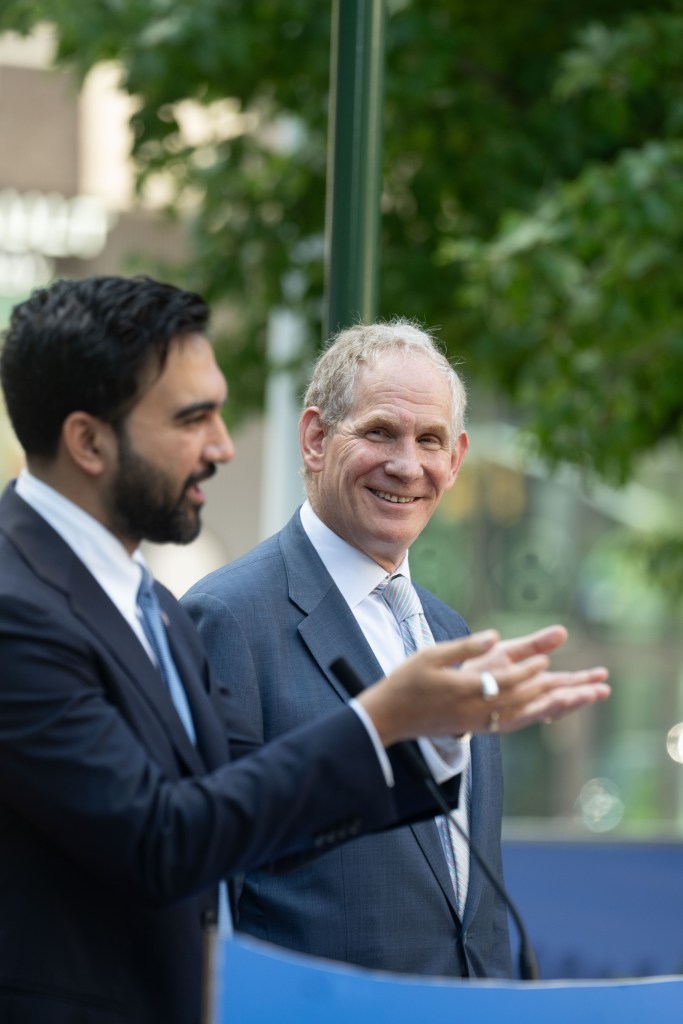
Gov. Hochul and Lieber also both used their remarks at a press conference on Wednesday to directly address the elephant blocking the bus lane.
“We’ve wanted to do this before,” said Hochul, took office while Adams was mayor. “This is not a brand new idea, but we never had the partnership and the leadership in City Hall that we have right now.”
Lieber, for his part, said that for the last six years the MTA has pushed and pushed for faster buses and better enforcement of the red paint to no avail.
“No secret, we had Gov. Hochul’s strong support, but the support at the local level in the prior City Hall was, shall we say, uncertain,” said Lieber. “Not the case anymore.”
Mamdani, Lieber and DOT Commissioner Mike Flynn all insisted that this plan had a better shot than those presented by previous mayors. Mamdani pointed to the financial resources being poured into street redesigns.
“What makes today different is not only the shared commitment to following through on those announcements, it’s also the fiscal commitment behind these announcements,” the mayor said. “When we’re talking about from the city level, we’re looking at a commitment of $254 million in expense funding over the next five fiscal years. We’re talking about more than $600 million in capital funding over that same period of time.”
Lieber noted that the MTA has a robust open data portal and very forward-facing metrics for how buses are performing, and Flynn said that the agencies are figuring out how to communicate what’s happening with goals as the plan gets implemented.
“Having clear benchmarks, as [Janno] said, means developing a series of performance indicators, things that we can actually measure to say, are we meeting the goals,” said Flynn. “We’re getting in the weeds, we’re working out [standard operating procedure] and processes that we’re going to use together, our two agencies to follow through.”
Rider advocates aren’t yet ready to gift another jacket to another mayor, but experts saw the new plan as more thought-out and holistic than the de Blasio plan, thanks to its combination of ribbon cuttings and management and policy changes.
“We’re not just getting bus lanes, but a commitment to service that will save riders lots of time,” said Danny Pearlstein, the Riders Alliance director of communications and policy. “In this case the whole of the plan is greater than the sum of its parts. This is a fully integrated whole and it’s a firm foundation for riders to win the better service and time savings we deserve.”
Of course, foundations still need to be built upon.

Read More:
Streetsblog has migrated to a new comment system. New commenters can register directly in the comments section of any article. Returning commenters: your previous comments and display name have been preserved, but you'll need to reclaim your account by clicking "Forgot your password?" on the sign-in form, entering your email, and following the verification link to set a new password — this is required because passwords could not be carried over during the migration. For questions, contact tips@streetsblog.org.