Hochul Could Cut ‘Runaway’ Crash Lawsuits With Default Motorist Liability
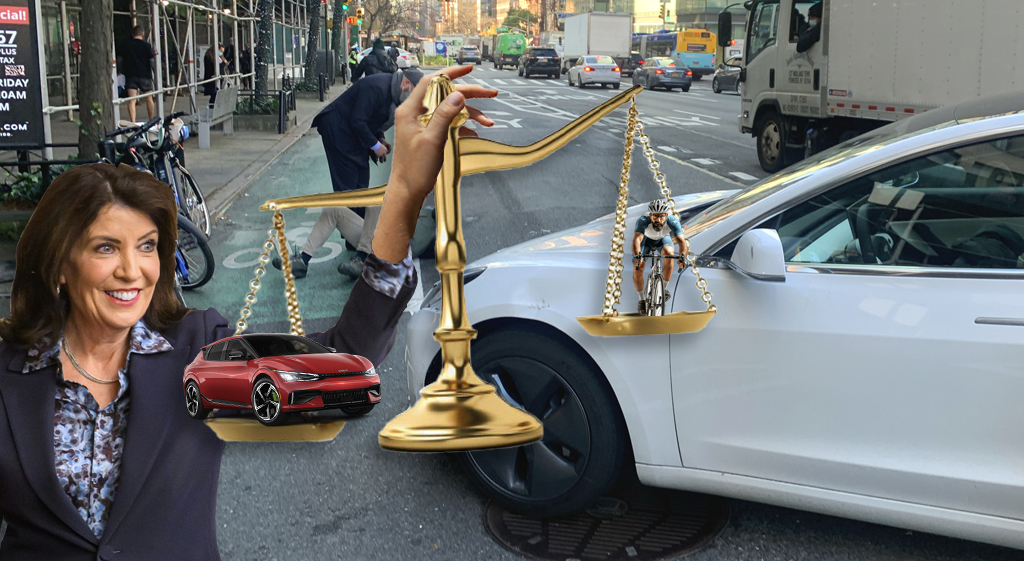
Gov. Hochul can reduce auto insurance premiums and slash what she considers “runaway litigation” if New York followed the European model that considers motorists automatically liable in crashes with vulnerable road users due to the inherent — and under-valued — danger of driving.
The concept, called “presumed liability” or “strict liability,” encourages drivers to be more careful on the road, while providing legal protection for people most at risk in collisions, according to advocates and experts in countries where this policy already exists.
“It’s a powerful incentive not to take driving lightly,” said Chris Bruntlett, international relations manager for the Dutch Cycling Embassy. “With great power comes great responsibility and we need to help automobile drivers understand that they wield great power.”
Generally speaking, several European countries have recognized for decades that driving is fundamentally a dangerous activity — and their laws reflect that. More powerful road users, i.e. drivers, are presumed to be at fault when they hit cyclists or pedestrians.
In the United States, motorists mistakenly believe they’re all above-average drivers, and the legal system treats each crash as an anomaly. That forces victims to go to court to prove that they were not to blame and deserve compensation for their injuries, according to Steve Vaccaro, a bike advocate and lawyer who has advocated for strict liability.
“[There’s the] idea that every traffic interaction is a one-off traffic interaction,” said Vaccaro. “Therefore you have to have this painstaking litigation of all the facts.”
European countries have since pulled far ahead in reining in traffic violence as the US gone in the opposite direction. In New York State alone, there are nearly 400,000 collisions a year, causing to 136,913 annual emergency department visits — or one every four minutes.
“It should be considered common sense, because we know the technology and the system that’s causing all the deaths and we know that strict liability is an effective means of putting the liability where it belongs,” said Vaccaro.
The Netherlands has enshrined blame for motorists since the 1990s, a key element of the country’s efforts to reduce traffic deaths, along with its expansive buildout of safe streets redesigns that turned it into a cycling haven.
“This strict liability law is a complementary policy to go with the infrastructure investments being made,” said Bruntlett. “It’s a complete mind shift change. … It treats driving as a privilege, not a right.”
There have been efforts to introduce presumed liability to the United States, most notably with a bill in Washington State that would presume driver fault for civil cases.
Presumed liability right-sizes legal accountability with the power of operating a two-ton vehicle, said Bob Anderton, founding attorney of Washington Bike Law based in Seattle, who has championed the proposal in the Pacific Northwest for nearly two decades
“This is not Big Brother coming to take away your car, this is society deciding that cars shouldn’t be seriously injuring and killing people. It’s a way to fairly reduce that,” said Anderton. “It’s just a matter of convincing lawmakers that they can do this and they should do this.”
The West Coast lawyer and other bike advocate lawyers noted that there could be the usual backlash from driver-first lawmakers, or opponents who claim it violates due process rules under the U.S. Constitution, but there are examples where it already exists, such as maritime law dictating that larger ships yield to smaller sail boats.
In Washington State, for example, dog owners are automatically liable if their canine bites someone, “regardless of the former viciousness of such dog or the owner’s knowledge of such viciousness.”
“You’ve not met my dog, but I can tell you he’s less dangerous than a car,” Anderton told Streetsblog.
New York has a precedent with presumed liability for drivers when they hit pedestrians and cyclist who have the right of way, which a judge upheld as being constitutional.
Hochul should broaden that framework to all crashes, which would more accurately reflect the threat drivers pose to everyone else on the road, advocates said.
So far, the state’s chief executive has been focused on eroding crash victim rights by following a campaign by Uber to reduce personal injury lawsuits in the name of “affordability.”
She has remained dismissive of alternatives that could achieve lower costs without sacrificing victims, like pay-per-mile insurance, which also rests on the fact that driving is by its nature a risky activity.
But if Hochul really wants to drive down costs for New Yorkers, she could reduce the need for them to litigate every crash when cars by definition wreak havoc on society – while encouraging more people to take up cycling without the fear of spending all their money on medical care if a motorist hits them.
“One thing that a lot of people in the U.S. have to worry about is the cost of healthcare,” Bruntlett said. “If they’re not insured, a crash can cost them tens of thousands of dollars and potentially bankrupt them.”
“Just to know that you’re covered and that you’re valued as a road user just because you’re not in this expensive piece of machinery is an important message,” he added.
Changing the blame game
There are two main systems of assigning drivers blame by default. Under presumed liability a driver is assumed to be at fault, but can still present evident and be found less at fault or not at fault at all.
With strict liability the driver is automatically and completely at fault, and a pedestrian or cyclist only needs to prove that damages are related to a crash.
Like the Netherlands, Germany has a strict liability system, which recognizes that driving is an activity that inherently creates a “source of danger.”
France adopted a law in 1985 requiring an “almost absolute obligation to indemnify for non-driver victims of a road crash,” in other words, passengers, cyclists pedestrians.
The shift even convinced the insurance industry to cut the rate of litigation for personal injury for permanent disability or death from 28 percent – “one of the highest in the world” – to 12 percent, according to an academic review six years afterward [PDF].
“That it’s in the interest of society, it’s in the interest of the insurance industry, and it’s definitely in the interest of people that want to walk the street,” said Anderton.
Closer to home, Ontario sets a “reverse onus” on drivers in crashes, meaning that they have to prove that damages or loss “did not arise through the negligence or improper conduct” of the motor vehicle operator, according to the Canadian province’s Highway Traffic Act.
New York could lead the way
New York has a comparative negligence system, where victims have to go to court and convince a jury to receive compensation for their injuries.
Victims often run up against cops and prosecutors with windhsield perspectives, and they may suffer from memory loss or other trauma from the crash, because they’re not protected by seatbelts, airbags and car frames.
“When police blame the cyclist or the pedestrian, often that’s the end of the story,” said Anderton. “By switching that, by making that presumption that the driver is at fault, then the driver is motivated to say, ‘No it isn’t, and here’s why.’”
The Empire State does require motorists to carry so-called no-fault insurance, which provides up to $50,000 to cover victims’s medical costs and lost wages – no matter who is to blame – but that amount has been unchanged for more than half a century and barely covers two nights at a hospital these days, so most people sue drivers to recover more to compensate for their pain and suffering. (Compared to 1974, $50,000 is worth only about $7,000 today.)
Hochul currently wants to make it harder for victims of crashes to claim damages above no-fault coverage, by narrowing the definition of a serious injury, barring compensation for people a jury finds more than 50 percent at fault, and capping damages at $100,000 for people driving uninsured, impaired or committing a felony.
She’s following a national playbook by Uber, which donated $8 million to her insurance campaign and has been lobbying lawmakers coast-to-coast to reduce insurance its requirements, which would in turn cut the tech giant’s costs.
A spokesperson for the governor did not bite for presumed liability either, claiming that cyclists and pedestrians are rarely to blame for crashes already, without providing any data to back that up.
“While these are ultimately jury decisions, it is exceedingly rare for a pedestrian or cyclist to be found responsible for being hit by a car,” said Sean Butler in a statement. “Under today’s laws, even if that cyclist or pedestrian is 1 percent at fault, they can be sued for pain and suffering for a crash they did not cause, which is why Governor Hochul is fighting to align with the 35 other states and change New York’s outdated liability laws and better protect these road users.”

Read More:
Streetsblog has migrated to a new comment system. New commenters can register directly in the comments section of any article. Returning commenters: your previous comments and display name have been preserved, but you'll need to reclaim your account by clicking "Forgot your password?" on the sign-in form, entering your email, and following the verification link to set a new password — this is required because passwords could not be carried over during the migration. For questions, contact tips@streetsblog.org.