Report: Safety Protections Have Not Kept Up With E-Commerce Boom, And Last Mile Is Making It Worse
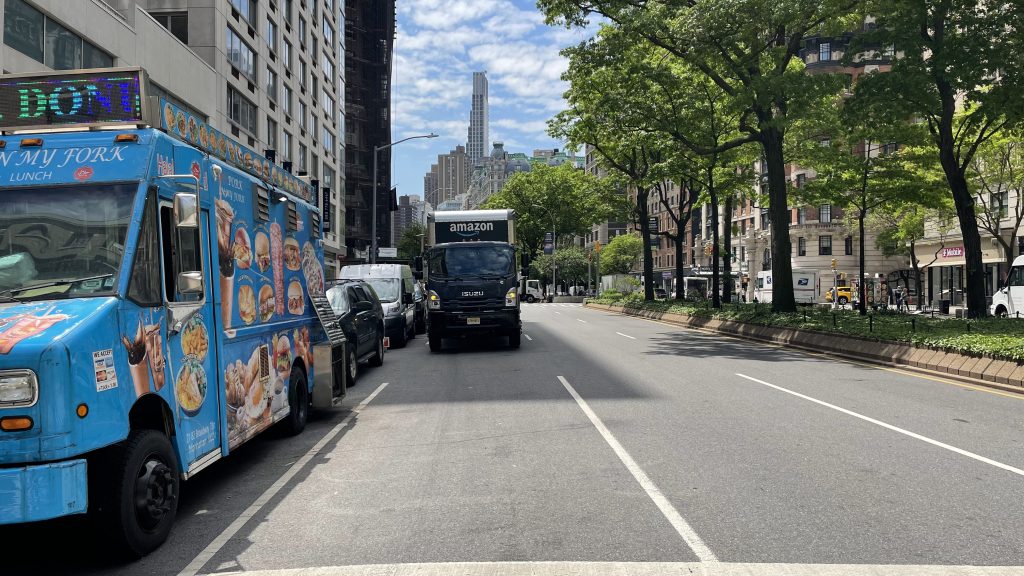
Amazon is not held accountable for the vast majority of its parking violations — and a new analysis by a Teamsters local argues that the lack of enforcement reveals the need for greater regulation of the last-mile delivery industry because the city can’t ticket its way to safety and equity.
The report by Teamsters Local 804 argues that the proliferation of “last-mile” warehouses has made city streets less safe partly because of rampant illegal parking with little consequences, but also because the algorithm-driven companies pressure workers with quotas leading to high driver turnover. The report mirrors one by the city comptroller’s office last year that showed higher injury rates around last-mile warehouses in the city’s industrial zones.
“We fully expect Amazon to deflect and deny responsibility for the damage its inflicting upon millions of New Yorkers, but facts don’t lie,” Teamsters Local 804 President Vincent Perrone said in a statement. “This company is driving down safety and workplace standards for the entire last-mile industry, and the best way to address this problem is by passing the Delivery Protection Act.
To prepare its analysis, the Teamsters combined publicly available data with research into enforcement. The city’s open data provided 1,553 license plates associated with Amazon. Between 2021 and 2025, those vehicles received 2,696 “No Standing” tickets, 906 tickets for blocking a bike lane and 2,183 tickets for blocking a hydrant.
Those are just some of the violations that we know of. But according to a study published last year in the Journal of Cities, the enforcement rate for parking violations is between 2.87 and 11.2 percent.
Assuming the higher enforcement rate, those 1,553 trucks had about 90,313 violations. At the 2.87-percent ticketing rate, the number of violations on those trucks is above 330,000 in the four-year period.
Those numbers suggest that the city can’t solve the problem through enforcement alone — the city’s 2,155 Traffic Enforcement Agents give out an average of 4,100 citations per year. It’s a lot, but not nearly enough if nearly 97 percent of violations aren’t ever punished.
Instead, the report is arguing that the system needs an overhaul. Currently Amazon operates under a subcontracting model that employs drivers through Delivery Service Partners rather than Amazon itself; advocates say this model encourages the partners to cut corners in a way that makes streets less safe.
Amazon slammed the Teamsters’ report as “flawed,” and “selective.”
“Every day, more than 40 independent Delivery Service Partners and their teams safely deliver packages to New Yorkers,” Amazon spokesperson Steve Kelly told Streetsblog in a statement. “These small business owners hire their own teams, manage payroll, determine route volume, establish their organizational structures, and decide whether to work with other companies in addition to Amazon. Safety remains central to everything we do, and we remain committed to helping partners and drivers stay safe.”
But advocates see Amazon’s DSP model as part of the problem.
“Today, New York City’s last-mile delivery system isn’t working for anybody. As daily package delivery continues to increase in our city, we can’t accept double parking, blocked crosswalks and bike lanes, and crashes as simply the cost of doing business,” said Transportation Alternative Deputy Director of Public Affairs Elizabeth Adams.
Daily package deliveries in New York City grew from 1.8 million before the Covid pandemic to 2.5 million in 2024. The report takes specific aim at Amazon, the “fastest-growing last-mile operator by volume in the United States,” because of the delivery service partner model. These “interposed contractors” are not truly independent, the report argues, because they have no assets other than often-exclusive contracts with the last-mile facility operation, which is often Amazon although FedEx uses this model, too. The last-mile facility operator has control over standards, delivery windows, productivity metrics, and vehicle specs, the report claims.
The report argues that the safety issues can’t be properly addressed without changing the DSP model, citing high turnover, productivity quotas dictated by companies that don’t claim an employment relationship to the drivers and algorithmic management as both barriers to change and symptoms of the model.
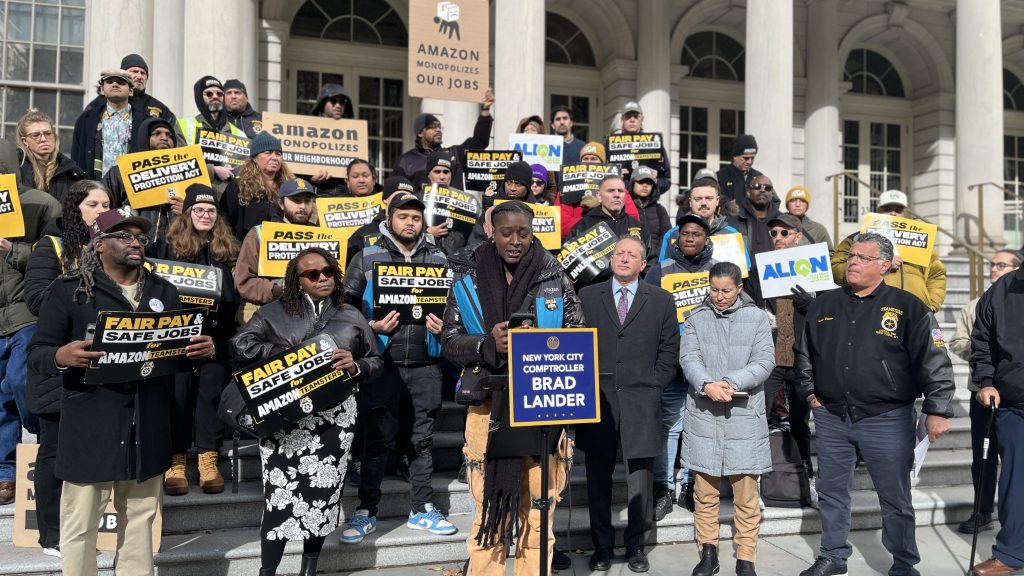
“Unregulated last-mile delivery services are putting our communities in danger to meet impossibly high quotas and unreasonably short delivery windows. Amazon’s disregard for worker and community safety is emblematic of an industry that is expected to deliver between half a billion and a billion packages in the city this year,” said Council Member Tiffany Cabán, who has introduced a bill that would stop the DSP model and force last-mile operators to directly hire their delivery drivers.
The bill has 41 co-sponsors from both sides of the aisle, and is supported by the Teamsters. It will get a hearing in the City Council Committee on Consumer and Worker Protection on Thursday, April 9.
DSP workers at Amazon’s Maspeth warehouse unionized under the Teamsters banner last year, and workers have been sounding the alarm on the link between the precarious employment model and street safety.

Read More:
Streetsblog has migrated to a new comment system. New commenters can register directly in the comments section of any article. Returning commenters: your previous comments and display name have been preserved, but you'll need to reclaim your account by clicking "Forgot your password?" on the sign-in form, entering your email, and following the verification link to set a new password — this is required because passwords could not be carried over during the migration. For questions, contact tips@streetsblog.org.