Department of Trucks: Brooklynites Beg for Relief on Third Ave. as Safety Redesign Stalls
Trucks first, safety last.
Sunset Park residents pleaded with the Mamdani administration this week to make Third Avenue safer before approving new truck routes in the area this summer, as a redesign of the deadly corridor has stalled for years.
Third Avenue is already a truck route, but the Department of Transportation’s proposed overhaul of the city’s truck route map would allow big rigs onto nearby Second Avenue as well. The agency also wants to designate a new truck route on Third Avenue further south in Bay Ridge — an addition that locals fear will inundate their streets with heavy haulers.
At the same time, DOT remains tight-lipped about a long-delayed proposal for a road diet and protected bike lanes on Third Avenue under the Brooklyn-Queens Expressway.
Sunset Park residents fumed at DOT for prioritizing trucks over the life and limb of locals.
“DOT’s proposed truck route redesign unacceptably forces our neighborhood to absorb massive commercial truck traffic increases without corresponding safety protection for members of our community,” wrote Brooklyn Community Board 7 Chair Julio Peña III in a letter to DOT Commissioner Flynn on June 6. “Forcing a single community to shoulder two parallel truck routes running through adjacent corridors is unfair to a neighborhood that has historically faced so many environmental and street safety challenges.”
The DOT press office disputed that its 44-mile net increase in truck routes will prompt more truck trips in the Big Apple, arguing that the new designated itineraries will encourage freight drivers to stay on commercial roads and off residential streets.
Truckers already must take the most direct path from truck routes to their destination, but expanding the network of sanctioned routes will bring them closer to their delivery end points, thus disincentivizing them from veering around neighborhoods, agency spokespeople told Streetsblog.
DOT’s plans come out of a City Council bill that aimed to reduce truck traffic, but the agency is effectively allowing truckers to drive on more roads. NYPD’s enforcement against off-route heavy haulers has plummeted over the last decade.
Sunset Park woes
The 2023 law by Council Member Alexa Avilés (D-Brooklyn), who represents truck-heavy communities in Sunset Park and Red Hook, mandated the map revamp, with an implementation date set for Sept. 15 of this year. The lawmaker has repeatedly criticized the agency for violating that goal by instead doubling down on freight traffic.
”I believe any redesign of the truck network should reduce truck traffic on local roads, improve pedestrian and cyclist safety, and reduce pollution — not just changes to the truck route itself, but also a commitment to street safety enhancements and concrete plans for enforcement,” Avilés said in a statement. She called on DOT to remove Third Avenue as a truck route, to avoid having multiple parallel corridors for freight traffic in Sunset Park.
The agency revised the map to add Second Avenue as a local truck route, between 29th and 58th Streets, while extending the Third Avenue corridor south of 65th Street to 86th Street in Bay Ridge and connecting back to the Gowanus Expressway via 86th Street. Officials took public comments on the proposal until June 9, and must implement a finalized version in September.
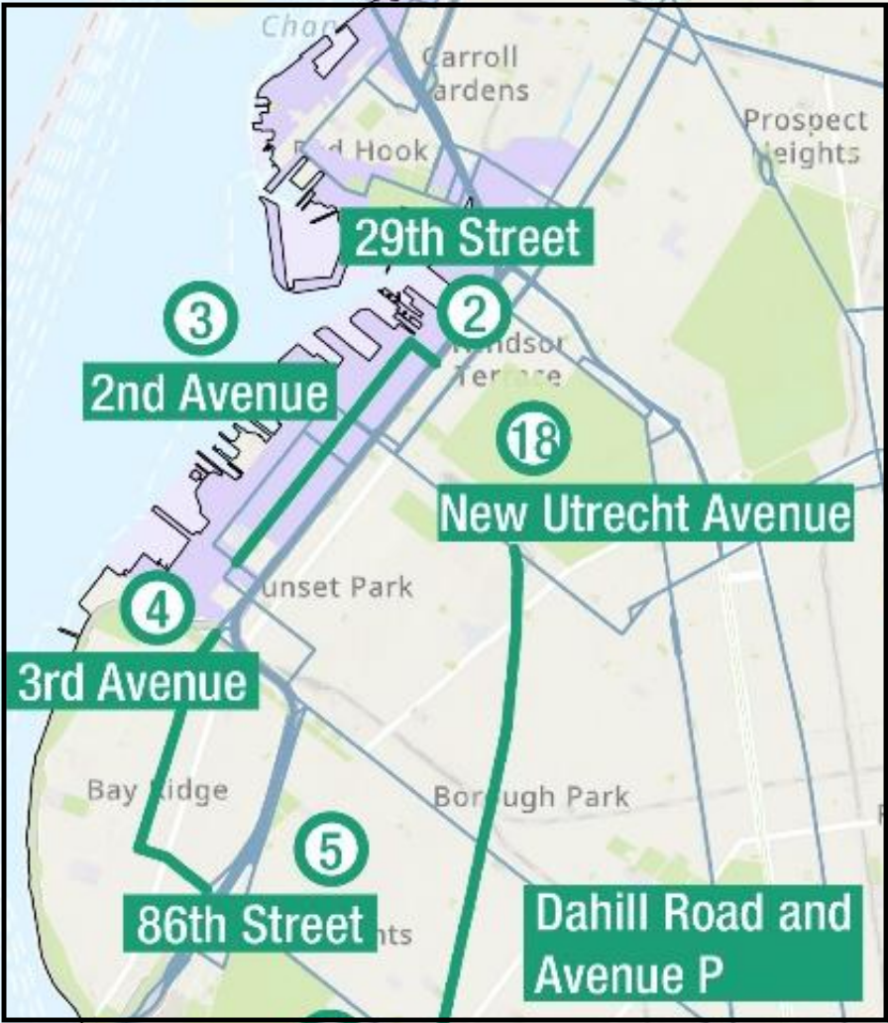
First, Third and Fourth Avenues already feature local truck routes, along with a long-distance truck route on the elevated Gowanus Expressway. DOT’s plan for Second Avenue would create four parallel avenues and an overhead highway for trucks in that part of the borough.
The proposed truck route also starts right where a recently-completed raised two-way bike path on the sidewalk of Third Avenue will connect to a future greenway extension on Second Avenue and 29th Street outside the Metropolitan Detention Center.
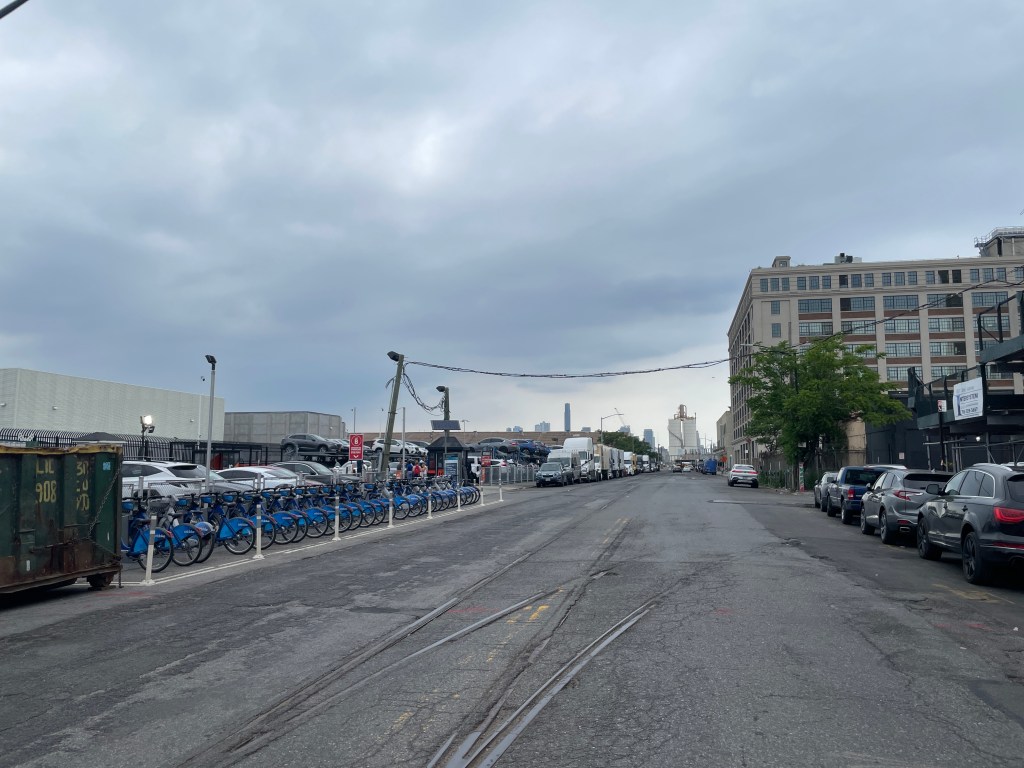
But officials have been slow to make Third Avenue less deadly for anyone outside of a truck or car. DOT in 2023 proposed to narrow the roadway and possibly install protected bike lanes there, but has delayed implementation for years.
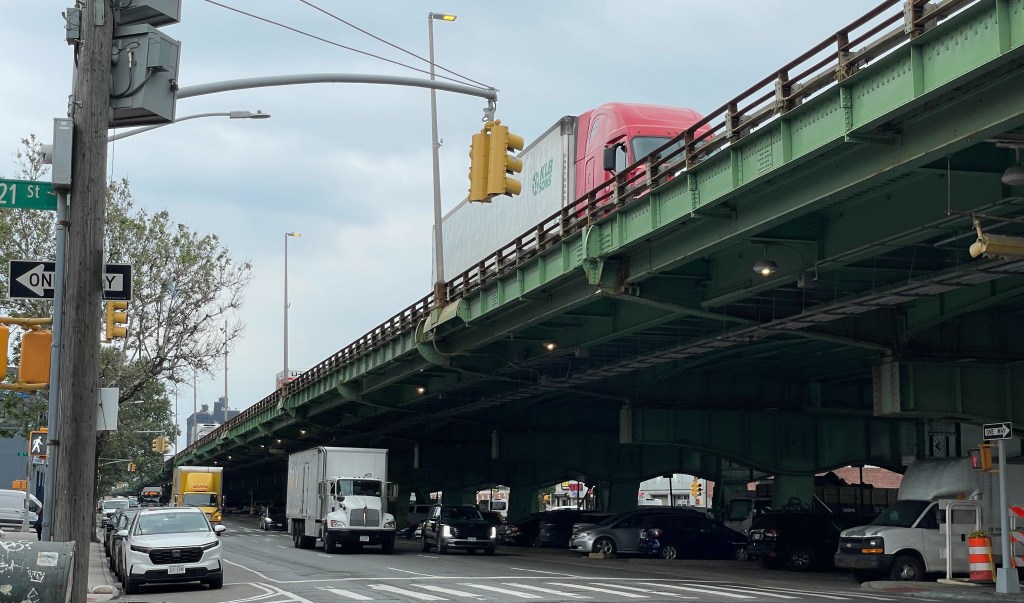
That proposed road diet, which CB7 endorsed, would have shortened crossing distances for pedestrians, who currently must traverse eight lanes dedicated to the movement and storage of cars — while passing underneath the exceptionally noisy Moses-era expressway.
Members of CB7 want the city to ensure safety before opening the floodgates to trucks.
“The way Third Avenue is currently designed, it’s designed for super speeders, it invites speeding on Third Avenue, so we need the redesign,” said CB7 member Sam Sierra at a meeting of its Transportation Committee on Monday.
Death Avenue
More than 80 people have died or suffered life-altering injuries in crashes over the past seven years along the corridor DOT was supposed to redesign, according to the advocacy group Transportation Alternatives. That is an average of a completely preventable death and injury every single month.
But groups like the Brooklyn Chamber of Commerce and the Southwest Brooklyn Industrial Development Corporation threw a fit over DOT’s proposal, claiming any hindrance to motor vehicles would hurt their businesses. DOT subsequently delayed the project, most recently until sometime this year. After the Adams administration paused the project last summer, a speeding driver blew through a red light and killed two men crossing Third.
Lawmakers and residents recently rallied for Mamdani to fulfill his campaign promise to finish the redesign, as the mayor has moved forward on other stalled projects like McGuinness Boulevard and Ashland Place.
Truck mitigations in Bay Ridge
Meanwhile in Bay Ridge, DOT has implicitly acknowledged the dangers of bringing more trucks to the neighborhood’s main thoroughfare of Third Avenue by proactively proposing mitigations.
Last month, the agency unveiled a roster of pedestrian upgrades in conjunction with the revamp, including painting and pouring concrete to expand curbs and shorten crossing distances for people on foot.
DOT officials claimed the redesign will divert truck traffic off quieter side streets and onto major thoroughfares in that neighborhood. Last month, they told Community Board 10 that a “lack of a dedicated truck route in Bay Ridge results in trucks using streets unsuitable for commercial vehicle traffic.”
For example, if a truck is making a delivery on Colonial Road in Bay Ridge, a driver currently has multiple east-west streets to choose from coming off the highway, but with a closer truck path on Third, the most direct route would be clearer and involve less time on the small side streets, argued DOT spokesperson Vin Barone.
Residents and pols in the neighborhood don’t buy it.
Bay Ridge lawmakers State Sen. Andrew Gounardes (D-Brooklyn) and Council Member Kayla Santosuosso (D-Brooklyn) have criticized the changes. Public comments on the website for the redesign’s rulemaking mentioned “Third Avenue” more than 200 times.
“I urge DOT to reject the proposed expansion of the Truck Route Network along 3rd Avenue and 86th Street,” Gounardes wrote in a letter to DOT. “This expansion would increase congestion without meaningfully improving freight access, undermine years of Vision Zero progress, and damage the economic vitality of one of Brooklyn’s most vibrant neighborhood corridors.”
On the northern end in Boerum Hill, residents want DOT to shave off two blocks of Third Avenue from the truck route because it encourages illegal cut-throughs on side-streets.
The Second Avenue addition lines up with Sunset Park’s industrial business zone, the agency noted in its redesign report, but the study admitted that “Brooklyn has the highest percentage of residential uses adjacent to proposed truck route additions at 16.6 percent.”
Sunset Park is home to schools, playgrounds, apartment blocks, a hospital campus, and Industry City, residents pointed out at a recent community board meeting. The influx of trucks also poses a “safety conflict” for operations at NYU Langone’s Medical Center, said a rep for the facility.
“NYU has hundreds of staff and patients arriving from and departing to the Fourth Avenue subway,” said Fred Mosher, an architect and the regulatory director for the hospital’s development and facilities told CB7’s Transportation Committee. “Staff and patients crossing the proposed Second Avenue truck route is a safety conflict.”
There are four schools and a daycare center at the intersection of Third Avenue and 60th Street alone, and the city should not be putting more trucks in the way of children, said another person who testified at the meeting.
“There is the number of schools, playgrounds and homes that are adjacent to Third Ave., and we need to be reducing the air pollution and fine particulate matter that affect our children’s health,” said local Kevin McCaul at the June 8 meeting. “We shouldn’t be expanding the trucking routes in Sunset Park, given the number of places we have to bring our children to along Third Ave.”
Another DOT spokesperson claimed that truck routes don’t incentivize more traffic, since they don’t build new physical lanes of roadway, and instead provide more direct routes to and from the trucking network and deliveries.
“Truck routes don’t create truck traffic; they keep truck traffic off the streets where they are least appropriate,” said Mona Bruno in a statement. “NYC DOT is committed to building on recent greenway construction to improve safety along Third Avenue and is reviewing feedback of our truck network redesign, which will shift existing truck trips off of local streets and onto major commercial roads.”
The routes add more legal roadway for truckers to drive, however. That makes it easier to drive, which generally tends to encourage more trips under a phenomenon known as induced demand. Barone, of DOT, countered that upstream factors determine the number of trucks on the road, like how many packages New Yorkers order, along with whether alternative delivery modes are available.
DOT did not provide any modeling to show that its plans won’t add trips.
The research isn’t as clear cut for induced demand from adding new truck routes as it is for, say, a highway expansion, but the increased number of roadways means freight companies could be less likely to face the cost of fines for going off-route and thus could afford to make more trips. One 2015 study by the Federal Highway Administration found that a “reduction in truck freight costs could stimulate an increase in total freight shipments.”
The city already over-relies on trucking, with 90 percent of all freight coming to the Big Apple via big rigs — well above the national average of 70 percent. Efforts to transport more goods by boat and smaller delivery vehicles, dubbed “Blue Highways” have moved at a snail’s pace.
Another resident argued that the city should focus on the safety of its residents, not on the swift movement of goods.
“I understand that Sunset Park is vitally important for our freight network, but inviting more trucks without safety fixes endangers our community,” said CB7’s Secretary John DeLooper at a public hearing for the rule change on Tuesday. “Please come back and finish the Third Ave. street improvement plan. Our children and neighbors should not pay for the city’s logistical efficiency with their lives.”

Read More:
Streetsblog has migrated to a new comment system. New commenters can register directly in the comments section of any article. Returning commenters: your previous comments and display name have been preserved, but you'll need to reclaim your account by clicking "Forgot your password?" on the sign-in form, entering your email, and following the verification link to set a new password — this is required because passwords could not be carried over during the migration. For questions, contact tips@streetsblog.org.