Year-Round Outdoor Dining Poised to Return Under Council Bill
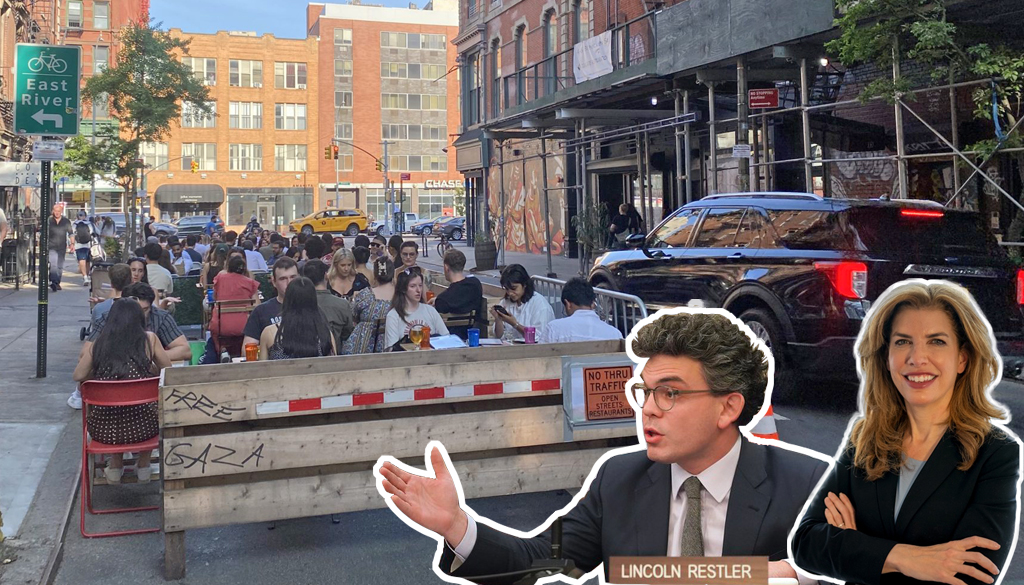
Restaurants will be able to keep their roadway dining setups year-round under a City Council bill that is poised to pass on Thursday with the goal of dramatically expanding roadside “streeteries” that were curtailed by the previous administration.
The new push, backed by Council Speaker Julie Menin, will encourage more restaurateurs to take up outdoor dining because they will no longer have to shell out thousands of dollars to build curbside streeteries only to have to take them down December, store them for four months and then set them up again in March, said the legislation’s author.
“The number one critique we’ve heard from restaurants for why they don’t participate in roadway dining is that setting up, deconstructing and storing outdoor dining structures is too darn expensive,” Council Member Lincoln Restler (D–Brooklyn) told Streetsblog. “Our legislation will restore outdoor dining to its previous glory, while maintaining some of the quality of life improvements that we have seen in recent years.”
Outdoor dining boomed during the Covid-19 pandemic under an emergency program that easily allowed restaurants to set up shop on the sidewalk and in the roadway, but such structures were barred in the curb in December, January, February and March when then-Council Speaker Adrienne Adams and Mayor Eric Adams codified a permanent program in 2022.
The program has become “too burdensome,” said Speaker Menin, adding that as a former restaurant owner, she knows first hand how hard it is to survive rising costs.
“Outdoor dining has transformed our streets, strengthened local economies, and became part of what makes New York City so special,” Menin said in a statement. “This is about making it easier for small businesses to thrive while creating more vibrant neighborhoods for New Yorkers and visitors alike.”
Participation plummeted from a peak of around 11,770 active outdoor dining setups to just around 1,500 businesses fully permitted by the Department of Transportation, according to recent stats by Mayor Mamdani’s Commission on Government Efficiency, which is proposing its own reforms to speed up applications.
“That’s fantastic news [because] the number one impediment for businesses that wanted to have outdoor dining was the seasonal nature of it,” said Sam Goetz, owner of Judy’s, a bar and café in Sunset Park. “That was just a logistical and cost problem for any business that didn’t have storage space – which is most of them.”
Restler’s bill, which would take effect immediately after an expected mayoral signature, will end the four-month ban by creating year-round outdoor dining permits (as well as seasonal permits if the restaurateur wants a less-expensive option). The bill would also create a $630 interim license for owners of existing setups to transition to a full-year permit, beyond the deadline for taking them down on Nov. 30.
“We wanted to make sure that it’s a seamless transition for restaurants for a year-round outdoor dining this November,” Restler said.
The seasonal permits to rent the road space – so-called revocable consent fees – are cheaper than the full-year license. The fees will still vary by zones, with higher rates in neighborhoods where the competition for curbside space is strongest, such as Greenwich Village, and less costly in the suburban parts of the city, like southeast Queens.
For full-year structures, curbside space fees will range from $6 to $31 per square foot. A roadway café of the maximum size — eight by 40 feet — in a busy city neighborhood would cost a restaurateur nearly $10,000 per year, or around $27 per day. That may sound cheap, but for the city, it’s money in instances where outdoor dining replaces two places where car owners would typically just park for free. The trade-off, of course, is that restaurants on avenues, with metered spaces, will pay less than what car users would collectively pay for the same metered space, which can be nearly $70 per vehicle to park for eight hours in Midtown and Lower Manhattan.
The upside is that outdoor dining generates sales and income taxes, and the dining areas themselves activate the street and can have a multiplier effect for other businesses. Meanwhile, car storage benefits a single person, the car owner, noted one livable streets advocate.
“Outdoor dining is about more than restaurant policy. It’s about what we want our streets to be used for: giving people more places to sit, eat, gather, and spend time in their neighborhoods—not simply storing private cars,” said Sara Lind, co-executive director of Open Plans, which shares a parent company with Streetsblog.
Under Speaker Adams, the Council barred roadway dining over the winter, with the top lawmaker personally believing that al-fresco eating should be restricted to the sidewalk. Negotiations in the lead-up to that bill at the time were among the lengthiest in recent memory, according to one Council insider.
The result was that restaurant owners decided en masse that the curtailed program was no longer worth the effort, and the program shrank dramatically. The remaining eateries willing to take part in the part-time program have had to go through lengthy public reviews that routinely pushed back their permits until after the peak warm weather seasons had passed.
The new rules will ban restaurants from using their roadway frontage for storage or any other purpose than serving patrons — and service has to conclude by 11 p.m., a cutoff an hour earlier than current regulations that Restler said was designed for “balancing the concerns of all stakeholders.”
“It’s important that restaurants are good neighbors and in many of our communities there are tenants directly above restaurants,” Restler said. “Asking people to move inside at 11 p.m. is a perfectly reasonable compromise.”
The outdoor dining legislative package includes three other bills that lawmakers are set to vote on Thursday.
The legislation will also allow for restaurants to make their outside structures winterproof, and requires them to clean their setups of snow.
Restaurant owners will be able to pay their revocable consent fees every three months, as opposed to a lump sum every year, bringing back the schedule that the old sidewalk café program charged businesses pre-pandemic, said Andrew Rigie, executive director of the New York City Hospitality Alliance.
“Not even a landlord requires a restaurant to pay their full-year rent upfront,” Rigie told Streetsblog. “There’s been enormous financial burden places on small businesses.”
Another bill will add new fines between $200-$500 per violation for restaurant owners that don’t clean their setups of trash, graffiti and vermin.
“The Department of Sanitation [will] require restaurants to clear snow from their outdoor dining structures, which is a better outcome than cars sitting there for days on end with piled up snow on them,” Restler said.
Community boards would also no longer be allowed to ask for extra paperwork from owners during the application review, an issue that has come up at some of the unelected civic panels, where members have demanded business owners provide extensive and notarized documentation.
Mayor Mamdani’s “Committee on Government Efficiency,” or COGE, also put several reforms on the November ballot to speed up the process for obtaining a license by 75 percent, by streamlining applications and reducing the role of community boards and Council members.
The Council and COGE proposals are not necessarily in conflict, Restler said.
“The time savings that COGE has identified largely relate to reduced public comment period, limited oversight by council members and community boards, and no longer filing notice in local newspapers,” Restler told Streetsblog. “Those changes should speed up the process for restaurants. COGE has also anticipated that DOT will much more swiftly review applications moving forward and on that the proof will be in the pudding.”
The outdoor dining structures became part of the city’s streetscape during the health emergency, and Goetz said New Yorkers have grown used to them, even on colder days.
“There’s some people that like to be out there even when it’s very cold,” said Goetz. “It’s one of those things where you didn’t know how much you were missing in New York City until they allowed it. And now it’s unthinkable to lose it.”
A spokesperson for Mamdani said the mayor supports the legislation and said the new laws, along with COGE’s ballot proposal, will make it easier for New Yorkers to use the curb for more than just private car storage.
“Mayor Mamdani proudly supports this much-needed legislation to improve outdoor dining and looks forward to working with City Hall to implement a year-round program that is more accessible to more restaurants and ensures our streets can be used in a variety of ways to benefit all New Yorkers — not just vehicles,” said Jeremy Edwards in a statement.
Update (Thursday, Aug. 13 at 3:08 p.m.): This story has been updated to include a comment from Mayor Mamdani’s office.

Read More:
Streetsblog has migrated to a new comment system. New commenters can register directly in the comments section of any article. Returning commenters: your previous comments and display name have been preserved, but you'll need to reclaim your account by clicking "Forgot your password?" on the sign-in form, entering your email, and following the verification link to set a new password — this is required because passwords could not be carried over during the migration. For questions, contact tips@streetsblog.org.