NEVER MIND: Bus Service Tanked After January Snowstorm, So MTA Nixed The Data
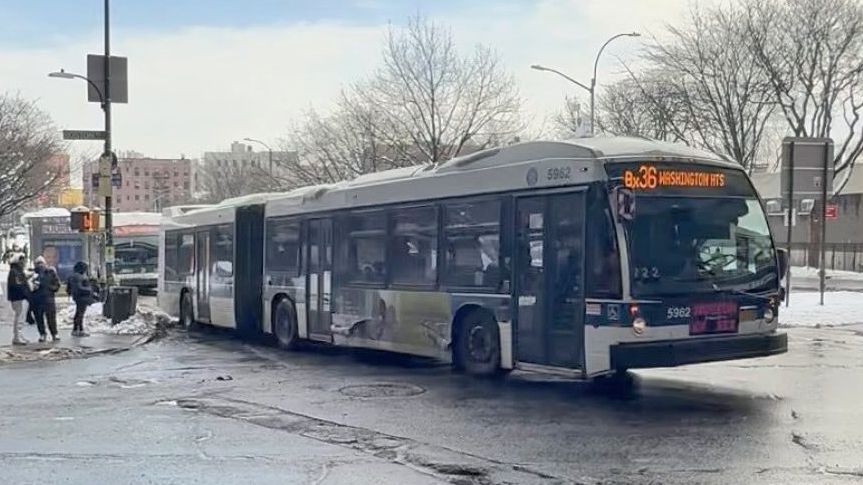
The impact of last month’s snowstorm and subsequent cold spell screwed bus riders so badly that the MTA decided not to include an entire five days of data in its monthly performance metrics, transit officials revealed on Wednesday.
New York City Transit President Demetrius Crichlow bragged to MTA board members on Wednesday about a 95.1-percent bus service delivery rate in January — but that figure excluded service stats from the five full weekdays after the Sunday, Jan. 25 superstorm in the end-of-the-month measures of bus performance.
“The January storm caused widespread detours and weather related obstacles, significantly disrupting normal bus operations,” Crichlow told board reps. “The January storm and ensuing freeze limited the system’s ability to deliver regular service. As a result, the metrics are excluded on Monday Jan. 26 through Friday Jan. 30.”
New Yorkers took more than 800,000 bus trips per day during that five-day period — compared to over one million trips on a typical weekday.
The MTA operates bus service, but the quality of that service depends highly on things outside of the agency’s control — including whether the city and its contractors clear bus stops and bus lanes of snow. Crichlow said the “diminished” bus service after the storm had a number of causes, but declined to criticize the city for what he called “a major event … beyond our control.”
“We operate our service based on what’s available to us,” he said. “There are different factors which effect our ability to operate our buses. It could be crew availability, it could be equipment availability, it could be street availability.”
Mayor Mamdani faced criticism for the city’s failure to make sure bus stops, sidewalks and crosswalks were cleared in the aftermath of “Winter Storm Fern.” But he led a noticeably more robust response to this week’s storm, dubbed “Winter Storm Hernando.”
Staten Island received more snow this time around than the rest of the city, which stymied bus service on the Rock, Crichlow said. Photos showed curbside bus lanes bearing the brunt of the city’s plowing efforts, which push snow to the edge of the roadway — as Council Member Frank Morano (R-Staten Island) observed on Tuesday on Hylan Boulevard:
The January snowstorm has faded from memory since this month’s more substantial blizzard, but the city’s seemingly haphazard snow removal effort and days of below-freezing temperatures after the storm combined to make many sidewalks, bike lanes, bus lanes and crosswalks nearly impassable.
With temperatures well below freezing, city workers often had nowhere to put the snow cleared from streets. Bus riders took to social with photos of mounds of snow preventing access to stops across the five boroughs.
“After the first storm it was just so apparent that the snow was put in bus stops as an available space of last resort, and widespread street parking made it hard to put the storm somewhere else,” said Danny Pearlstein, spokesman for the straphanger group Riders Alliance.
Crichlow could not immediately provide the service delivery data for the weekdays that the MTA excluded from its January stats.
“Both on the rail and bus side, we operate a schedule and in most instances, we judge ourselves based on our ability to maintain that posted schedule,” he said. “But in the instances where you have a major, major event, generally beyond your control, beyond your ability to plan for it, in the instances that we notify the public that the schedule is not going to be the posted schedule, we do not include those days in our performance [metrics].”
Still, Pearlstein called on officials to be more forthcoming. The City Council will hold a hearing on post-snowstorm transit and accessibility on Friday. (Click here for details.)
“The more we know at a granular level to bus service after each storm, the better we can reflect on what practices work and what needs improvement for the future,” Pearlstein said. This isn’t about blaming the city and the MTA; it’s helping everyone serve riders better. This is a missed opportunity to learn from experience and figure out what to do differently in the future.”
— With Dave Colon

Read More:
Streetsblog has migrated to a new comment system. New commenters can register directly in the comments section of any article. Returning commenters: your previous comments and display name have been preserved, but you'll need to reclaim your account by clicking "Forgot your password?" on the sign-in form, entering your email, and following the verification link to set a new password — this is required because passwords could not be carried over during the migration. For questions, contact tips@streetsblog.org.