Snow Problem: Can New York City Handle Big Winter Storms Anymore?
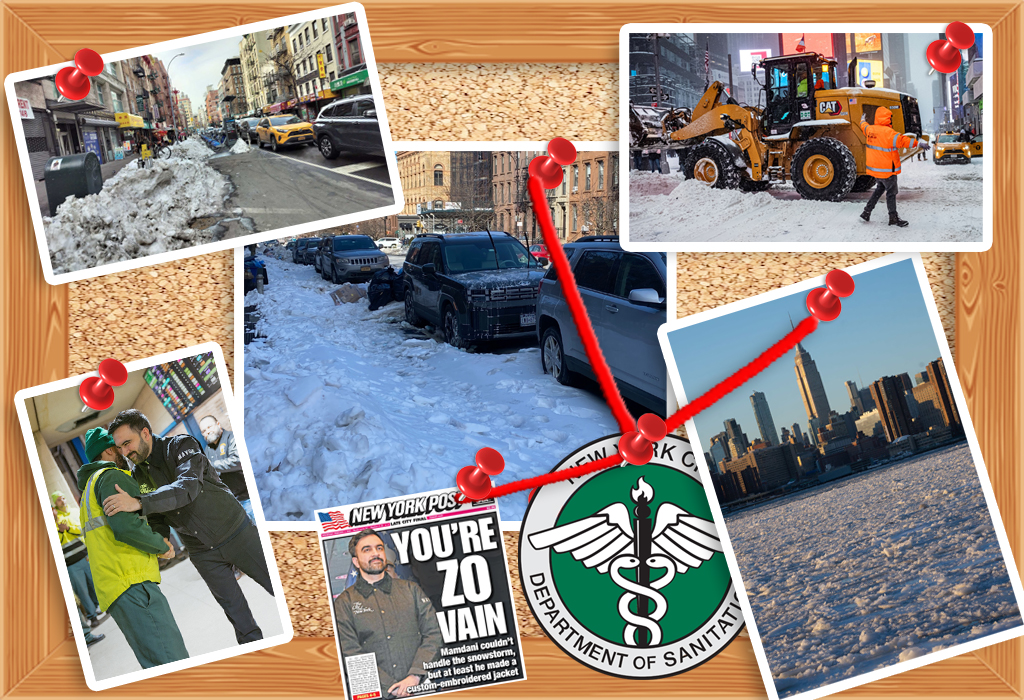
There are eight million people in the big city. And 32 million opinions on the Mamdani administration’s response to its first snow crisis.
On Jan. 25 — 15 days ago today — New York City had its worst snowstorm in years. We’ve endured bigger dumps from Mother Nature, but rarely do temperatures remain below freezing for so long, not only keeping the snow in place, but hardening it into immovable bergs that block bus stops, sidewalks and bike lanes — and make a mockery of the notion of getting around on foot, in a wheelchair or on a bike.
Was the city under-prepared? Or did the new mayor blow it? Let the debate begin. This month, the City Council will hold two hearings on the city’s snow response, starting on Tuesday at 10 a.m., as two committees hold a joint hearing on the 17 New Yorkers who died in the cold.
Another hearing has been promised by Council Member Shahana Hanif (D-Park Slope) to focus on snow clearing effort at bus entrances, crosswalks, and sidewalk accessibility.
As the Council begins to dig out from the storm, we thought we’d provide an overview of all we’ve learned.
A pedestrian ‘hellscape’
Streetsblog Editor-in-Chief Gersh Kuntzman’s “Cycle of Rage” column the day after the storm deemed the city a “hellscape” for pedestrians — a hot take that turned out to be prescient.
When snow falls in New York City, responsibility for cleaning it up is spread between property owners and the city departments of Transportation, Sanitation and Parks.
City law requires property owners to shovel the sidewalks outside their buildings to create a four-foot walking path. If snowfall ends between 7 a.m. and 5 p.m., property owners have four hours to get shoveling. If the snow ends between 5 p.m. and 9 p.m., they have 14 hours. And if it ends between 9 p.m. and 7 a.m., property owners must clear the sidewalk by 11 a.m. That was the case in this storm: property owners needed to clear the sidewalk by 11 am on Monday, Jan. 26.
The city is in charge of removing snow from roads, bus stops and crosswalks. Sanitation handles city streets, highway ramps, off-ramps and public walkways. DOT clears highways and municipal areas. And Parks does park pathways and sidewalks lining its emerald empire.
After the Jan. 25 storm, piles of snow accumulated at corners, making it difficult for pedestrians to get to the crosswalks. Some corner property owners did their civic duty and cleared paths to the crosswalk, but city plows sometimes pushed the snow right back onto them — as Streetsblog broke down in a video days after the storm:
The Sanitation Department said that as of Friday, it wrote 3,000 summonses to property owners who didn’t shovel. But as Streetsblog reported, of the 8,169 complaints that the agency received between Jan. 27 and Feb. 4, only 85 resulted in violations.
Bus riders brave the elements
The city’s thousands of bus stops serve over two million average daily riders. After the storm, bus riders took to social media to post photos of mountains of snow piled at bus stops around the city. To get on the bus, New Yorkers often found themselves climbing piles of snow — or walking in the street.
We took this photo days after the storm:
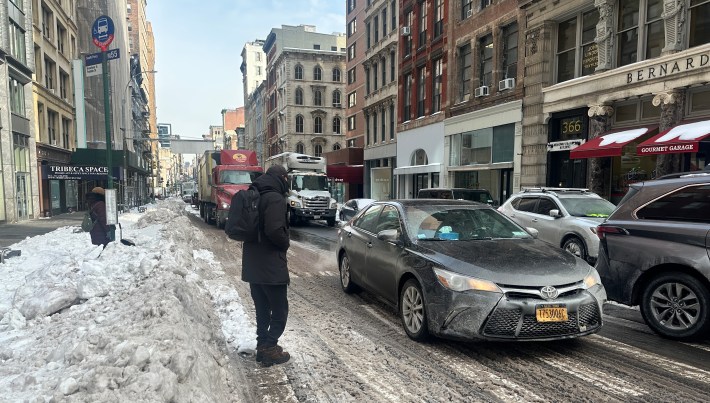
For the 3,400 bus stops with shelters, the city subcontracts with the advertising firm JCDecaux, which is responsible for prepping the areas for snowfall and clearing the bus stops after the store. DOT told the Daily News all sheltered bus stops had been cleared by JCDecaux as of last Thursday.
But the majority of the city’s bus stops, over 10,000 of them, do not have shelters. The responsibility to shovel those falls to the property owner of the adjacent building. But property owners failed bus riders, so the Sanitation Department deployed emergency shovelers, officials said.
“In addition to brining, salting and plowing all roads and bike lanes, we also cleared paths at all unsheltered bus stops, as well as more than 44,000 crosswalks citywide,” DSNY Press Secretary Vincent Gragnani told Streetsblog. “Yes, much of this infrastructure is the responsibility of the adjacent property owner but, knowing that many property owners fail to do so, DSNY has stepped in.”
But did the city hire enough emergency snow shovelers? Obviously, critics of Mayor Mamdani don’t think so, as the Post was all too happy to report, but the persistent cold is close to the 16-days-below-freezing set in 1961.
But cold is a natural part of the winter. Is the city prepared? The Sanitation Department’s response to the Post story wasn’t very convincing, arguing that local weather patterns, the snow laborer program itself and “the nature of work post-pandemic” have changed.
“This is the largest deployment of emergency snow shovelers since the pandemic, and it included extremely rare night shifts, making this a round-the-clock effort that we have not seen in years,” the agency said.
In other words, wait ’til next year?
The little bike lane plow that could … or couldn’t
DSNY is responsible for plowing the city’s protected bike lanes, just as it is responsible for plowing roads meant for cars. But cyclists noticed that major protected bike infrastructure, like Grand Street and Ninth Street in Brooklyn, remained unplowed for more than a week after the storm — despite past promises from DSNY to treat bike lanes and car lanes with the same priority.
The city’s protected bike lanes are life-saving infrastructure for those who get around on two-wheels. But they are also the workplace of over 80,000 delivery workers, most of whom can’t afford to take a day off due to weather. One delivery worker told Streetsblog that the storm made his already-dangerous job more harrowing.
“I have to share the road with the vehicles,” said delivery worker Aboubacar Ki of biking post-snowstorm. “They clear the road for the vehicle, but not for the bicycle. It’s very difficult to bike right now. It’s scary because people who drive don’t pay attention to people riding bikes.”
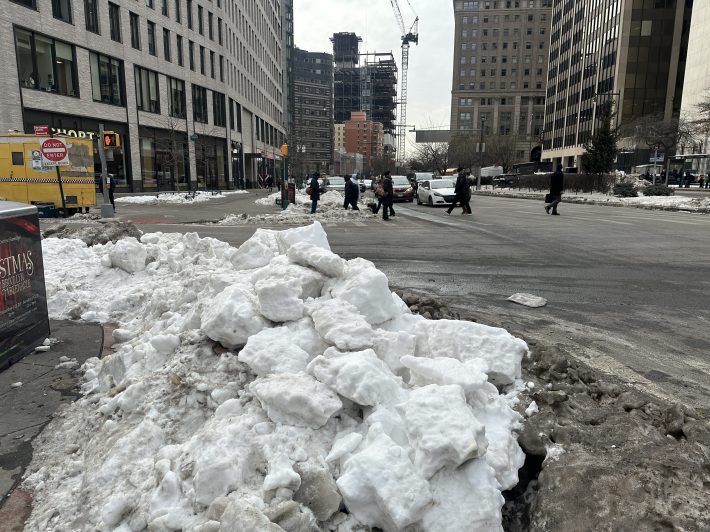
DSNY has a fleet of special small snow plows specifically for protected bike lanes. But they couldn’t be everywhere. And to make roadways passable for car drivers, the snow had to go somewhere — and that somewhere was often bike lanes:
We took this photo of the protected bike lane on Adams Street in Downtown Brooklyn on Friday, Feb. 6, two working weeks after the storm:
Citi Bike: public-private breakdown
At the storm’s peak, Citi Bike announced that it would suspend service for 22 hours due to the nearly one foot of snow accumulation. But it’s unclear what the Lyft-run bike-share program, whose contract gives it the exclusive right to operate in its service area, did with that time.
After the snow stopped and the roads became usable, Citi Bike users wanted to ride again. The Friday after the snowfall, over 40,000 cyclists braved the cold on a Citi Bike. But it wasn’t only the cold that kept people from using a Citi Bike — on many winter days in the past, the system has served 100,000 rides. Too many bike docks were frozen solid.
Lyft made little progress in clearing the docks. Citi Bike told the New York Post that it had cleared just 500 of the over 2,400 stations as of Feb. 4, leaving more than three-quarters of the system un-shoveled.
Lyft, meanwhile, has not been transparent with Citi Bike users, or the press, about which stations it has cleared, which costs people time. And on a Citi Bike, time is money. Citi Bike members expressed frustration on social media, but instead of apologizing or giving discounts, the company reportedly sent “swag” to “winter warriors” who biked a lot in the snow.
The city’s contract with Lyft puts the onus on Citi Bike to clear its own infrastructure, but the company has apparently decided it isn’t worth the hassle or expense in most of its service area.
Because Lyft has no competition in the bike-share space thanks to its exclusive contract with the city, and does not receive public subsidies, there is no incentive for the company to provide a good service if it doesn’t increase shareholder value for Lyft. But since the bikes are in the public right of way, it’s the public – and Lyft customers – that lose.
What about parked cars?
Over three million people learned what a “sneckdown” is thanks to Streetsblog’s video team’s storm coverage.
The phenomenon, combining the word “snow” with the urban-planning device “neckdown,” reveals the public space given to cars that could easily be repurposed to pedestrian and bike infrastructure.
But the snow also reveals how many New Yorkers store their cars on the street for weeks at a time without having to move them. DOT suspended alternate side parking rules for over two-weeks, so drivers didn’t have to move their cars for street cleaning. In that time, unused cars stuck out like a sore thumb, piled high with icy snow. Some drivers paid enterprising tech-bros and high schoolers to dig their vehicles out ahead of the return of alternate-side-of-the-street parking rules on Tuesday.
The city’s failure to hold car owners responsible for the public space they occupy exacerbated the snow’s negative effects. For instance, on one-way streets, roadways are significantly narrower due to snow piled up around automobiles. And on streets with parking-protected bike lanes, car owners shovel snow into the bike lane, creating danger for cyclists and undoing the work of the sanitation department’s bike-sized plows.
The city used to have an emergency system and signs marking car-free snow routes. But sometime during the Bloomberg Administration, the signs vanished and the program – which helped sanitation clear vital routes – was quietly shut down, as Streetsblog reported on Friday.
The Council will have a lot to cover for one hearing.

Read More:
Streetsblog has migrated to a new comment system. New commenters can register directly in the comments section of any article. Returning commenters: your previous comments and display name have been preserved, but you'll need to reclaim your account by clicking "Forgot your password?" on the sign-in form, entering your email, and following the verification link to set a new password — this is required because passwords could not be carried over during the migration. For questions, contact tips@streetsblog.org.