FLASHBACK: What Happened To Car-Free ‘Snow Routes’ — And Could They Have Helped City Clear the Streets?
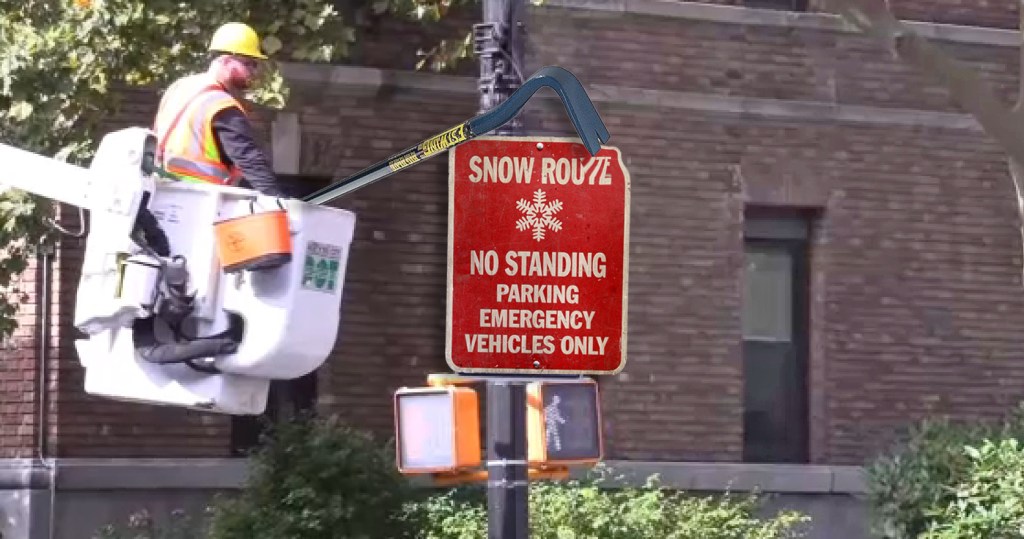
New York City’s prolonged difficulty in clearing streets and sidewalks after the Jan. 25 winter storm may have its roots in a car-first policy enacted by the Bloomberg administration that allows drivers to leave their private vehicles on public streets that can’t be properly plowed as a result.
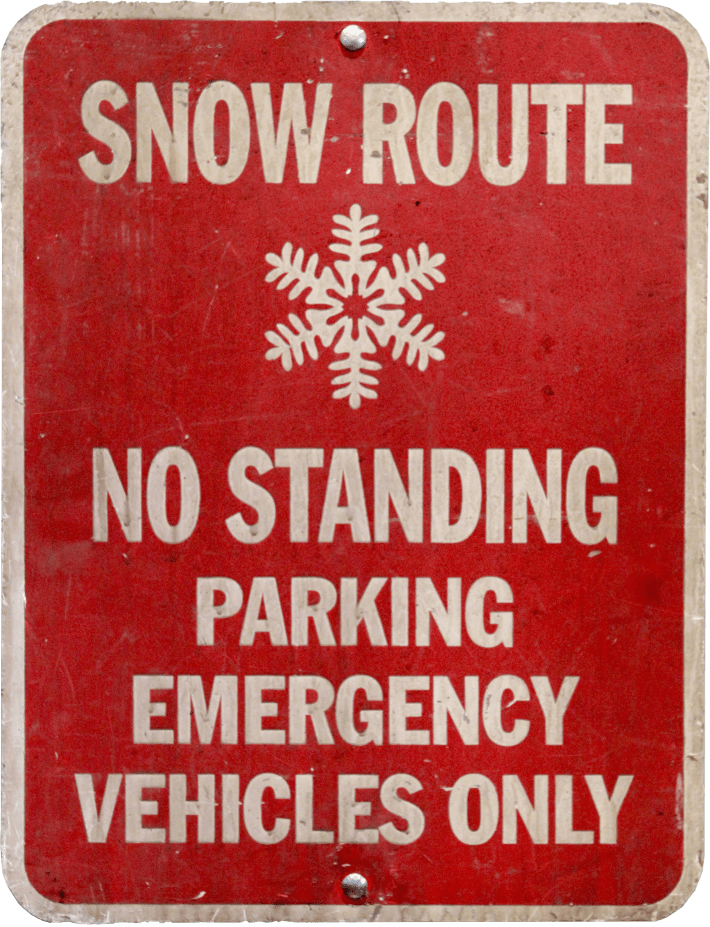
For decades, thousands of red signs (right) designated major roadways as “snow routes,” where drivers could neither park nor stand during declared snow emergencies. The city began installing the signs in 1961 after a particularly brutal winter.
The snow route system worked for more than 50 years, though true emergencies were rare. Former Mayor Rudy Giuliani declared the last one in December 2000 from the city’s emergency bunker in the former World Trade Center and ordered tow trucks to remove cars from the designated routes.
But in 2013, during the final stretch of Michael Bloomberg’s tenure, the city quietly removed every last snow route sign and abandoned the idea of snow routes altogether.
The Department of Transportation, which manages street signs and is theoretically in charge of declaring snow emergencies, confirmed that the city no longer uses snow routes.
A DOT official added that the department removed the signs more than a decade ago “because it was determined that having drivers scramble to move vehicles ahead of an advancing snowstorm wasn’t necessary, nor productive for snow removal efforts.” The official declined to clarify who made this driver-friendly determination, and on what basis.
A different DOT official referred Streetsblog to the Department of Sanitation, which oversees snow removal operations. Sanitation spokesperson Vincent Gragnani said the agency couldn’t immediately determine why the city abandoned snow routes in 2013, but claimed the routes had become unnecessary.
“As the streetscape has evolved, so has our equipment and our snow-fighting work,” Gragnani said. “We can now get into narrow locations such as protected bike lanes with new specialized equipment that can brine, salt and plow. This is part of why the specific ‘snow routes’ program you’re asking about is no longer necessary, and has not been for some time.”
Not every expert agrees.
Cancelling snow routes was a “big mistake,” said “Gridlock” Sam Schwartz, who oversaw the Department of Traffic in the 1980s and argued that the lack of snow routes hinders Sanitation’s ability to safely clear roads.
“It’s not safe for bike riders, it’s not safe for bus riders and it’s not safe for car drivers,” he said.
Schwartz also disputed the argument that car drivers accustomed to street parking would not know where to park their vehicles during a snow emergency. He never witnessed that issue when DOT declared snow emergencies in years past.
“People adapted to it,” he said. “They figured it out. They moved their cars. And that portion of the snow emergency could be lifted in two or three days because Sanitation could clear those streets.”
Schwartz said the NYPD chose the first snow routes with the idea of targeting arterials, commercial districts and bus routes for quick snow removal.
“The rule of thumb was that if it had a parking meter, it was a snow street,” he said. The city even had three levels of snow emergencies — limited, regular and full — with different rules for each.
A number of snow-prone peer cities — including Boston, Washington, Toronto and Montréal — ban parking on major roads during winter emergencies. Chicago bans all overnight parking on major roads between December and April. These policies appear to work well.
So what happened?
Many New Yorkers would be surprised to learn that their city completely abandoned its own snow route network. Indeed, the 2013 policy change received so little notice that the city’s official website still insists that the signs, and the snow routes they once designated, are real and continue to exist:
Snow Emergencies are declared by the NYC Department of Transportation. Certain streets are part of Snow Emergency Routes. You can identify these streets by a special red and white sign. You should follow signs posted to determine if you can park or drive at a specific location. During a Snow Emergency: You can’t park on any street with a Snow Emergency Route sign.
And it’s still unclear who made the decision to cancel snow routes. Was it DOT, Sanitation, or some other entity?
The snow route signs disappeared when the Department of Transportation was run by Commissioner Janette Sadik-Khan, the widely regarded urban planner who memorialized her tenure at the agency in her 2016 book, Streetfight. Two knowledgeable sources linked the end of snow emergency routes to her campaign to remove or redesign garish parking signs that listed a lot of complicated rules. That effort launched in early 2013, which coincides with the disappearance of the snow route signs.
But a third insider said that, back in 2012, Sanitation officials asked their counterparts at DOT to no longer declare snow emergencies and remove the related signage, because Sanitation had independently determined that car drivers on snow routes would simply double-park on other streets, create unnecessary congestion, and otherwise interfere with its efforts to brine the streets before snow begins to fall.
If this is true, it isn’t clear how Sanitation determined that car drivers would interfere with snow operations. After all, the department primarily deals with removing garbage and snow, not studying the movements of vehicles. Nor is it obvious why Sanitation approached DOT in 2012 — more than a decade after Giuliani declared the final snow emergency. The Sanitation Commissioner in 2012 was John J. Doherty, who died in 2023.
Today, there are few remaining traces of the city’s former snow routes. One exception is the interactive website AllText.NYC, which allows users to search for specific words within Google Street View’s historical imagery of New York City. Searching for “snow route” returns more than 5,000 results. Here’s a zoomed-in heat map of lower Manhattan:
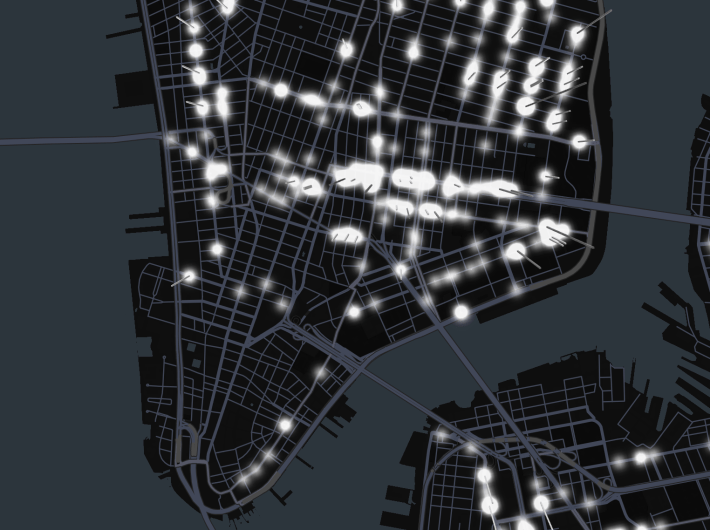
Clicking on each map marker reveals photos of the long-forgotten snow route signage. For example, here is one sign on the intersection of Houston and Elizabeth Streets, photographed by Google in June 2009:
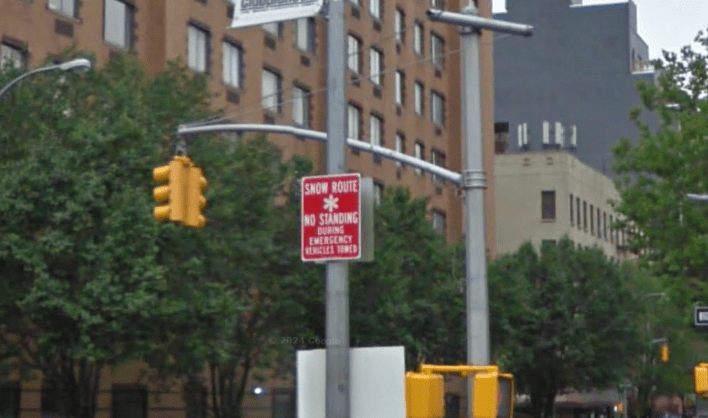
Google snapped the same sign again in July 2011 and July 2012. But by August 2013, the sign was gone — and never reappeared.
And thus, one key component of the city’s snow removal effort itself was quietly swept away.


Read More:
Streetsblog has migrated to a new comment system. New commenters can register directly in the comments section of any article. Returning commenters: your previous comments and display name have been preserved, but you'll need to reclaim your account by clicking "Forgot your password?" on the sign-in form, entering your email, and following the verification link to set a new password — this is required because passwords could not be carried over during the migration. For questions, contact tips@streetsblog.org.