Serious Traffic Injuries Went Up This Summer Under Adams, Bucking a Trend
Summertime and the living was queasy.
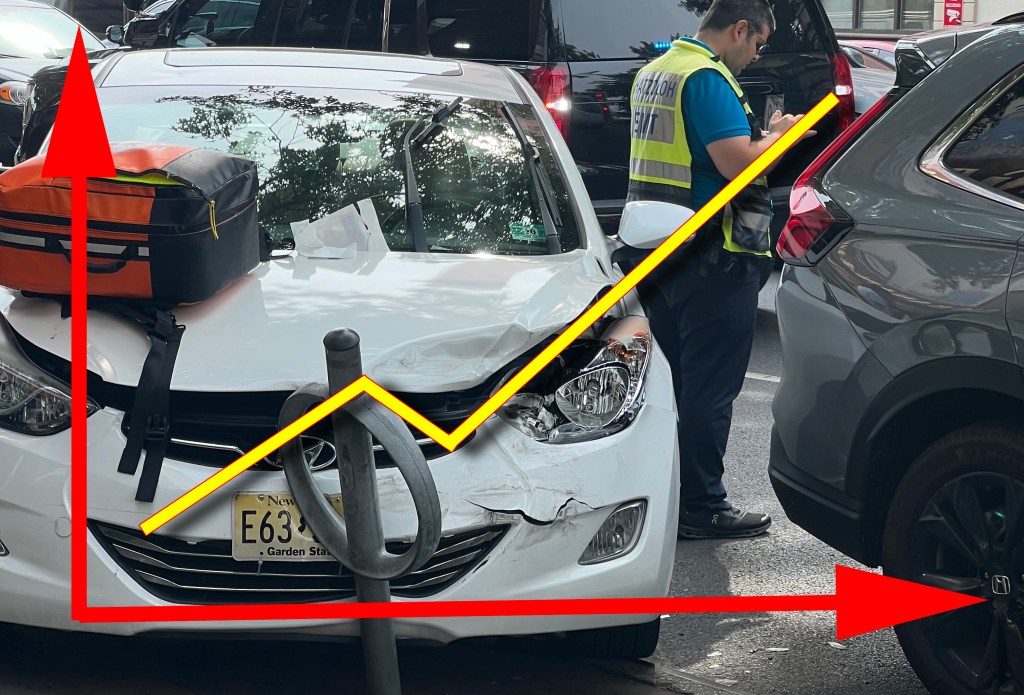
The city set an ignominious record for serious traffic injuries in the third quarter of 2025, with 940 people sustaining life-altering wounds — a 5-percent increase from the average for the same four-month period since 2022, according to a new analysis of city crash data by Transportation Alternatives and Families for Safe Streets.
Transportation Alternatives blamed the Adams administration for diluting, halting, and even reversing road safety measures in 2025, though total serious injuries were down between Jan. 1 and Sept. 30.
“The city has spent its time stalling street safety projects and botching the rollout of Sammy’s Law,” said Ben Furnas, executive director of Transportation Alternatives, referring to a state law passed last year that gives the city the authority to reduce speed limits. Neither the mayor nor the City Council has seized this power to lower speed limits beyond a few short road segments and a handful of tiny neighborhood slow zones.
TA and Families for Safe Streets were especially concerned about two major project rollbacks. For instance, the Department of Transportation planned to implement a road diet and protected bike lane on Third Avenue in Sunset Park, but abandoned it after complaints from local businesses. Since 2022, 29 New Yorkers were seriously injured on the 2.5-mile stretch that would have been redesigned, TA’s analysis found.
The group found a similar pattern on McGuinness Boulevard, where 13 New Yorkers were seriously injured between Meeker Street and the Pulaski Bridge over the same timeframe. The redesign along that 2.5-mile-long corridor was watered down after former Adams adviser Ingrid Lewis-Martin allegedly took bribes from a politically connected firm in the neighborhood that opposed traffic-calming.
In response, DOT characterized TA’s analysis as arbitrary and inaccurate in depicting Vision Zero as a failure. Indeed, total traffic injuries are down from 38,731 last year to 35,153 in 2025 — a decline of 9 percent.
“Vision Zero is working,” said spokesman Vin Barone. “Traffic deaths have reached historic lows … with serious injuries and total injuries also trending down this year across nearly every travel mode. We know the work is not done – no loss of life on our streets is acceptable – and we look forward to building on our success.”
Traffic fatalities are also down this year, but certain statistics from the TA analysis stand out. For instance, low-income New Yorkers remain most at risk of serious injury.
The 10 poorest City Council districts experienced 18 percent more serious injuries per capita than the citywide average. In these districts, pedestrian injuries are 21 percent higher and bicyclist injuries are 15 percent higher.
Injuries in the category called “other motorists,” which includes moped and scooter riders, are 35 percent higher.
Council District 8, which covers East Harlem and the South Bronx, recorded the most serious injuries per capita, with 21.9 residents per 10,000 seriously injured since 2022 – a rate 70 percent higher than the citywide average. More than 90 percent of the district’s residents use public transit or walking as their primary means of transportation, and their median household income is $36,445 — less than half of the citywide median of $79,713.
No data set fully captures the reality of traffic violence, which takes a daily toll in this city. There are roughly 230 reported crashes every day, with about half resulting in injuries.
“This new data should illustrate the depth of the violence on our streets and inspire the City to fully deliver on Vision Zero,” said Jack Greenwood, research associate at Transportation Alternatives.

Read More:

Streetsblog has migrated to a new comment system. New commenters can register directly in the comments section of any article. Returning commenters: your previous comments and display name have been preserved, but you'll need to reclaim your account by clicking "Forgot your password?" on the sign-in form, entering your email, and following the verification link to set a new password — this is required because passwords could not be carried over during the migration. For questions, contact tips@streetsblog.org.