DC Inspires Bike Lane Envy With Curb-Protected Cycling

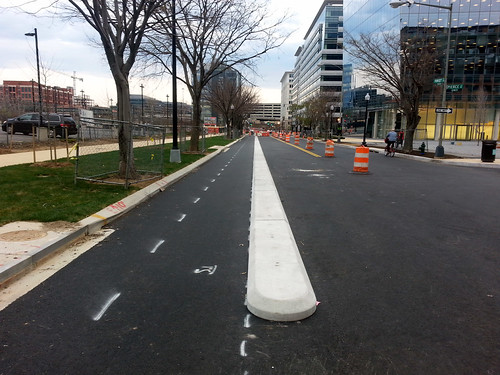
Here’s a good sign that protected bike lanes are here to stay in American cities: Cities are increasingly trading plastic bollards for concrete curbs, making the lanes a more permanent feature of the landscape.
As I reported for People for Bikes last year, Chicago, Austin, Seattle, New York and Portland have all either installed or plan to install curb-protected bike lanes. The latest city to join this elite group is Washington, DC.
Dan Malouff at Greater Greater Washington explains the new bike lanes coming to M Street and 1st Street in the nation’s capital:
Their designs are a step up from previous DC cycletracks, since they each include spots — though on M, a very brief spot — where a full concrete curb separates bikes from cars.
The 1st Street NE cycletrack connects the Metropolitan Branch Trail to Union Station and downtown DC. DDOT installed its curb last week, from K Street to M Street. Crews are still working on striping and signals, but the project is close to opening.
The M Street cycletrack is longer than 1st Street’s overall, but the portion with a curb is shorter. It’s less than one block, where the cycletrack briefly curves onto Rhode Island Avenue in order to approach Connecticut Avenue more safely. Officials say the M Street cycletrack is a week or two from opening.
Typically DDOT uses plastic bollards instead of curbs. The bollards are less expensive, easier to install, and can be removed occasionally to perform street maintenance. But they’re less attractive and less significant as a physical barrier, compared to a curb.
Elsewhere on the Network today: Treehugger reports that Ontario is planning to install bike infrastructure as part of all future provincial highway and bridge projects. And CincyMap argues that a new study touting the “efficiency” of Cincinnati’s SORTA transit agency really signifies how poorly funded the agency is.

Read More:
Streetsblog has migrated to a new comment system. New commenters can register directly in the comments section of any article. Returning commenters: your previous comments and display name have been preserved, but you'll need to reclaim your account by clicking "Forgot your password?" on the sign-in form, entering your email, and following the verification link to set a new password — this is required because passwords could not be carried over during the migration. For questions, contact tips@streetsblog.org.