Bronxites: Don’t Sacrifice Our Waterfront Access For Yet Another Amazon Warehouse
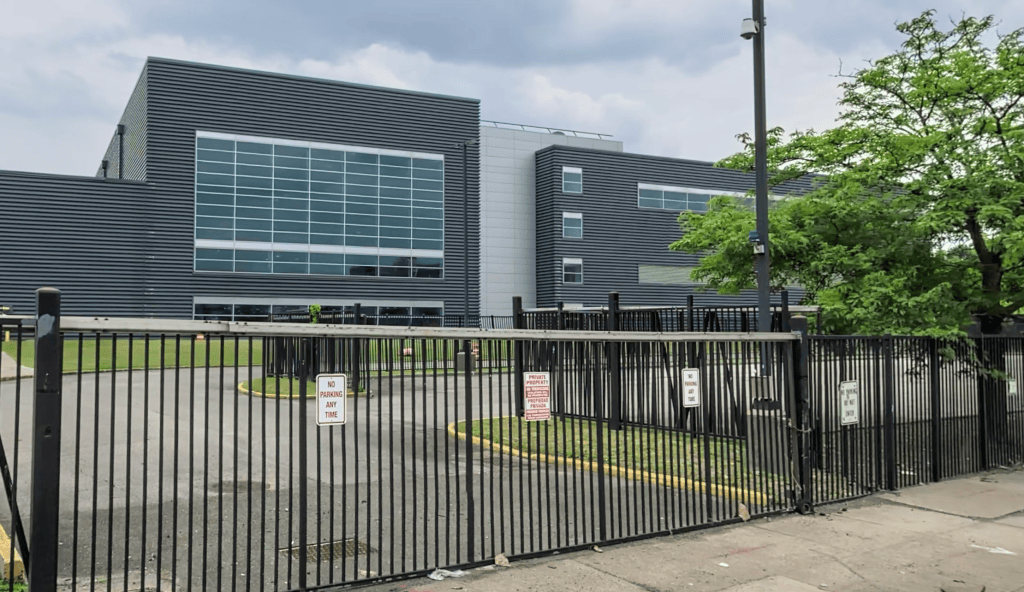
Bronx residents are calling on Gov. Hochul to block an Amazon contractor from converting a former New York Post printing plant into a last-mile warehouse they say would inundate the area with trucks and sacrifice a huge chunk of the borough’s waterfront.
Environmental activists with South Bronx Unite say that logistics giant Prologis, which builds warehouses across the city, wants to convert the dormant printing building — located in Port Morris across from Randalls Island — into a last-mile fulfillment warehouse.
Jeremiah Kane, a vice president at Prologis, met with representatives from South Bronx Unite on Oct. 6 and told them that the company planned to tear down the existing printing plant building and replace it with a last-mile warehouse.
Prologis’s top tenant nationally is Amazon, according to its most recent Securities and Exchange Commission filing.
The South Bronx waterfront, meanwhile, already hosts a large Fresh Direct warehouse in the Harlem River Rail Yard, which abuts the lot right next to the former newspaper plant. Researchers from Columbia University blamed the Fresh Direct warehouse for increasing motor vehicle traffic after it opened in 2018. With 1,000 Fresh Direct diesel trucks driving through the neighborhood each day, residents are understandably hostile to the possibility of another truck-heavy logistics operation opening in the lot directly next door.
“There’s this feedback loop of ‘Oh well, there’s warehouses here, so it’s a great place to put another warehouse’ instead of ‘Oh there’s warehouses here maybe and 60,000 people live here, maybe we should like think about other other things we can do,'” said South Bronx Unite spokesman David Rosales.
Port Morris and Mott Haven are stuffed with warehouses, and the city government so far has failed to regulate their associated emissions and traffic impacts. One option for doing so is an indirect source rule, under which the city would use a points-based system to force warehouse owners to electrify their fleets and shift some deliveries to cargo bikes.
Researchers with South Bronx Unite believe that New York state has an opportunity to stop the warehouse development because the state Department of Transportation owns part of the land beneath the Post building.
Originally constructed by the defunct New Haven Railroad, the Harlem River Yards stretch from Lincoln Avenue to slightly east of Willow Avenue. The Penn Central Railroad, which acquired the site from NHR in 1969, sold it to New York State DOT in 1982. Nine years later, the state leased the land to a real estate developer, The Galesi Group, which operates the property under a subsidiary known as Harlem River Yard Ventures. The Post building sits on a lot which includes the easternmost piece of the Harlem River Yards, plus a former MTA bus depot, which the state sold to Harlem River Yard Ventures in 1999.
Before anyone builds anything, South Bronx Unite wants the state to investigate whether it has any direct control over how the land can be used, and if it does, to block a new warehouse from materializing.
“There are restrictive covenants that are tied to the lease that give both the city and the state certain enforcement rights over the land, so an ask that we have for the state is to essentially confirm whether or not these covenants are still still active,” said South Bronx Unite’s energy and economic justice advisor, Zoe Voss Lee.
Lee encouraged the state make use of its cumulative impacts law, which legislators intended to dissuade developments if they add more pollution to historically polluted areas.
“Since the plan for this is to become a warehouse, we can anticipate that there will be significant numbers of trucks that will be brought to the area,” she said.
Rather than another warehouse, South Bronx Unite wants the city and state to open the Bronx Kill waterfront to the public. Rosales pointed to the fact that the state Department of Environmental Conservation has highlighted SBU’s own Mott Haven-Port Morris Waterfront Plan in its official Open Space Conservation Plan.
For the former Post facility, South Bronx Unite envisions a hub for community solar power and a green manufacturing and job-training space. Formerly industrial waterfront spaces — such as Brooklyn Bridge Park, the East River waterfront parks in Manhattan and Brooklyn, Hunter’s Point South and Brooklyn Marine Terminal — have experienced, or will soon experience, second lives as mixed-use neighborhoods.
As the city has shifted so much of the waterfront away from warehouses and heavy industry, Bronxites while they haven’t received the same treatment.
“Brooklyn and Queens and Manhattan have started to move away from that a lot more, and it feels like in the Bronx it’s moving a lot slower,” Rosales said. “At the end of the day, this stuff comes down to the willingness to do it, the willingness to prioritize it, the willingness to fund it.”
The old Post building is a short walk away from the abandoned and crumbling E. 132nd Street Pier. That proximity has led South Bronx Unite to speculate whether Prologis will pitch the warehouse as part of the city’s “Blue Highways” program to move more freight around the city by boat. That could make the project more palatable to decision-makers, but EDC has already identified locations for that program, and none of them include the pier or anywhere else in the Harlem River Yards.
Lee noted that Kane, the Prologis executive, told the trade publication BisNOW that he was interested in using the Blue Highways program to roll trucks onto and off of boats, in contrast to using small vehicles or even cargo bikes or quad bikes. His comments raised the group’s hackles because they suggested Prologis’s plan would invite even more truck traffic.
“We had a call with Prologis, they were positioning this development as part of the Blue Highways program, but we know that this is not formally a part of EDC’s Blue Highways initiative,” she said. “With the roll-on, roll-off model of Blue Highways, it’s likely that there will be increased truck traffic around the places where the hubs or the last-mile warehouses are actually located.”
The activists oppose the E. 132nd Street Pier’s potential conversion to industry because it conflicts with their vision for opening the waterfront. Rep. Alexandria Ocasio-Cortez, who subscribes to the same vision, allocated $1 million just this year to the city’s Department of Small Business Services, who can use the grant to put in oyster reefs, clean up the shoreline and eventually rebuild the pier to restore public access to the pier.
“A concern that South Bronx Unite has regarding the potential of this site being a blue highway, has nothing to do with the premise of blue highways, which of course make a lot of sense when it comes to moving trucks off the road,” said Lee. “It has to do with specifically the positioning of this warehouse and the fact that the site for barging would be the 132nd Street Pier, which has been a project that has been prioritized for public access to the waterfront.”
For now, New York State DOT does not consider itself a participant in the fight over the warehouse. An agency spokesperson said the potential project is entirely privately owned. “The State Department of Transportation can confirm that it owns a portion of Harlem River Yards and has a ground lease with Harlem River Yards Ventures (an affiliate of the Galesi Group) on that portion of property,” said New York State DOT spokesperson Rolando Infante.
A spokesperson for Prologis said the company has only looked at a site that includes completely private land. The company spokesperson also denied that it bought the former Post printing plant, and that it is planning on building a warehouse for Amazon on the site.
“Prologis is not currently under contract to buy the former New York Post printing plant,” said spokesperson Mattie Sorrentino. “We are evaluating the site, as we do other potential projects in the region. Prologis has studied maritime freight options at the site, but the site has not been selected for the Blue Highways program. We have been part of the regional business community for years, investing in the local economy. We have and will continue to grow relationships here and be a long-term partner.”