The E-Moto Effect: To Make Roads Safer, We Need To ‘Reverse-Engineer’ Micromobility Regulations
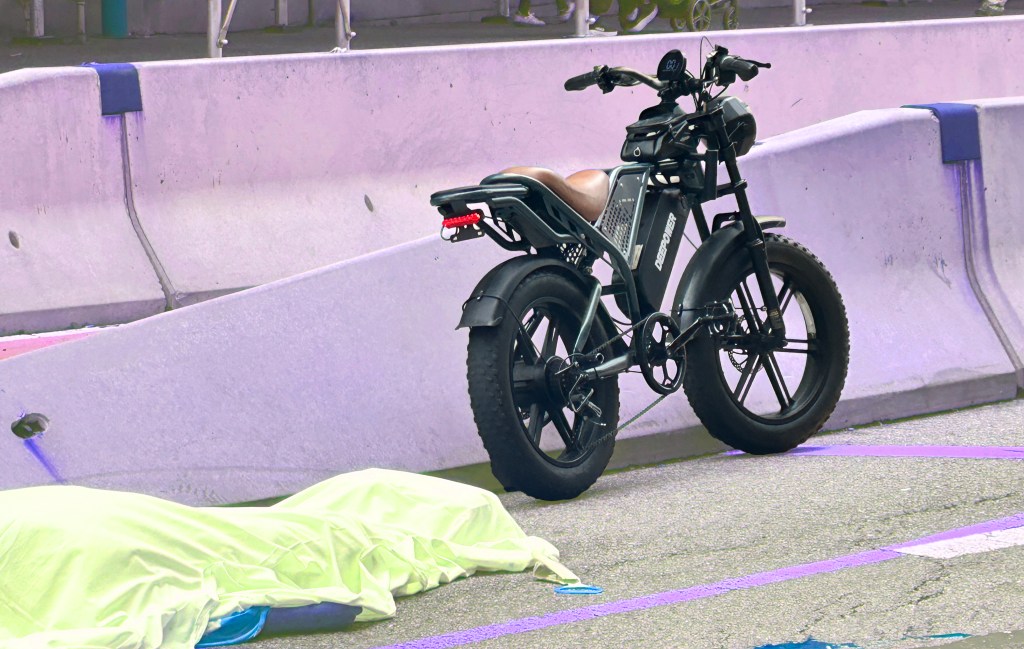
The death of 17-year-old Gabriel Nacato has reignited the frenzy of calls for intense regulation on micromobility vehicles, including the most-recent slate of (17!) bills before the New York City Council to curtail e-bike use and supposedly enhance roadway safety (based on data that conveniently lacks context in public addresses). Yet the measures on the table — ranging from mandatory licensure and insurance mandates to outright bans — are deeply problematic.
In order to figure out how to effectively regulate e-bikes, we first need to determine what types of actions constitute legitimate, observable enforcement mechanisms, so strap in (and try not to park in the bike lane!). Let’s think about what an officer actually can see on patrol. Consider these factors:
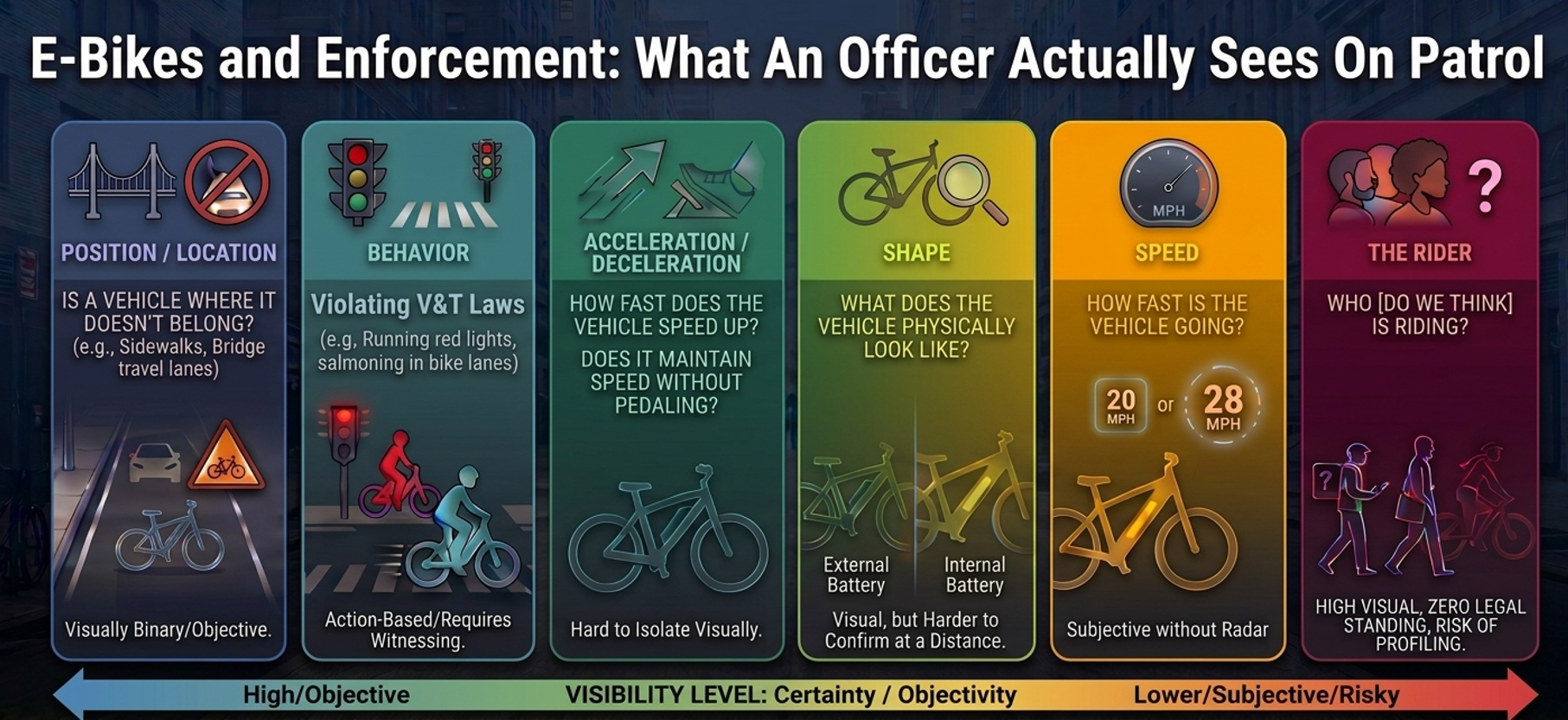
- Speed: How fast is the vehicle going?
- Acceleration/deceleration: How fast does the vehicle speed up? Does the bike maintain speed when the user isn’t pedaling?
- Shape: What does the vehicle physically look like? Is there an external battery mounted on the frame, or a larger-than-normal bottom tube housing an internal battery compartment? Are there any stickers or markings on the frame?
- Position/location: Is the e-bike operating in a space where it doesn’t legally belong (e.g., a bridge travel lane, a pedestrian plaza, or a sidewalk)?
- Behavior: Is the vehicle salmoning down a one-way bike lane, blowing through red lights, or otherwise violating New York City’s Vehicle & Traffic laws?
- The Rider: Who (do we think) is riding the vehicle?
The problem with today’s popular regulatory ‘solutions’
When you break down enforcement to visual reality, the flaws of the current legislative push become glaring. Take licensure, for example. Licensure still requires police to have a legitimate reason to pull someone over (see behavior above). Even if the state required licenses for legal Class 2 and Class 3 e-bikes, an officer would still need reasonable suspicion of an underlying violation to stop a rider and check for papers — same as for car drivers.
This introduces an incredibly slippery slope — especially in today’s political climate — when we factor in who is riding the e-bike. Without distinct visual cues on the vehicle itself, or a clear traffic infraction, enforcement inevitably devolves into pretextual stops. If you’re having trouble imagining what this might look like on the ground, think back to the dark era of stop-and-frisk (or the many ICE raids that have resulted in the arrests of people who were not the target of the enforcement action).
Equity issues aside, licensure will ultimately make streets less safe for cyclists, and in turn increase the burden on both law enforcement and emergency services. How? We have more than 20 years of data showing that higher bicycle ridership correlates with increased safety for cyclists — otherwise known as the “safety-in-numbers” effect. Licensure represents a new barrier to entry for New Yorkers who want to bike, and will functionally reduce the number of people who follow through with the process and earn back the “right” to ride.
Worse yet, advocates and elected leaders will be less inclined to allocate resources to build and/or maintain unused active transportation infrastructure. Essentially, here’s the salient equation: more paperwork = fewer cyclists on the road = less support for infrastructure = less infrastructure money allocated = more crashes = more death = more liability = more paperwork.
Speed-based enforcement faces similar operational challenges as well. Speed alone is notoriously hard to gauge visually without dedicated radar equipment. It also raises fundamental questions:
- How can we hold riders to strict speed thresholds when conventional bicycles, and many e-bikes, lack speedometers — an expensive feature that is not widely adopted across standard bicycle stock?
- Will pedal bikes be held to the same speed restrictions?
- If the city sets a date whereafter all bikes sold in New York City need a speedometer, do all cyclists then need to present a proof of purchase if pulled over?
- What if the bike was purchased years ago, or as a gift?
- Do smart phone apps count as speedometers?
As these questions illustrate, this very quickly becomes an operational rabbit hole. To be clear, there are definitely areas of the city where cyclists need to slow down (the Central Park loop comes to mind), but posting speed limit signs is both functionally unenforceable and ineffective, especially compared to the ever-growing number of design solutions in the Department of Transportation’s toolkit that are proven to passively slow users down.
Since top-down bans and unenforceable license mandates aren’t the answer, we need to “reverse-engineer” regulations based on what can practically be identified, categorized, and enforced on our streets. Here are seven workable policy solutions for effective micromobility regulation:
- Treat Class 1 e-bikes like conventional pedal bikes
Class 1 e-bikes (defined in the law as pedal-assist only and capped at 20 mph) should share the same legal status as standard pedal bicycles. The speed differential between human-powered cyclist and a Class 1 e-bike rider is marginal, and the electric assistance only works while the rider is actively pedaling. This is something that law enforcement can easily differentiate from other vehicles, and provides built-in safety. The only potential exception to this rule are the exterior bike racks on seven MTA bus lines where an e-bike weight may exceed design limitations (which are typically around 50 pounds per rack space).
- Align city and state legal definitions of Class 3 e-bikes for law enforcement and consumer clarity
We cannot enforce laws if our jurisdictions can’t even agree on what is being regulated. According to New York State law, a Class 3 e-bike is strictly a pedal-assist vehicle that can reach up to 25 mph, operating exclusively within New York City. The city’s local law, however, defines Class 3 with the same speed restriction but allows either pedal-assist or throttle control. How can officers fine or confiscate an “illegal” e-bike when state and local codes contradict one another? Aligning the city with state code creates a single, enforceable standard. Crucially, a clear legal definition forces the manufacturing and retail market to shift gears over time, choking off the supply of ambiguous vehicles at the point of sale. (There is currently a City Council bill to ban Class 3 e-bikes in New York City, but this bill would also create enforcement confusion.)
- Create a distinct classification for low-speed throttle devices
The pedal requirement within the current definition of a Class 2 e-bike serves no functional purpose other than to aesthetically signal, “This vehicle vaguely resembles a bicycle.” In reality, many Class 2 e-bikes function like low-speed electric scooters that rely exclusively on a throttle. By removing the superficial “pedal” requirement and establishing a dedicated legal class for low-speed electric throttle devices, we open the door for tailored rules (such as distinct visual marking/sticker requirements) without burdening basic pedal-assist cyclists. Full motor-vehicle licensure still isn’t the right fit here, but updating legal definitions allows us to separate these vehicles visually and regulate them within their own practical category.
- Reclassify illegal ‘e-motos’ and Class 3 e-bikes electric mopeds
High-powered, throttle-driven vehicles that easily exceed 25 mph are not e-bikes — period. They are motor vehicles.
Illegal e-motos cannot be regulated until we call them what they are: electric mopeds subject to standard motor vehicle registration, licensing, minimum age limits, insurance, and helmet mandates. On this, virtually everyone agrees — but since the vehicles are currently illegal, there is no legislative framework to regulate them beyond threats to online vendors and on-street enforcement by a confused police force.
A vehicle operating at speeds higher than 25 mph under pure throttle power belongs in the street with vehicular traffic, not in protective bike infrastructure. Establishing this clear boundary gives police officers an unambiguous visual marker: if it moves like a motorcycle without pedaling, it gets enforced like a motorcycle.
- Hold delivery companies accountable without additional burdens on workers
There are, of course, equity considerations here, given that tens of thousands of delivery workers use these vehicles to deliver everyday goods to our doorstep. And as Upton Sinclair famously observed, it’s unfair to expect the lowest-paid workers in a society to follow a law that makes it impossible for him to make a living.
Still, delivery workers on electric mobility are similar to taxi drivers — professional motor vehicle operators who are regulated and licensed. To avoid unduly burdening the worker, it’s crucial for regulation to shift the burden to companies by holding app platforms accountable for equitably implementing both education, licensure, and umbrella insurance for their workers.
But many of the regulatory requirements that are currently under consideration ultimately end up hurting delivery workers who rely on their bikes for income and transportation. Targeted policy can mitigate impacts on these vulnerable populations. Specifically:
- Expectations for safety education and licensing should never come out of a worker’s paycheck or personal time. Delivery platforms must be mandated to cover all DMV registration and licensing fees for high-speed vehicles. Furthermore, apps should be required to pay workers for their time while completing required state or city safety and battery handling courses.
- If existing vehicles used by delivery workers are either classified as illegal or come with burdensome requirements, workers should have the option to convert to a legal vehicle with fewer restrictions. New regulation could establish a platform-funded Micromobility Fleet Conversion Fund. App companies could be required to contribute a small micro-fee per delivery to fund buyback programs, allowing workers to trade in illegal, non-compliant emotos for street-legal, safety-certified Class 1/2 e-bikes or licensed electric mopeds at zero cost to the worker.
- Shift the burden of enforcement from local police to the tech platforms. The city already has policy in place to provide more transparency and allow workers to set trip limits, but tech loopholes and lax enforcement have stifled this legislation’s implementation allowing traffic infractions to continue. Even though most delivery cyclists are considered gig workers, they are still legally required to carry an ID card, clothing, and a frame decal indicating what company they are working for. The city should pass tickets for traffic infractions onto the tech platforms, much like the current practices for UPS, FedEx and other carriers. This would incentivize app companies to self police their own algorithmic practices and set expectations for gig workers. I’m not a labor attorney — who would likely point out that FedEx and other freight carriers have W2 employees — but if gig workers are still required to indicate what company they work for, surely that comes with some liability or at the very least, accountability.
Licensure would also come with insurance requirements, but workers who wish to continue using their existing devices — for convenience or physical need — should not bear the cost when rides are completed for commercial purposes. Rather than requiring individual low-wage gig workers to shop for private motor vehicle insurance, state and city law should mandate that third-party delivery app platforms provide continuous corporate umbrella liability insurance.
- Implement an e-bike incentive like Bike New York’s Ride Clean Program
Jurisdictions across the U.S., Canada and Europe have proven how e-bike incentive/subsidy programs provide a market-driven path to safer, more manageable e-bike adoption. Bike New York’s proposed “Ride Clean” program — sponsored by NYSERDA — was one such measure which not provides subsidies exclusively for Class 1 e-bikes, but imposes mandatory education requirements on any perspective program participants. By supporting programs like Ride Clean, and pairing financial subsidies with required consumer training, policymakers can proactively shape buyer behavior at the point of sale, stocking our streets with certified legal vehicles operated by educated riders.
- Build safe, wide, and connected bike infrastructure
Ultimately, the primary driver of current street conflict isn’t malice — it’s spatial scarcity. We are experiencing an unprecedented surge in micromobility ridership, kicked into overdrive by the pandemic and the legalization of e-bikes in New York State in 2020. Millions of New Yorkers turned to two wheels during lockdowns and never looked back. Yet, our street design remains trapped in the past. There simply aren’t enough safe, dedicated, and physically protected spaces for people to operate conventional bicycles, Class 1 e-bikes, and delivery workers simultaneously. You cannot enforce your way out of an infrastructure deficit; the long-term solution to roadway safety requires expanding the physical network to accommodate modern street use.
In addition to adding more bike lane and Greenway mileage, the city should identify specific cycling slow zones and prioritize design improvements such as chicanes, tactile strips and bollards in those areas.
Micromobility has changed the transportation landscape and is here to stay. Opponents leverage a rise in e-bike and e-scooter related ER visits as evidence of lawless danger, yet forget to mention that this follows a proportional increase in ridership on public roadways that were not designed for this volume. Who is to blame when a police officer pulls over an e-bike rider on the sidewalk because they don’t feel safe in the road?
The fundamental breakdown in New York City’s micromobility strategy isn’t a lack of rules — it’s a reliance on enforcement mechanisms that fail the basic test of street-level reality. Asking patrol officers to perform split-second spec-sheet audits on fast-moving vehicles forces them to rely on pretextual stops and visual profiling. To build a safe and workable micromobility policy framework, the city (and state) must align street-level enforcement with what patrol officers can actually observe and institute a crackdown on distributors and delivery companies to address device and regulatory issues before illegal e-motos hit the street.

Read More:
Streetsblog has migrated to a new comment system. New commenters can register directly in the comments section of any article. Returning commenters: your previous comments and display name have been preserved, but you'll need to reclaim your account by clicking "Forgot your password?" on the sign-in form, entering your email, and following the verification link to set a new password — this is required because passwords could not be carried over during the migration. For questions, contact tips@streetsblog.org.