‘Unsafe Disaster’: New Yorkers Ask Mamdani Charter Panel To Cut Street Redesign Red Tape
Green light or red tape?
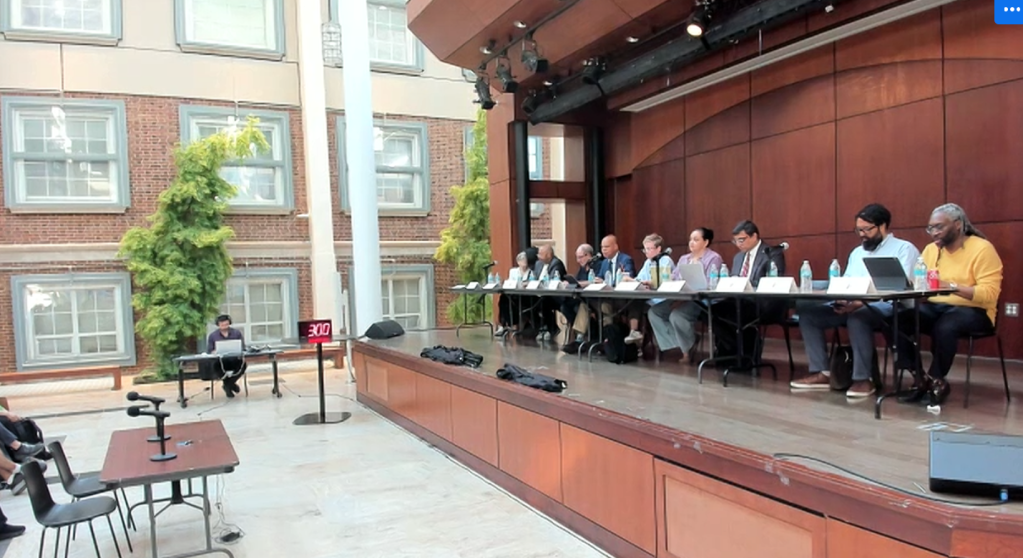
New Yorkers demanded that the city ditch time-consuming reviews that undermine street safety redesigns — and the Big Apple’s struggling outdoor dining program — while several politicians hoped to cling to their power to delay projects in testimony on Monday before a mayoral government efficiency commission.
Advocates and residents at a public hearing in Queens backed a proposal by Mayor Mamdani’s Commission on Government Efficiency, or COGE, to speed up street redesigns that have proven to make the city safer for decades, while supporting the group’s efforts to simplify regulations for restaurants to join in the city’s al-fresco seating initiative.
“As a fourth-generation native New Yorker and lifelong resident of Brooklyn, I am aware of how New York’s streetscape is an unsafe disaster, and the only way we can fix this is by fast-tracking streetscape changes,” Steve Flack told COGE commissioners at a public hearing at Queens Borough Hall. “As it currently stands, the only thing slower than making these changes is the M42 bus.”
The charter review commission earlier this month revealed that its leaders were looking into ballot proposals for the November election to undo city laws that hamper efforts to improve street safety, a key tenet of Mayor Mamdani who vowed to make the city’s streets the “envy of the world.”
Dozens of people told the panelists that layers of outside review for even simple bus and bike lanes have held up scores of projects across the city under a Bloomberg-era law requiring extra input for so-called “major transportation projects” (aka “the bikelash law”).
That law from 2009 required DOT to consult with the Police Department, the Fire Department, the Department of Small Business Services and and the Mayor’s Office for People with Disabilities for any street redesign that exceeds 1,000 feet or three blocks. The City Council has added requirement upon requirement over the years, most recently with a provision that DOT also get a written confirmation that officials sought feedback from “any affected firehouse” in the area of an overhaul.
The COGE panel found that these regulations have allowed non-experts to undermine DOT’s planners and designers, drained city resources with repetitive feedback sessions, and set back desperately needed revamps in a city where roughly 50,000 people are injured in more than 80,000 reported crashes each year.
“In practice, these requirements delay critical safety upgrades, leading to fewer street safety redesigns, significant staff time used, and legal challenges that can cause substantial delays to important safety upgrades,” reads the commission’s paper released earlier this month.
One physician testified to the life-altering wounds that come from so much carnage.
“I’m talking about skilled nursing needs with toileting, cleaning, like respiratory care, speech language care. These are patients that are not a constituency because they will never get out of bed, they will never vote, they will never speak again,” said Rex Tai, an internal medicine physician at the city’s public hospital system. “The data from New York City and globally is clear about the value of street safety projects, and they should be able to move with all due haste.”
One north Brooklyn street safety advocate listed redesigns in her neighborhood that have been stuck in the Department of Transportation’s pipeline for years, like Metropolitan Avenue and Grand Street, or the push for a safer Morgan Avenue, which the city recently found to be the truck corridor with the highest rates of people killed or seriously injured in the entire city.
“I know the folks at DOT are trying to do their jobs, but the current rules make it impossible for them to deliver projects in a timely manner, and they are often years behind on these projects,” said Meryl LaBorde.
A Queens dad and civic activist echoed these concerns, adding that he worried the laws will continue to keep roads dangerous for him and his kids.
“We’re putting families at risk unnecessarily, and I have to believe that it has to do with the major transportation infrastructure laws,” said Edgar Alfonseca, a co-chair of Queens Community Board 6’s Transportation, Public Transit and Street Safety Committee. “I really kindly ask all of you to take into consideration communities like mine, which are fighting for you know these infrastructure improvements, but we just have a lot of red tape and laws getting in the way of allowing us to do so.”
No residents at the three-hour meeting objected to the reforms. But several local politicians, who would lose out on power to weigh in on projects, spoke out.
One lawmaker, who actually championed legislation to trim bike lane timelines, still urged the Mamdani administration to work with the Council on legislation – while also criticizing the mayor for failing rein in rogue Fire Department leaders who have recently criticized bike lanes.
“Community feedback on transportation projects is critical, and I’d be happy to work with the administration to further amend this process legislatively, while ensuring robust and timely community notifications remain,” said Council Member Lincoln Restler (D-Brooklyn Heights). “I have urged the FDNY to commit to a 30-day time frame to provide feedback on bike lane proposals, but they have refused. I hope that City Hall will work this out with their agencies.”
Another pol from across the aisle agreed with Restler, saying the panel’s plans were nothing short of a “backdoor” for redesigns.
“When government hears fewer voices, publishes less information, or reduces meaningful public review, that isn’t necessarily efficiency. Sometimes it’s simply just less democracy,” said Council Member Frank Morano (R-Staten Island). “Charter revision shouldn’t become a backdoor for making it easier to implement major street redesigns or busways or bike lane projects while reducing meaningful neighborhood input.”
The commission is also looking into cutting back the process to apply for outdoor dining permits, which was decimated from up to 8,000 restaurants during the pandemic-era program to just 1,405 fully licensed establishment as of last month.
The drop came under the more restrictive rules enacted by the Mayor Eric Adams administration and the City Council under Speaker Adrienne Adams in 2023, which also limited roadway cafés to a seasonal program with a winter ban.
The three-year-old rules require different reviews depending on tables and chairs being in the roadway or on the sidewalk, and allow for community boards and local Council Members to delay or stop applications.
Applications can take upwards of six months, leading to restaurants missing peak warm months, the city’s Department of Small Business Services commissioner told COGE.
“Businesses raise concerns around roadway and sidewalk cafes having different processes and the lengthy community review periods. Any delay carries real consequences for participating restaurants, who may miss peak seasons during warmer months and lose revenue from not being able to add seating capacity while waiting for mandated review periods to lapse,” said Kenny Minaya.
The commission will look into getting rid some of the mandated public hearings and notices for licenses, and reconsidering the city’s revocable consent structure that charges restaurants rent to use the sidewalk or roadway space for outdoor dining.
Restler again called on City Hall to instead work with lawmakers on a bill that he said he and his colleagues will vote on soon.
“The Council is actively working on legislation to restore outdoor open dining to year-round,” Restler said. “We’re hoping to vote on it in weeks, not months.”

Read More:
Streetsblog has migrated to a new comment system. New commenters can register directly in the comments section of any article. Returning commenters: your previous comments and display name have been preserved, but you'll need to reclaim your account by clicking "Forgot your password?" on the sign-in form, entering your email, and following the verification link to set a new password — this is required because passwords could not be carried over during the migration. For questions, contact tips@streetsblog.org.